A man drives a car into a crowd of people outside an Orthodox synagogue on the holiest day of the Jewish calendar. He proceeds to attack those gathered outside, fatally stabbing one before being shot dead by police, who also tragically killed another whilst attempting to neutralise the attacker.
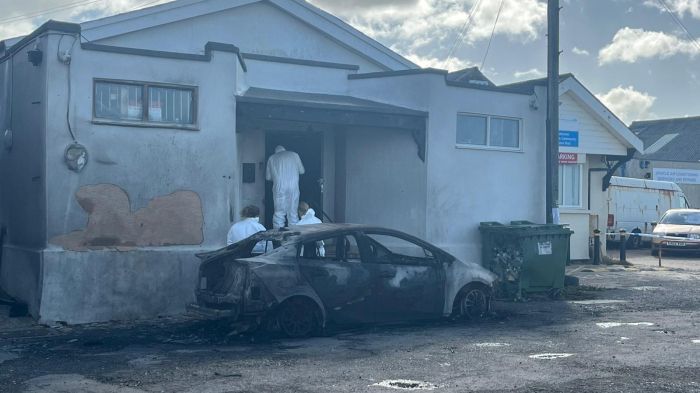
Two days later, two individuals in balaclavas set fire to the entrance of a mosque and a car parked outside it in what police are treating as a hate crime. Mercifully no-one was killed, with the two people who were inside the mosque able to escape.
At CSW, our work often involves reporting on attacks like these on places of worship in a number of countries – and often particularly in situations of conflict – around the world.
While the death tolls in those situations are, tragically, often far higher, and the destruction much more extensive, it is still alarming to witness incidents that cast similar shadows occurring on the streets of Manchester and Peacehaven in the UK, an ostensibly peaceful country that often vaunts its diversity as a strength.
The atmosphere that makes these incidents more likely is fostered by those with political and cultural power who stoke divisions. The debate surrounding immigration and protests against people seeking asylum that took place over the summer included rhetoric denigrating migrants and ethnic and religious minority communities already settled in the UK.
Unfortunately, politicians did little to lower the temperature. Reform UK’s proposal for mass deportations of migrants, for example, which was vague on the matter of who exactly would be affected, how they would be identified and any legal ramifications, did not face serious political challenge. Instead the government merely said it was ‘unworkable’, while the official opposition declared that it was copied from their own policy. The impression given was that the policy and sentiments expressed were universally popular, and therefore politicians sought to guarantee their own political survival by agreeing with it in principle, with some minor tweaks in implementation.
Without a doubt, the blame for the attacks lies squarely with the perpetrators. There is some evidence to suggest that the Heaton Park synagogue attacker had reportedly pledged allegiance to the Islamic State, while the background and motives of the Phyllis Avenue mosque attackers remain unknown.
Nevertheless, these attacks have occurred in an atmosphere of heightened social tensions and religious intolerance engendered after far right politicians, celebrities and the richest man in the world denigrated migrants and minorities relentlessly, and instead of promoting a healthy debate that reflects the range of views in a diverse nation, others in the position to challenge this toxicity articulated moderated variations of far right talking points, normalising them unwittingly.
To be clear, the UK is not at immediate risk of the scale or intensity of violence CSW sees in other countries on which we work. However, these attacks must be taken seriously and those with political power should offer leadership, reassurance and reconciliation at this critical moment. The grief of the families and loved ones of Melvin Cravitz and Adrian Daulby, and the fear currently felt by members of the country’s Jewish and Muslim communities, demands nothing less.
Attacks on places of worship and acts of violence have no place in any society, and every citizen should be free to practise their religion or belief – including in public with others – without fear of threats or harassment or violence.
The UK has often stood as a proud champion of the right to freedom of religion or belief (FoRB). In December the Labour government appointed David Smith MP as the Special Envoy for FoRB, tasked with shaping and strengthening the UK’s response to violations of FoRB worldwide – a position adapted from a similar role created by the Conservative Party in 2018. In July, Smith announced the government’s new FoRB strategy at the Foreign, Commonwealth & Development Office (FCDO), illustrating that the UK remains acutely aware of the fundamental importance of FoRB and the ways in which it can come under threat.
An additional consideration for the UK as it seeks to advance its FoRB agenda globally is the fact that religion-related incidents that occur here, and indeed throughout Europe, are not only closely followed, but also have ramifications in countries where FoRB violations are more frequent.
In June 2023, for example, the desecration and burning of a Quran in Stockholm, Sweden sparked sectarian outrage in Pakistan, with the banned extremist group Lashkar-e-Jhangvi labelling it an attack by Christians on Muslims and vowing that they would make Pakistan a ‘hell for Christians’. Seven weeks later, when two young Christians were accused of blasphemy in Jaranwala, a mob stormed the city’s Christian neighbourhood, vandalising and burning at least 21 churches and hundreds of homes, and demanding that the two accused be handed over so that they could lynch them.
All the more reason why individuals in positions of power and influence should fully comprehend how alarming the recent attacks in Manchester and Peacehaven really are, as none have arisen in a vacuum, and should address the underlying stressors in a manner that restores and strengthens social cohesion.
It is therefore essential that such individuals ensure their language and actions do not exacerbate fear, division and tension, but instead promote healing, reconciliation and peaceful co-existence.
By CSW’s CEO Scot Bower
Featured Image: Heaton Park Hebrew Congregation/Facebook