An engaged Alawite couple shot dead at close range by masked men on a motorcycle. A Christian schoolteacher – likely mistaken for an Alawite – fatally shot in the head in the same neighbourhood days later. Five Druze civilians murdered by a policeman in an unprovoked attack whilst they were tending their olive fields. Four Alawites killed and another severely injured when fired upon whilst entering a taxi outside the hospital where most of them worked.
The reports of sectarian violence coming out of Syria in this year alone highlight the challenges that lay before the country’s transitional government and its interim president, Ahmed al-Sharaa, if they are to make good on their promises of justice and inclusivity.
Both the Alawite and Druze communities in particular have witnessed a significant increase in tensions and clashes with Syria’s Sunni majority since the fall of the Assad regime in December 2024, with this resulting, in some cases, in violence that has claimed thousands of lives.
The transitional government itself is not necessarily to blame, but it does have urgent responsibility to act.
The Alawites: ‘Guilty by Association’
For Syria’s Alawite community, which accounts for approximately ten percent of the country’s population, shaking its association with the ousted Assad dynasty, with whom it shares an ethnoreligious identity, has proven difficult – despite the fact that most Alawites were not affiliated with the former regime.
On 6 March 2025 fighters loyal to Assad ambushed and killed 13 Syrian security officers in Latakia Governorate, prompting the authorities to call for a ‘general mobilisation’ that saw thousands of pro-government fighters descending on the region. Within days, approximately 1,400 people had been killed, the vast majority of them Alawite civilians, with the UN Commission of Inquiry (COI) on Syria later concluding that some of the violations committed during the violence may amount to war crimes.
Since then, and despite the COI’s calls for the interim government to increase protection for the community, Alawites have been subjected to targeted attacks with alarming frequency.
Among them was a 14-year-old schoolgirl identified only as Ghina, who died in her mother’s arms on 19 August after she was hit in a drive-by shooting as she stood on the balcony of her home in the Wadi al-Dhahab district of Homs, and Alawite schoolteacher Reham Hammouda, who was killed in the same city’s Al-Walid neighbourhood after an assailant threw a hand grenade at her family home.
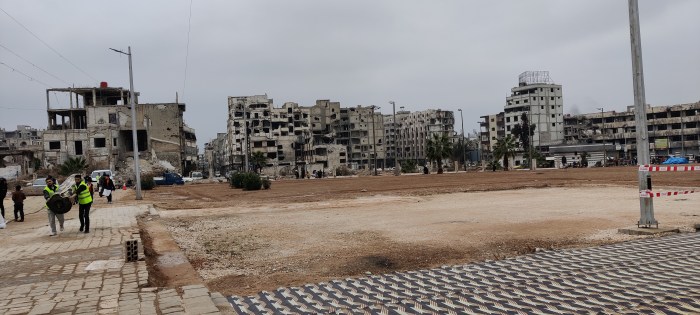
Later, on 23 November, anti-Alawite riots erupted in Homs following the killing of a Sunni Muslim couple. Hundreds of Alawite homes, shops and cars were destroyed in the ensuing violence, with subsequent investigations revealing that the inciting incident was a burglary committed by a family member who had killed the couple when he was discovered, and who proceeded to write phrases insulting Sunnis on the walls of the victims’ house to hide his identity.
The Druze: A Target for Extremists
The Druze, meanwhile, are believed to constitute around 3.2 percent of Syria’s population. The community originates from the Near East and its members self-identify as ‘Unitarians’ or ‘the People of Monotheism’. They are deemed by hard-line Islamists to be heretics, and had been sporadically subjected to violence long before the fall of Assad. This has continued in the aftermath of the Hay’at Tahrir al-Sham (HTS)-led takeover.
Tensions reached a boiling point in July 2025, when clashes broke out between Druze militia and government forces and Sunni tribes in As-Suwayda Governorate. Hundreds were killed on both sides, with many others taken hostage, and there are allegations that army and police units sent by the government to intervene and stabilise the situation were ambushed by Druze militia.
Further violations documented during this period included sexual violence, the extrajudicial killing of children, doctors and medical staff, and the destruction of Druze shrines, churches and sacred objects.

Later, on 27 October, masked armed men stormed the home of Druze community leader Dr Hamza Shaheen in Deir Ali near Damascus, shouting abuse at him before proceeding to abduct him. The kidnappers subsequently called Dr Shaheen’s family several times and demanded a significant ransom whilst repeatedly refusing to provide evidence that he was still alive.
When arrested by security forces on 4 November, the kidnappers, who CSW sources claim belong to an extremist group, confessed that Dr Shaheen had died due to severe mistreatment he had suffered whilst in captivity. His body was recovered, and his funeral was held in his family village days later.
A Struggle to Break with the Past
While in some cases, such as that of the kidnappers of Dr Shaheen, or the policeman who murdered the five Druze in their fields, the authorities act relatively quickly to apprehend perpetrators, if the government is to truly build a peaceful and inclusive Syria it must do far more to combat sectarian violence and incitement.
The inclusion of members of the Alawite, Christian and Druze communities in the government’s cabinet is a welcome start; however, it is also notable that most of those elected to the country’s revamped People’s Assembly in October were Sunni Muslim and male, and that the interim constitution signed by President al-Sharaa in March maintains its predecessor’s stipulations that the head of state has to be a Muslim and that Islamic jurisprudence is the principal source of legislation.
These things are important. They highlight the country’s continued struggle to break with its sectarian past, and if left unaddressed could mean Syria remains a nation in which the rights and protection of some matter more than others – one in which attacks such as those reported over the past year remain a fact of life for a population already traumatised by decades of violence and repression.
By CSW’s Press & Public Affairs Officer Ellis Heasley