On the evening of 15 December 2012, Sombath Somphone, a leading democracy activist from Laos, was stopped at a police checkpoint on a busy street in the country’s capital Vientiane. Footage from a traffic CCTV camera shows that within minutes of him being stopped, unknown individuals forced him into another vehicle and drove him away in the presence of police officers. The footage also showed an unknown individual arriving and driving Somphone’s vehicle away from the city centre.
Three years later, Somphone’s family obtained new CCTV footage from the same area and made it public. The video shows his car being driven back towards the city by another unknown individual.
Somphone specialised in advocating for education of all Laotians, particularly in poor rural areas. He was perhaps the most prominent member of Laos’ small civil society: his work aimed at setting up a community-based development by incorporating the knowledge and opinion of rural people in the planning and management of development projects and programmes throughout the country.
Ever since his disappearance, Somphone’s wife Ng Shui-Meng has led a tireless campaign in search of truth and justice for her husband and to end enforced disappearances in Laos and elsewhere. CSW recently interviewed Ms Ng about her husband’s disappearance, the situation of human rights in Laos today, and where she hopes to see change in the future.
This interview has been edited for length and clarity:
How has your life and your work changed since your husband’s disappearance?
Since his disappearance, I lost my partner, and I also lost my greatest love. It’s like you have lost something. It’s something which is missing, and for the last 12 years, this loss has remained. It says I’m not complete, and I have to carry this burden. I know I must carry on, and I will have to continue living. And one way to address this is to ensure that how he was disappeared and the circumstances under which he disappeared is made known.
I work with other victims from the region, and I draw support from them. I call them my sisters in pain, because they’ve all lost their husbands, their sons or someone they love very, very dearly, and they understand what it is. And so we as a group have always spoken up against enforced disappearance. We hope that the world is listening, and more and more people join forces to counter this heinous crime.
To disappear someone, take someone outside the realm of the law, and to never reveal what had happened to them, leaving their family in great distress and loss without ever knowing the truth – this is worse than you could ever know.
A government can arrest a person wrongly and put them in jail, but at least you know that person is in jail. At least you can use the judicial system to try and right the wrong. But when you disappear a person, the person is not available and is hidden from the truth and has no recourse to justice whatsoever.
By removing one, you warn all the others who are trying to work in the area of social justice, or community justice, and it puts fear not only in the family, but in the entire community, so that other people will not stand up if they see any wrong, because they know that if they stand up, they could be targeted. It is a targeted crime, targeted to silence, and targeted to induce fear in the community and in the society.
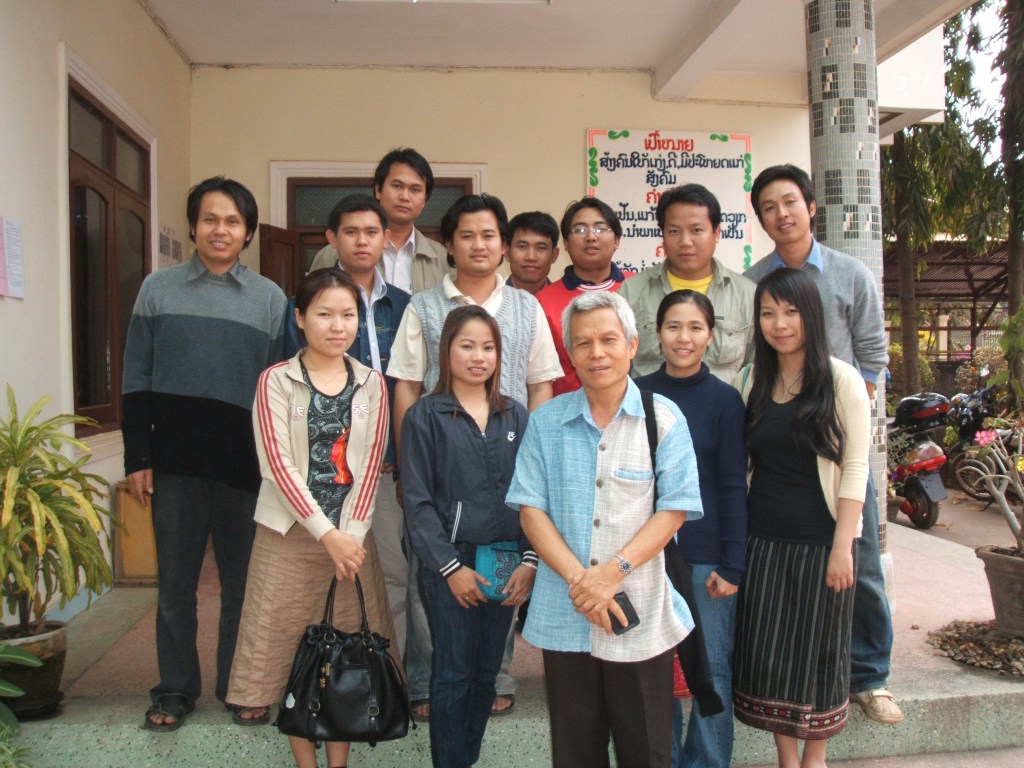
Despite the passing of time, the pain, the suffering does not go away. It remains as time passes because the fear that he will not come back looms larger and larger. And the hope that he will return also fades. That is why enforced disappearance is the most difficult criminal act against human rights.
What has changed in Laos since your husband’s disappearance?
Nothing very much, though I still appeal for his case, and his case is now with the UN Working Group on Enforced or Involuntary Disappearances. His case is one of the iconic cases that the working group has been working on. And they raise it every time that Laos goes to the UN and presents its human rights report or [during] the UPR [Universal Periodic Review] process, for example.
People who had fought for their own community against abuses including land grabbing, persecution or even speaking up against injustices – the government has come down very, very heavily on them. Again, it is used as a fear tactic to induce fear and to ensure compliance from the rest of the population.
Laos rarely makes it to international news headlines, why do you think this is?
I think Laos is hardly in the international news for several reasons. One, Laos is a very small country. It is big geographically in terms of land size, but population wise it is only about eight million people. And so what happens in Laos is not raising the attention of many other countries, partly because it is a small country, and also it is a country of little economic significance in terms of trade.
I think the world should pay attention, especially to smaller countries where human rights abuses or other kinds of abuses are kind of swept under the carpet. I don’t think you need to have a major genocide before the world cameras come in and focus on the issue.
This is another issue I want to raise. One of the biggest challenges that we face with the news media [is that they] chase after stories that make headlines. For example, what happened to the Rohingyas when they landed on the shores of Thailand and got evicted and all their villages were burned, that got the news headline for a while, and then the news fades out and their fate is no longer highlighted
What are your hopes for the future of ASEAN and the next generation of democracy and human rights advocates?
I think the whole world is facing a regression on many fronts. I hope young people will not be so individualised. It’s easy to become very individualistic in this current world. I hope young people will look to build bridges with one another. I think some of it can be attributed to the way social media has controlled people’s lives and allowed individuals to only focus on consumerism and the individual.
Young people will have to ask themselves if they want a world which is right and just, by which means social justice will be enjoyed by majority of the people, especially the young, and see abuses as not only against individuals, but as an abuse against the whole of humanity.
What can our readers do to help?
I think we shouldn’t get too distracted. I think we shouldn’t also be too depressed by what we see. There’s a lot of bad news in the world. The situation is not good all around the globe. We should not look at the bad stuff and despair. And I’ve used that in my own life. I could give up, I could just wallow in my own sorrow, [but] sorrow is a defeatist movement.
We have to have hope. We have to have aspirations, and we have to have compassion for the suffering of the world. We may not be able to change the world, but if you change ourselves and the people around us for the better and help the people around us or the community around us for the better, I think we can.