On 28 December Myanmar will begin its first general elections since its military junta seized power in a coup in February 2021.
Of course, these elections will be neither free nor fair. They will take place against a backdrop of the continued detention of at least 22,000 political prisoners, including the country’s last freely elected leader Aung San Suu Kyi, the deregistration of numerous political parties by the military-controlled Union Election Commission (UEC), and the relentless killing of civilians.
The outcome is guaranteed, but this can by no means be permitted to grant the regime a veneer of legitimacy on the international stage, and specifically among its neighbours in the Association of Southeast Asian Nations (ASEAN) where it seeks it most.
A suffocating legal framework
Months before the elections were due to take place the military was already going to great lengths to ensure its victory, introducing and amending a number of laws aimed at suppressing civic space.
On 28 July the junta introduced the ‘Military Secrets Preservation and Protection Law’, which authorises life imprisonment or the death penalty for using ‘military secrets’ in the service of other organisation – a vaguely defined offence that provides expansive grounds to criminalise dissent.
The following day, it enacted the ‘Law on the Prevention of Disruption and Sabotage of Multi-Party Democratic General Elections’, again allowing for punishments up to the death penalty for disrupting or opposing the elections. Several individuals have since been convicted under this law, including a resident of Taunggyi Township in Shan State who was sentenced to seven years with hard labour due to comments he made on social media.
Next, on 30 July, a new Cybersecurity Law came into force, penalising the use of VPNs, granting the authorities sweeping powers to access user data, and even applying to Burmese nationals abroad. This law has been enforced aggressively, with reports of junta soldiers in Mandalay conducting intrusive phone checks and using digital surveillance systems at hotels and checkpoints to monitor and detain individuals.
Finally, on 1 August, the junta re-suspended three key provisions (Articles 5, 7 and 8) of the 2017 ‘Law Protecting the Privacy and Security of Citizens’, restoring powers for warrantless raids, detention for over 24 hours without court approval, and interception of private communications.
Collectively, these measures have established a legal framework for widespread surveillance and collective punishment, making online activities and even private communications justifications for immediate arrests and prosecution, and essentially granting the military the power to stifle any and all criticism of the elections and their legitimacy. It is likely that they will also further codify discrimination on religious grounds, given the military and country’s legacy of targeted arrests and attacks on ethnic and religious minorities.
A bleak future
The lead-up to the elections has also been marked by an uptick in attacks on civilian targets, including churches, monasteries and schools that are all clearly safeguarded by international law.
On 11 July the Myanmar Air Force carried out an airstrike on a monastery in Lintalu village, Sagaing Township, killing at least 30 civilians and injuring 14 others who were sheltering in the monastery after having been displaced from their homes. A resident told the Democratic Voice of Burma (DVB) that ‘Many were killed because the attack occurred while people were sleeping’.
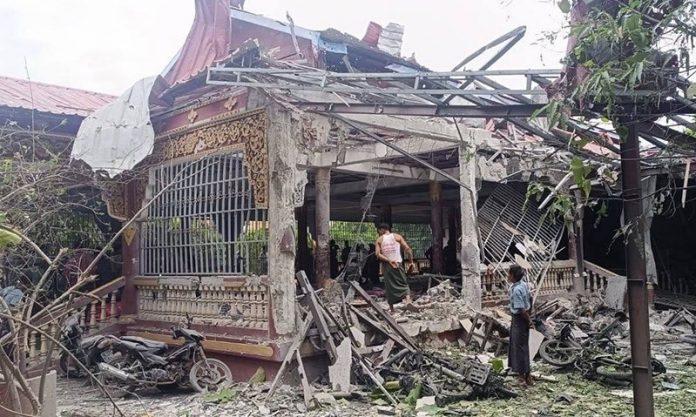
Three days later, six people including five children were killed in airstrike on a church in Poe Zar Village, in Thabeikkyin Township, Mandalay. Four of those killed were from the same family, with the youngest victim being a one-year-old.
More recently, on 10 December – International Human Rights Day – military airstrikes on the general hospital in Mrauk-U Township, Rakhine State killed 34 civilians and wounded at least 77 others. Victims included a newborn baby, in-care patients, heath volunteers and medical staff. A similar deadly airstrike was launched the following day in Kyauk Phyu, also in Rakhine State, killing eight displaced persons and injuring ten others.
Such incidents are typical of the barbarity with which the military has brutalised civilians ever since it seized power almost five years ago – and indeed before that in its genocide against the Rohingya in 2017 – the victims among over 7,500 people estimated to have been killed since the coup took place.
When it is not destroying places of worship and other civilian infrastructure, the military is often violating the right to freedom of religion or belief (FoRB) by forcibly closing churches, mosques, pagodas, religious cemeteries and temples – in some cases repurposing said sites as bases in further violation of international humanitarian law.
It has also made considerable efforts to appeal to hardline nationalists, granting prominent figures positions to monitor local and foreign organisations under the election protection law, whilst instructing Christians to celebrate Christmas early, on 20 December, to avoid festivities falling too close to the start of the elections. The junta has also increasingly framed pro-democracy resistance as anti-Buddhist, no doubt seeking to capitalise on a legacy of religious nationalism in Myanmar that predates the coup by decades.
All this points to a bleak future for the people of Myanmar. The military is sure to win the election, and once it does it will no doubt continue to violate FoRB, to kill civilians indiscriminately, and to silence anyone it perceives as a critic or a threat.
A call for clarity – and action
Many in the international community are well aware of this. In an October 2025 report to the United Nations (UN) General Assembly, the UN Special Rapporteur on the situation of human rights in Myanmar urged the international community to ‘to unequivocally reject and denounce the charade the junta is presenting as an “election,”’ adding that the process ‘will only deepen division and fuel further violence in the country.’
Similar warnings were echoed last month by a spokesperson for the UN human rights office, who stated: ‘Far from being a process that could spearhead a political transition from crisis to stability and the restoration of democratic and civilian rule, this process seems nearly certain to further ingrain insecurity, fear and polarisation throughout the country.’
The European Union (EU) is similarly wary, with the EU’s High Representative issuing a statement to mark International Human Rights Day which emphasised that ‘the essential conditions for free and fair elections, namely a credible, transparent, inclusive process, in line with international standards, are not in place, and that these elections are only pursuing bolstering legitimacy objectives for the junta.’
It is with this clarity that other states must also approach the elections. Countries like Belarus and Russia, which have committed to sending international observers, and China, which is believed to be supportive of the elections, should be condemned for propping up this murderous and illegitimate regime, particularly given their own authoritarian tendencies.
Simultaneously, the International Criminal Court (ICC) must urgently issue an arrest warrant for the military’s Commander-in-Chief, Senior General Min Aung Hlaing, who is sure to become the country’s president. His case has been pending before the ICC’s Pre-Trial Chamber for over a year, and cannot be delayed any longer.
Most importantly of all, the international community must demonstrate a robust commitment to the people of Myanmar, applying crucial pressure to stop the ongoing atrocities against civilians, demanding unhindered humanitarian access to regions affected by both military bombardments and the April 2025 earthquake, and ultimately sending a clear message to Min Aung Hlaing and his regime that their so-called ‘elections’ will not make their rule legitimate.
By CSW’s Press & Public Affairs Officer Ellis Heasley