Earlier this month reports emerged that Myanmar’s military ruler, Senior General Min Aung Hlaing, may step down as army chief within a matter of weeks. Given the atrocities he has presided over since his military seized power in a coup in February 2021, and indeed for many years before then, on the surface one may consider that a positive development.
But Min Aung Hlaing isn’t going anywhere.
Myanmar’s 2008 constitution requires the posts of president and army chief to be held by different people, and it is only with his eyes on the former that Min Aung Hlaing would ever let go of the latter. Since July 2024 he has officially held the title of Acting President, exercising presidential duties through the National Defence and Security Council (NDSC), and at present continuing to use this to bypass the constitutional restrictions.
The fact that this may soon change arises from Myanmar’s recently concluded so-called ‘elections’, in which the victory of the military-backed Union Solidarity and Development Party (USDP) was long guaranteed given the vote took place against the backdrop of the continued detention of at least 22,000 political prisoners and the deregistration of opposition parties by the military-controlled Union Election Commission (UEC).
If he does not become president outright, internal military dynamics suggest Min Aung Hlaing is weighing two specific paths to maintain absolute control. First, he may appoint a loyalist ‘proxy’, such as current Prime Minister Nyo Saw or USDP Chair Khin Yi, to hold the formal presidency, while he remains Commander-in-Chief. Second, he may take the chairmanship of the Union Consultative Council (UCC), a body established in February 2024 to sit above the executive, legislative, and judicial branches.
Either way, the end result is largely the same: Min Aung Hlaing will remain the most powerful man in Myanmar, only one that now believes he has gained a veneer of civilian legitimacy.
A legacy of atrocity
Of course, Min Aung Hlaing’s legacy of atrocity began long before the coup. The most damning mark on his record is without doubt his leadership of the military’s so-called ‘clearance operations’ against the predominantly Muslim Rohingya in Rakhine State in August 2017.
The details have been widely reported in the years since, but they bear repeating here: mass killings, torture, enforced disappearances, sexual violence, the burning of entire villages to the ground, over 700,000 people forcibly displaced to Bangladesh – all under Min Aung Hlaing’s leadership.
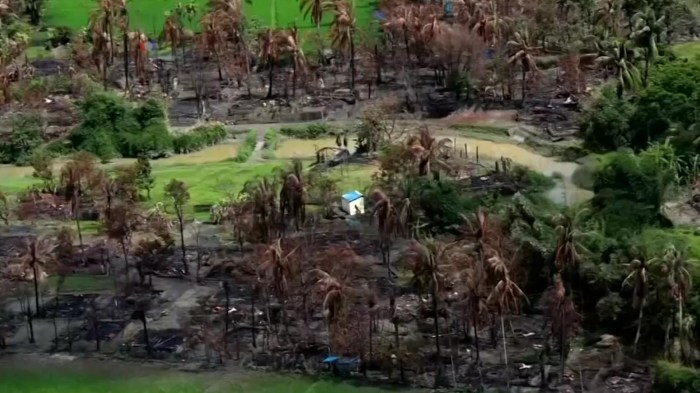
In August 2018, a year after the army launched its attacks, a United Nations Independent International Fact-Finding Mission concluded that Min Aung Hlaing and other top military generals should be investigated and prosecuted for the crime of genocide in Rakhine State, as well as for crimes against humanity in Rakhine and the Christian majority Kachin and Shan States.
Of the operations in Rakhine State in particular, the experts drew explicit links to Min Aung Hlaing’s own vision for the region, highlighting a Facebook post in which he stated ‘the Bengali problem was a longstanding one which has become an unfinished job despite the efforts of the previous governments to solve it. The government in office is taking great care in solving the problem.’ [Editor’s Note: Bengali is a term used by the Myanmar government to label the Rohingya as illegal immigrants from Bangladesh].
No respite for civilians
Despite this and similar conclusions drawn by several others including the US State Department, Min Aung Hlaing had faced no justice by the time he and his military brought an abrupt halt to Myanmar’s fragile transition to civilian democracy, seizing control of the government and imprisoning the country’s last freely elected leader Aung San Suu Kyi among thousands of other civilian leaders and members of civil society and the media.
Over 7,800 civilians have been killed by the military since then, amid rampant violations of human rights and international humanitarian law including the routine bombing of schools, hospitals and places of worship.
In January the Office of the UN High Commissioner for Human Rights reported that it had verified the killing of 170 civilians in over 400 military airstrikes during the election period alone.
Other sources place the death toll higher still. The Myanmar-focused advocacy organisation Progressive Voice documented at least 556 human rights violations during the first phase of the election, including airstrikes that resulted in the deaths of at least 198 civilians and injuries to 275 others. In one such attack on 5 December, a junta airstrike on civilians watching a football match in Ma Ra Kan Village in the Sagaing Region’s Tabayin Township killed 18 people including a child.
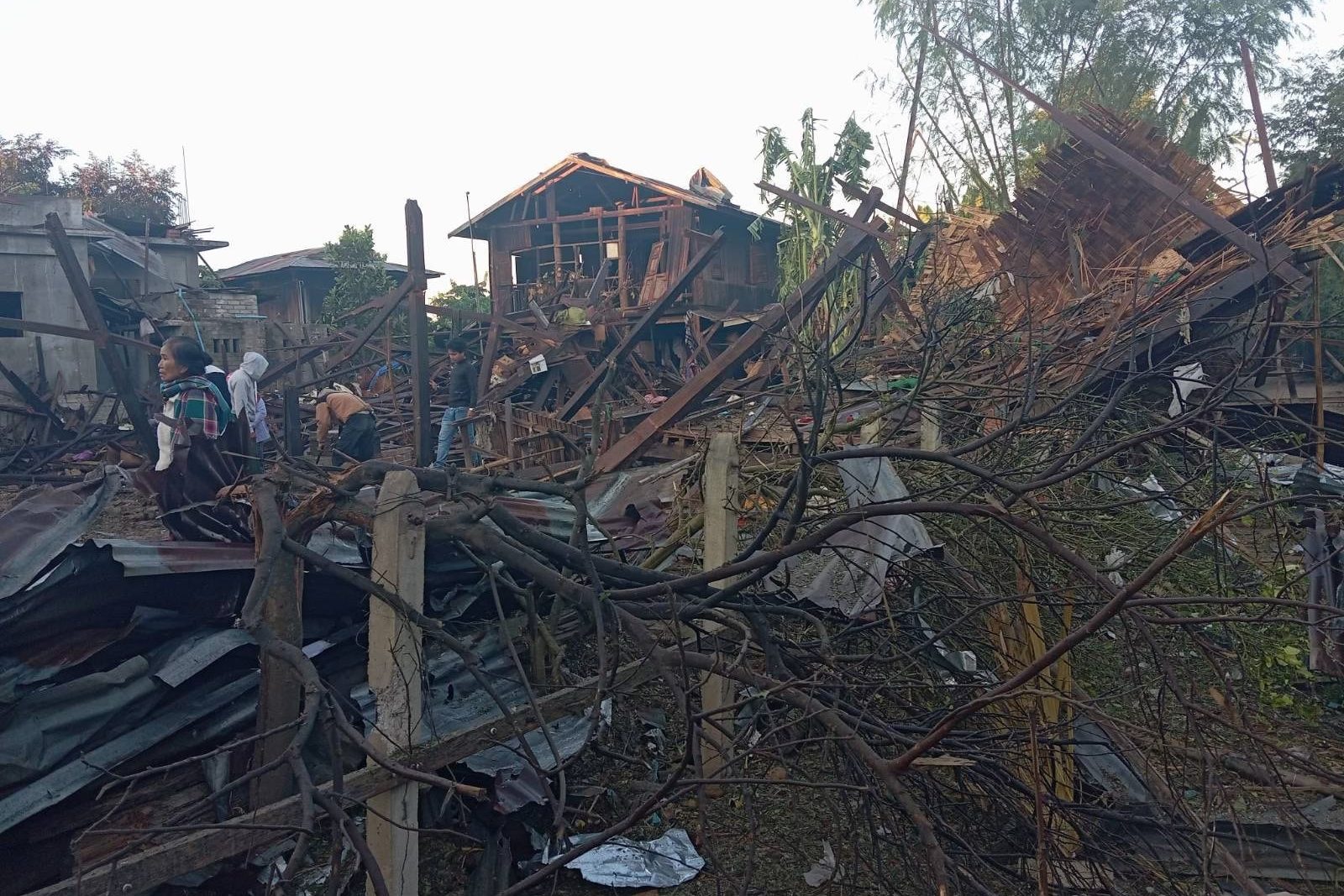
In the second phase of the election period, ALTSEAN-Burma documented 102 airstrikes across 112 townships nationwide, including 60 bombs dropped across just two townships in the Sagaing Region in a single day alone. On 22 January the junta bombed a funeral in Kaung Jar Village, Bhamo Township, Kachin State, killing 22 people and injuring 28 others, mere hours after another military airstrike on a crowd preparing for a wedding in Tat Kone Village in the Magwe Region had killed at least five people including a child.
It is also worth highlighting that the elections were only held in 263 of Myanmar’s 330 townships, with voting severely limited in conflict areas and resulting in the exclusion of large segments of the population, including the Rohingya and other displaced and ethnic communities.
Justice must come soon
For all his attempts at a political makeover, however, the international community still largely appears to see Min Aung Hlaing for the murderous dictator that he is. His military is currently the subject of a genocide case brought to the International Court of Justice by the Gambia and supported by 60 countries.
Meanwhile, in November 2024 the International Criminal Court (ICC) prosecutor applied for a warrant to arrest Min Aung Hlaing for the crimes against humanity of deportation and persecution of the Rohingya between 25 August 2017 and 31 December 2017. The case is currently pending before the ICC’s Pre-Trial Chamber, and must be acted upon urgently.
In addition, universal jurisdiction cases – which allow state authorities to take action regardless of where offences took place, or the nationality of the victims and perpetrators – have been brought against the military for its involvement in violations against the Rohingya and Chin ethnic groups in Argentina and Timor-Leste respectively, with a federal criminal court in the former issuing arrest warrants against 25 Myanmar government officials, including Min Aung Hlaing for the crime of genocide and crimes against humanity in February 2025.
Ultimately whether he wears a suit as president or a uniform as senior general, Min Aung Hlaing remains a wanted man in the eyes of international justice. He cannot buy legitimacy with a sham vote, and efforts to hold him to account must be strengthened and supported wherever possible.
By CSW’s Press & Public Affairs Officer Ellis Heasley, and CSW’s Research & Advocacy Officer for Myanmar Seng
Featured Image by Mil.ru licensed under CC BY 4.0.