On 15 March Pastor Rolando Pérez Lora was arrested in front his family in a park in Peñas Altas, Matanzas, in northern Cuba, moments after he had finished uploading a Bible teaching video to his YouTube channel.
It is not clear what offence the political police officers who arrested him believed he had committed. Pastor Pérez told CSW that he records and uploads videos in the park, which is one of only two locations in the area with public Wi-Fi, every week. His wife, Gelayne Rodríguez Ávila, joins him and often prays for those who gather to listen and request prayer.
Video footage taken by Mrs Rodríguez depicts her husband being forced into a patrol car by two officers as he protests: ‘You’re mistreating me for no reason. I haven’t done anything wrong.’ The cries of his young children can be heard in the background.
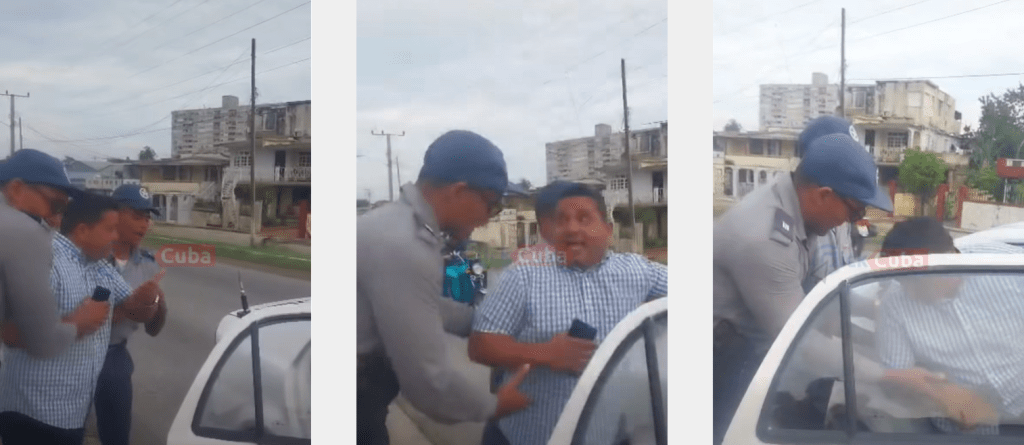
Pastor Pérez was taken to the Playa Police Station, where he was held for three hours before being released several kilometres from his home, which took him a further three hours to return to on foot.
The next day authorities in Morón, in the central province of Ciego de Ávila, detained Pastor Elier Muir Ávila and his 16-year-old son Jonathan Muir Burgos.
Pastor Muir, who leads the independent Protestant Tiempo de Cosecha (‘Harvest Time’) Church, was released hours later the same day, but, concerningly at the time of writing, Jonathan – a minor with a serious medical condition – has been detained for two days.
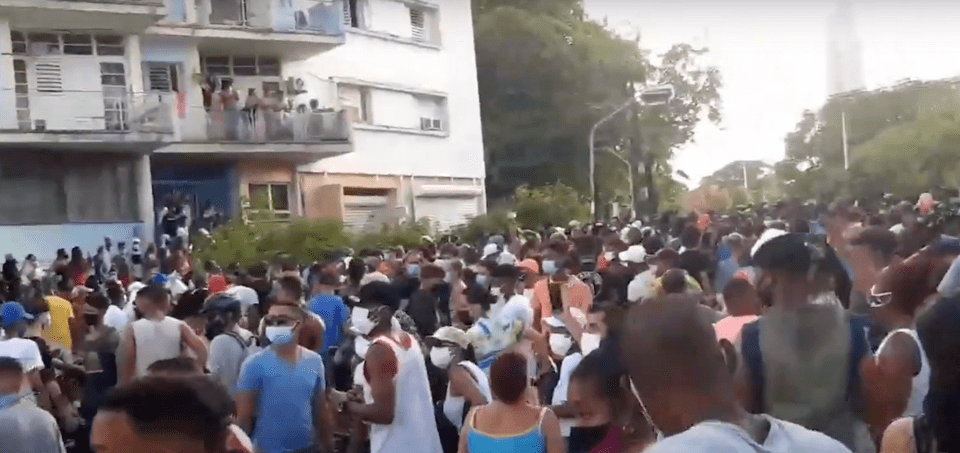
During his detention, Jonathan has been reportedly interrogated about his participation in protests that took place in Morón on 13 and 14 March, during which some protesters sacked and then set fire to the Cuban Communist Party (CCP) offices in the city. He has not been formally charged, but was asked whether he had specifically called for freedom during the demonstrations.
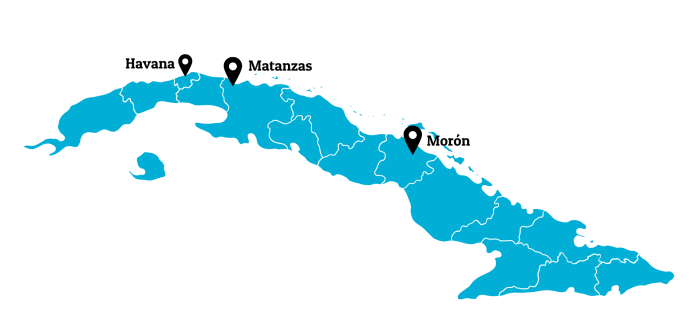
While the arbitrary detention of religious leaders and even their minor family members is sadly not unprecedented in Cuba, it is clear from these cases and the backdrop of renewed protests against which they take place that the island is once again at a crisis point. But how did it get here?
Calls unheeded
Recent developments immediately bring to mind the events of July 2021, when spontaneous protests spread across the island as Cubans took to the streets shouting ‘patria y vida’ (homeland and life), a twist popularised by a Cuban hip hop ensemble on the longtime CCP slogan of ‘patria o muerte’ (homeland or death). The demonstrations focused primarily on shortages of basic necessities made more acute by the COVID-19 pandemic, but many protesters also called for social and political change.
Despite being peaceful in nature, the protests were met with violence and harsh repression after President Miguel Diaz-Canel made a televised call for ‘revolutionaries’ to take to the streets and fight. Hundreds of people, including religious leaders such as independent Protestant Pastor Lorenzo Rosales Fajardo, were arrested, and many subsequently received lengthy prison sentences.
Rather than listening to the demands of the protesters, the government dug its heels in, with CCP leaders vowing no social or political change.
This has had exactly the consequences one might expect. Shortages, especially of food and medicine, have only grown more severe; poorly maintained and aging infrastructure is failing, leading to prolonged and repeated black outs; and over the past year numerous outbreaks of disease have put additional pressure on a healthcare system which many experts believe is on the brink of collapse.
Many Cubans, disillusioned with the government, have found themselves unable to see any future for themselves on the island. Over the past five years, the country is estimated to have lost approximately a quarter of its overall population, due in part to mass emigration. Meanwhile, the number of unhoused people – especially among vulnerable populations such as the elderly, who may no longer have family in Cuba to support them – has grown exponentially.
The situation has deteriorated further still since the removal from power of Nicolás Maduro by the United States government in Venezuela in January this year. Oil deliveries from the country, which previously provided approximately half of Cuba’s oil needs, have been halted, while US President Donald Trump has also threatened sanctions against other countries, including Mexico and Russia, which supplied oil to the island.
A predictable response
Renewed protests – which are now breaking out regularly across the island – were inevitable, as was the government’s response.
Following the attack on the CCP offices in Morón, the authorities reportedly shot at least one person and cut off internet to the city and its surrounding areas in an attempt to stop news of the protest from spreading to other parts of the island. Jonathan is not alone, it is believed that around 20 other teenagers are in detention in connection with the protests.
As evidenced in the cases of Pastor Pérez and Pastor Muir and his son, the government has also intensified its crackdown on religious leaders, no doubt out of a combination of fear and frustration that religious groups make up the largest sector of independent civil society in Cuba, and that their efforts to meet needs in their communities expose the authorities’ own inability or refusal to do so.
Both pastors have long histories of being targeted by the CCP. The former told CSW that even when he led a church associated with the registered Evangelical League in the eastern province of Las Tunas, he was routinely summoned and harassed by State Security, with police patrols sent to his house and following him and his church whenever they would prayer walk through their town.
More recently, ClickCuba reports that Pastor Pérez had posted messages on social media expressing support for the people of Cuba amid the ongoing crisis, in one post stating: ‘We stand with the suffering people and believe this is the year of freedom.’ He had also been summoned by political police shortly before his arrest on 15 March.
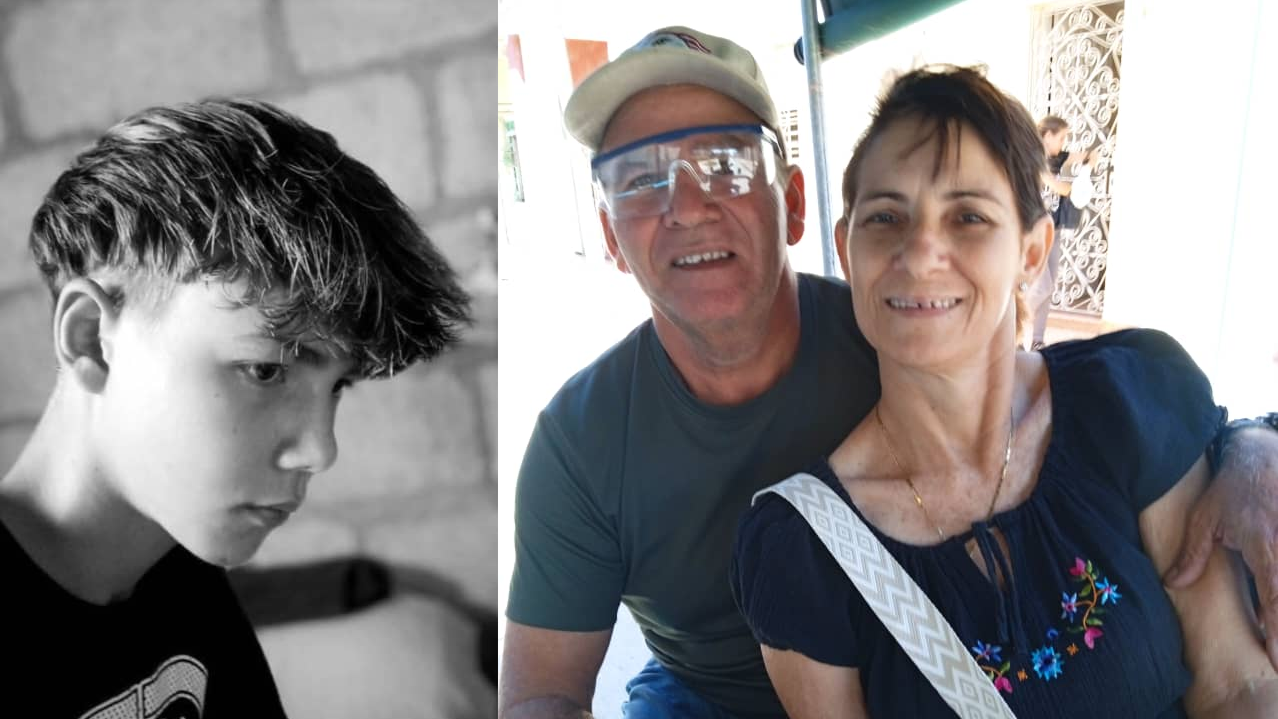
Meanwhile, Pastor Muir has been visited on multiple occasions by government officials and religious leaders acting on the instructions of the CCP’s Office of Religious Affairs who warned him that neither he nor his church were ‘authorised to exist’.
What happens next?
At a time of ever-increasing uncertainty, and with the recent actions and comments of President Trump regarding ‘taking Cuba’, the CCP should cease its targeting of those speaking about the seriousness of the country’s predicament and instead listen urgently to the concerns of its people, allowing for open discussions and seeking ways to support those leading initiatives to meet the needs of their communities.
A realist may be fairly inclined to suggest that this is highly unlikely. The CCP has held power on the island for almost 70 years and it will never give it up lightly. The truth, however, is that without swift and significant reform, either the Cuban people or external actors are likely to make that choice for it.
By CSW’s Press & Public Affairs Officer Ellis Heasley