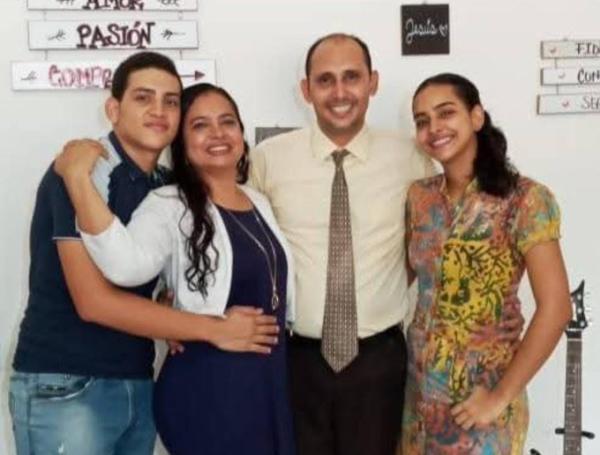
Many Christians in the north-central part of Colombia encompassing the neighbouring regions of Magdalena and Cesar are on edge after the targeted assassinations of two church leaders in the space of two weeks. On 29 December, an entire family of four – Pastor Marlon Lora, his wife Yurlay, and adult children Ángela and Santiago – was shot to death following a Sunday morning service at the service at the Missionary Bible Church in the Villa Paraguay neighbourhood of Aguachica, Cesar Department.
On the evening of 8 January, Iván García, a 28-year-old church leader and husband of a pastor, died after being shot six times, after leaving a religious service. In both cases, the killings were carried out by masked hitmen on motorcycles.
Mr García was followed by the hitmen as he was walking home along a dark, rural road with his 14-year-old stepdaughter and six other individuals following a spiritual celebration at the People of God Christian Vision Church, where his wife, Pastor Karen Nierles, had been invited to lead a Bible study. Pastor Nierles leads the New Rebirth in Christ Church in the village of Garital, in the Banana Cultivation Zone, in Magdalena. According to the witnesses, after being shot the young preacher fell to his knees and raised his hands in thanks to God. The hitmen left the scene without speaking.
Pastor Nierles, who had been married to Mr García for six months, told CSW that García’s enthusiasm was one of the key contributors to the rapid growth of their small congregation, which in a short time went from seven to 30 committed members. The church, a humble sanctuary made of rough wooden planks and a dirt plays an important role in their rural community. Pastor Nierles told CSW that, ‘…my husband died loving the church, if there was a light bulb missing, he would get it, if someone needed something, Ivan was always ready to help. He, along with brothers from the church, fixed the floor.’
One month before the murder, the couple ran home after hearing two shots as they were leaving Iván’s workplace. Neither of them thought, however, that it could be a direct warning aimed at them, Pastor Yimys Peñalosa, president of the Church of Revival and Fire for the Nations, Under His Glory denomination, to which the church in Garital belongs, told CSW.
Pastor Peñalosa also said that although Iván García expressed his Christian faith publicly eight months ago, he had been taught from the Bible as a child. ‘Although his reunion with Christ was a relatively short time ago, he was bearing admirable fruits of his love for the Lord. His dedication to helping the brothers in the church and the community led to him being called a pastor. I also considered him a pastor and anointed him as such.’
Pastor Nierles said that although her husband was a former member of an illegal group, he had never mentioned receiving any threats or warnings to her. ‘A couple of days ago he told me that he was not afraid to teach the Bible, that his life was new, he told me [recited the verse] “For me to live is Christ and to die is gain.’
In the meantime, on 30 December a group of 19 evangelical pastors in the southern part of Cesar, Colombia, filed a complaint with the City of Aguachica regarding death threats targeting the wives of pastors in the city made via a telephone call to a female pastor in the region. This took place the day after the family of Pastor Lora Rincón was assassinated in a restaurant following a Sunday church service.
In the complaint, the religious leaders told the public institution that the phone call threatening the wives of pastors in Aguachica was made by an unknown man who did not ask for money, and did not give any names or other specific details about the targeted women. According to CSW sources, the pastor who received the call had also been summoned by telephone call to a physical location by unknown individuals who spoke to her in a derogatory manner. Her husband, who is also the pastor of a church with more than 100 members, was also ordered in a telephone call to present himself at a specific location in Aguachica on 3 January by a man who did not identify himself. Neither of the two obeyed the orders; both changed their SIM cards and fled the city to escape the threats. According to officers at the Unified Action Groups for Personal Freedom (GAULA), the calls came from inside a prison.
Secondly, in the complaint, the pastors noted that at 10am on the same day of the massacre, an individual at the Foursquare Gospel ‘Christ Spring of Life’ Church was asking questions about various congregations in Aguachica Municipality. He took photos of the outside of the church and later violently forced his way inside the church where he continued taking photos. After that, he entered a car and left.
Finally, in the document, the church leaders mentioned that a person identified as Jeorge Lenum Baleth Romero made direct threats via Facebook to the physical integrity of various religious leaders in Aguachica.
Another pastor told CSW that his family had fled Aguachica because of the tension and fear generated by the words of a man who approached them during the funeral of the Lora Rincón family: ‘How ironic, pastor, you’re next.’
At least six pastors of churches of over 100 members have personally received calls threatening and/or extorting them. Others have taken advantage of the holiday season to leave and guard against the psychological violence spreading in Aguachica. Out of fear, many of them have not spoken publicly about this, nor have they filed complaints. The daughters of one pastor asked him to quit because of the risks to him, but, like other religious leaders, he does not know what to do because of the responsibility of looking after his congregation and now he feels lost. ‘The majority of pastors are outside Aguachica right now. We don’t know how many have left because of personal threats or in order to protect themselves, but the environment is very tense. We are afraid to walk in the streets,’ said one pastor.
Another leader was crying as they told CSW: ‘No one expects these types of things to happen… it is complex, there is a little fear, pain… One is used to giving encouragement to others and helping people, but now it is us who feel powerless and fearful for our families… We go into the streets with fear… Please do not leave us alone; today, every word of support means so much.’
On Sunday 5 January, after a Bible study, a pastor was verbally insulted by someone in attendance who felt mistreated by the content of the preaching. The man aggressively criticised and warned the pastor that he should watch what he said or he might find himself living a tragedy. The pastor temporarily left the region.
‘Some people do not sympathise with the pastors and are taking advantage of the situation to do harm. Preaching the Word is offensive to many, since we address issues in the region that displease both the prisoners, who govern from the prisons, and the armed groups that operate in the area,’ a source told CSW.
Following the murder of the Lora Rincón family, attendance at regular spiritual services in churches has decreased. Pastors told CSW that people continue to pray in their homes, but are fearful that more killings will take place. In particular, members of the Missionary Bible Church in the Villa Paraguay neighborhood, where Marlon and his wife were pastors, did not gather to celebrate the New Year, as is their custom. In addition to their sadness over the loss of their leaders, they also felt unsafe, so many preferred to meet in their homes.
Despite the insecurity, the number of congregants at the Villa Paraguay church grew significantly in 2024, reaching up to 150 attendees at Sunday services. This occurred despite the fact that the neighbourhood, located on the outskirts of Aguachica, is near the mountains where illegal armed groups such as the National Liberation Army (ELN), the Los Pelusos criminal group, and Revolutionary Armed Forces of Colombia (FARC) dissident groups that splintered after the 2016 peace agreement operate. ‘The growth of churches as well as their influence in the communities is something that affects illegal groups. People repent of their sins and do not want to continue committing crimes and the bad guys do not like this,’ said a pastor.
Amid pain and uncertainty, the religious ministers requested that the government roll out a special security scheme for religious leaders, avoiding the usual protocol and delays. ‘There is a clear urgency, and if collective protection arrives in three months, many of us may no longer be alive,’ warned one pastor.
By CSW’s Colombia Desk