A mid-size church located in a population facing significant economic and social challenges organises a weeknight, evening prayer service. Members of the church attend and participate in a series of structured times of prayer. At times they pray silently, at others the pastor leads them in prayer, and in one session they gather around the national flag to pray for the needs facing those in their community and country. Their prayers speak of fundamental needs – for food, for medicine, for a reduction in crime, for the provision of basic services to all.
In another part of the country, the pastor of a church takes steps to address a specific need in his community, which is also enduring hardship. Together with the church leadership, he coordinates a general collection to meet the needs. Members of the church, and many in the larger community, join in the effort and together they are able to put together packages of essential goods to give away to the most desperate.
Neither of these scenarios would attract much notice in many parts of the world. Those who did not share the faith of those involved might think some of the practices a little strange, but not harmful. Not so in Cuba, however, where the simple act of praying for the country – especially in conjunction with the use of the national flag – and any effort by a religious group to meet the acute needs of the population, are met with hostility by the government, which is increasingly threatening religious leaders who organise such activities with criminal charges.
A national symbol, but not for everyone
In December 2022 a new criminal code came into force. This was followed in 2023 by a revised family code. Both new codes are problematic, increasing minimum prison sentences for many infractions, including leading or participating in unauthorised associations or meetings – extending the government’s ability to crack down on religious leaders, especially those associated with unregistered groups. The two codes also contain explicit references to ‘patriotic symbols’, with the criminal code criminalising the failure ‘to revere [Cuba’s] symbols’ and the family code threatening the legal removal of children from parents who do not instil in their children ‘respect of [Cuba’s] symbols and respect for the authorities.’
While these vaguely worded provisions have not been implemented uniformly, in 2024 CSW noted an increase in cases in which religious leaders were warned to put a stop to activities that incorporated the use of patriotic symbols, especially when the activities also acknowledged the problems the country – which has chronic and severe shortages of food and medicine, and where lengthy electricity blackouts are a frequent, even daily, occurrence – is facing.
In one such case, in March last year, the pastor of an unregistered church was interrogated by a National Revolutionary Police (PNR) officer who arrived at her office without warning and questioned her use of the national flag during church services. In response to her explanation that she had no intention of making any kind of political statement and the use of the flag was simply to inspire the members of the church to pray for God’s blessing on Cuba, the officer accused the pastor of attempting to discredit and damage the image of the Revolution, and threatened her with a fine and the confiscation of the flags.
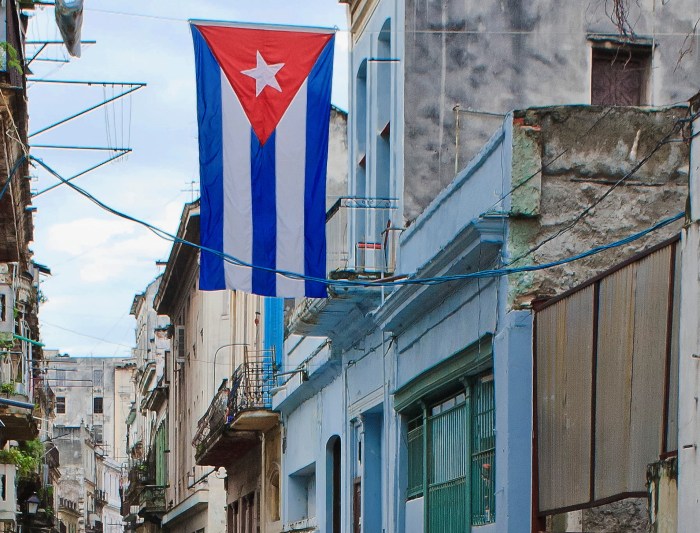
A few days later, the youth pastor at the same church was summoned to a Department of State Security (DSE) station, where a DSE captain again referenced the church’s use of Cuban flags in its services. He claimed that by teaching young people to take part in the ‘illegal’ church’s use of national symbols, the youth pastor was committing an act of counter-revolution and terrorism.
The same month, the pastors of an unregistered church in another part of Cuba were repeatedly summoned and interrogated separately by DSE and PNR officers about their use of the Cuban flag during religious services. The lead pastor was threatened with arrest for a number of supposed offenses, including failing to remove Cuban patriotic symbols and the flags of other countries on display in the church, using a social media profile picture showing her with a Cuban flag, sharing photos of prayer services using the flag on social media, and requesting prayer for Cuba on social media and mentioning specific needs in the country. The pastor responded:
My church is not a communist church, nor a revolutionary church, nor a counter-revolutionary church. It is the church of Jesus Christ, and national symbols are not used on behalf of communists or non-communists. The symbols used are those of my homeland, where God called me to pastor, build, pray, and intercede for my country.
Just as in the other case, a few days later, the youth leader at the church was summoned for interrogation. The officer expressed anger that the youth leader and others had mentioned problems in Cuba on social media, ‘discrediting and damaging the image of the Revolution in the eyes of the people’. The youth leader denied the accusations, stating:
I am not a counter-revolutionary, neither am I a communist. I have not done anything that violated Cuban law or the constitution, since all I have done was pastor the young people of my church, encouraging them to pray and cry out on behalf of the Cuban nation – and that includes Captain [redacted] and his family.
A reality denied
A simple public acknowledgement of the severe hardships that many in the country are experiencing and asking for prayer was sufficient for the authorities to summon Pastor Orlando de la Fuente Lovaina of the Nuevo Pacto First Baptist Church, a registered church that is part of the legally recognized Baptist Convention of Eastern Cuba, in Ciego de Ávila City, Ciego de Ávila, to an immediate interview at the police station on 23 March. There, PNR Officer Osvaldo Morejón interrogated Pastor de la Fuente Lovaina, referencing social media posts calling for prayer for Cuba shared by the pastor previous day. Officer Morejón accused the pastor of ‘using the pulpit to claim that there were problems in Cuba that the Church can solve, when only the Revolution and its political systems can solve people’s problems.’
When the pastor explained his religious conviction that God can provide for the many needs in the country, the officer warned him that ‘religious people’ are strictly prohibited from using national symbols, which can only be used by revolutionaries, adding that the pastor’s position sends a message to the people that the Revolution cannot solve the people’s problems. Officer Morejón threatened Pastor de la Fuente Lovaina with criminal charges if his preaching encourages ‘ideological divisionism’ among the members of his congregation, adding that ‘his family and members of the church will suffer the consequences’.
In addition to prayer, many religious groups also organised and carried out humanitarian aid projects in their communities. This included working with the most vulnerable, including the elderly, those in need of medicine and food, and people living in remote rural areas, where in some of the needs are most serious. The act, however, of recognising the existence of these needs – however obvious – and attempting to address them is interpreted by the government as an indictment of its own inability or refusal to adequately address them.
At the end of March, the pastor of a registered church that is part of a denomination that participates in the Cuban Council of Churches, a body that generally enjoys a mutually supportive relationship with the government, was visited by two DSE agents who issued him a verbal summons to attend the local Office of Religious Affairs (ORA), an entity within the Cuban Communist Party that oversees religious activity in the country, at 1pm the same day. When the pastor complied with the summons, he was received by an ORA representative, a politician who did not identify himself, and a Technical Research Department (DTI) agent. Initially, the three government officers appeared sympathetic to the pastor but expressed concern that humanitarian work with the unhoused population carried out by his church and the ‘images he was projecting abroad’ could be misinterpreted by the ‘enemies of the Revolution.’
The government agents asked the pastor, at first politely, to stop this work, clarifying their position that such work is the responsibility of the government and ‘the Revolution’. When the pastor stated that his church would continue to respond to the needs around them, the government agents became hostile. They interrogated him, demanding to know why he had shared photos of unhoused people living on social media and who was financing the church’s humanitarian work. The ORA representative threatened the pastor with the cancellation of his religious credentials. The pastor made it clear that the church receives no outside funds for its humanitarian work, and said, ‘you who direct religious affairs in the city, you in the department of investigations, and you as a politician, do what you have to do, because I will continue to serve God and the church will continue to help the most helpless.’ The ORA officer produced a prepared Acta de Advertencia – a document that acts as a justification for arrest for future crimes outlined in it – and ordered the pastor to sign it. The pastor refused and asked permission to leave, which was granted after he was warned, again, that there would be consequences if he refused the order to stop the work.
In October, a government inspector arrived at property used by a church affiliated with an unregistered Protestant denomination and handed the pastor a 20,000 CUP fine – more than four times the average monthly salary in Cuba – and an order to demolish a wooden shed and greenhouse built by the church to cultivate food to eat and share with the hungry in their community. Although the pastor had been granted a permit by the authorities to use the land for this purpose, the inspector told him that none of it could be considered legal, as long as the church was ‘illegal’. The pastor told CSW:
We built this project legally, with our church’s own funds, and now that we have managed to build a greenhouse with vegetables to provide for several members of the community who lack resources, the state orders us to demolish and complete a project that allows the church to be a tangible testimony of love, evangelism and service. But unfortunately, even that is prohibited in the Cuban system, and they want the church to pay the consequences.
A crumbling regime exposed
Over the past few years, Cuba has experienced a historic wave of emigration with around ten percent of the population leaving, many young people and almost always via irregular channels. This and other factors have led to a humanitarian crisis involving the elderly, some of whom are left with no one to look after them. With the systemic shortages of food and medicine across the island, many are unable to access much in the way of support from the government, and for many years, religious groups have organised small scale initiatives to provide care to this especially vulnerable population. Sadly, although it seems would seem difficult to object to such work, it, too, attracted the ire of the authorities.
In the first half of the year, a pastor affiliated with an unregistered denomination, who has developed a ministry providing food, clothes, medical care and in some cases shelter to the elderly, was accused of ‘illegally helping the elderly’ and fined 20,000 CUP. One week later, a housing inspector arrived at the pastor’s home in eastern Cuba and demanded to search the place in order to ascertain whether an ‘illegal’ church met there and if the pastor was providing support to any elderly people. This time the pastor was fined 50,000 CUP for allowing meetings in their home with attendance exceeding the maximum number of people allowed to assemble in a private home. The pastor did not deny the charges but pointed out that the funds to pay the fine could have been used to provide food to the elderly in need. In response, the inspector threatened the pastor with the loss of their job, warning that then their ‘own children would be left without food’.
Even the act of receiving aid was apparently enough to provoke a negative and even violent reaction from the authorities. In the second half of the year, in a remote, rural community in eastern Cuba, members of a small church gathered to hold a time of thanksgiving for aid, including food, they had received the previous day from a Christian ministry. As they began the service, their church – a rustic building made of wood – was surrounded by individuals that no one recognised as being local to the area, and who were wearing distinct shirts used by some members of CCP militant groups. The mob began to throw rocks at the tin roof and shout at those inside, threatening to burn the church down if the activity inside was not halted. The members of the mob dispersed after the people inside the church panicked and cancelled the service. Those who reported the case to CSW said: ‘this was a warning to us to stop carrying out missionary work and offering humanitarian aid.’
It is not difficult to understand the motivation of the government in attacking those who acknowledge its failures. Cuba is a one-party state, which has been under the political leadership of just three men since 1959 – two of whom were brothers who ruled consecutively for 45 of those years. The only justification for such a political system and the refusal of its leaders to make any reforms at all, is that it is able to provide for the needs of its citizens. Cuba’s leaders sit atop a structure that is built upon a foundation of sand, eroded over time by the waves of mismanagement, injustice, intolerance, and the systematic violation of basic human rights. Those who acknowledge and take steps to address the basic needs of the Cuban people, for which the government is all too clearly fundamentally unable to provide, expose its leaders’ critically precarious position.
By CSW’s Director of Advocacy Anna Lee Stangl
Click here to download CSW’s new report on Cuba as a PDF.
Click here to download the report in Spanish.