In today’s India, the term ‘conversion’ carries a weight far heavier than its dictionary definition. It is invoked with suspicion, folded into political rhetoric, and increasingly framed as a threat to social stability. Yet conversion, at its core, is simply a change of belief, an act that is rooted in conscience. In any democracy, this should not be controversial. It should be protected without hesitation.
As India marked 77 years as a Republic last month, the moment invites more than celebration – it calls for reflection. How did a constitutional democracy that explicitly guaranteed freedom of conscience arrive at a point where changing one’s religion is so often treated as inherently suspect?
Conversion is not a transaction. It cannot be reduced to paperwork, nor can it be meaningfully regulated by administrative oversight. It is an individual’s decision, deeply personal and shaped by experience, reflection and choice – and sometimes by profound personal transformation.
The framers of the constitution appeared to grasp this complexity. This is why Article 25 begins with the individual’s conscience before it speaks of practising or propagating religion. The placement was deliberate. Conscience was placed first. To change one’s religion is to exercise that conscience, and a disruption of public order – it is an exercise of moral agency.
And yet, across large parts of the country today, the legal architecture suggests a deep discomfort with precisely that agency. Generally known as anti-conversion laws, these legal regimes effectively dismantle the very ethos that the founding generation sought to protect. These laws treat conversion not as a personal decision, but as a suspicious act requiring state surveillance and control.
Today, a dozen states have enacted laws regulating religious conversion. While these statutes are often justified as necessary safeguards against coercion, their operational logic tells a more troubling story. These laws assume that conversion is likely to involve force, fraud, or inducement. Many require individuals to notify the state before converting, submit declarations afterward, and subject their decision to official scrutiny.
Religious leaders may be criminal liable if someone converts after interacting with them. In several jurisdictions, the burden of proof lies on the accused to demonstrate that a conversion was free of improper influence. The effect is unmistakable: the state moves from protecting freedom to supervising it.
Equally concerning is the vague language embedded in these laws. Terms such as ‘allurement’ and ‘inducement’ are defined broadly enough to include activities that, in most democracies, would fall squarely within protected religious expressions – charitable acts such as offering food, education, running schools or medical care. When ordinary acts of service can be framed as criminal persuasion, the space separating legitimate regulation from intrusion steadily narrows.
At this point, the question is no longer whether coercion should be prevented – few would dispute that – but whether suspicion has become the default posture of the law.
This approach directly conflicts with the constitution. Article 25 protects not only belief, but the freedom to profess and propagate religion. Persuasion is not the same as force, and a democratic state has no role in regulating sincerity of belief.
Yet, the growing expectation that state authorities should determine whether faith is ‘genuine’ signals that conscience will be legible to the state, in other words: an individual’s faith is no longer just theirs, the state expects to see it, assess it and sometimes approve it.
Furthermore, these laws appear to fall disproportionately on minority communities. In particular, they are overwhelmingly invoked against Christians and Muslims. For instance, a small Christian prayer meeting held in a private home could easily be disrupted, followed by police investigations due to accusations of conversion; or when a Muslim man takes a Hindu bride, her statements of consent could be scrutinised by the authorities.
On the other hand, organised campaigns such as ‘ghar wapsi’ often involving physical force or pressure by far-right religious groups are rarely investigated. Reports from civil society groups and rights monitors describe Christian prayer gatherings interrupted following anonymous complaints about illegal conversions. Pastors and lay clergy are arrested, only to be released when evidence fails to materialise, while places of worship are subject to vandalism. When a law is applied unevenly, even when it seems neutral in the statutes, it risks eroding confidence in the rule of law.
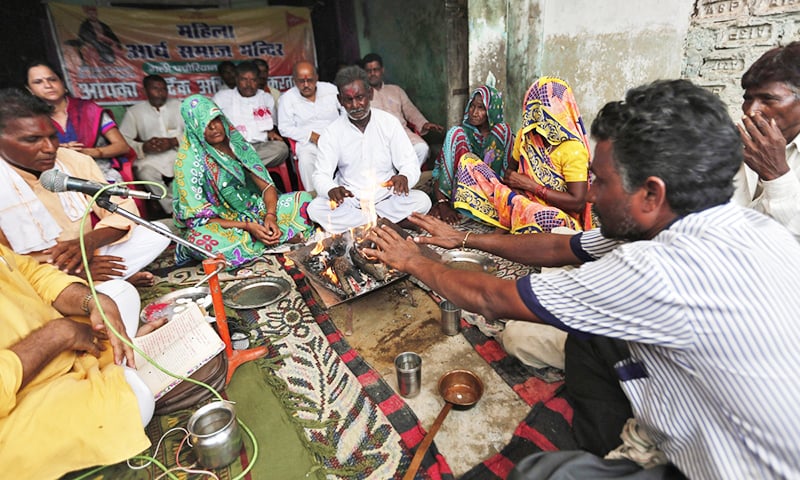
Usually, the legal outcome in such cases matters less than the process itself. The assumption of guilt and police investigations that ensue become forms of punishment in themselves, where reputational harm arrives before any judicial clarity. The long impact is that for religious minority communities, the cumulative effect is difficult to ignore.
Interfaith marriages have become another premise for heightened scrutiny, as marriages between consenting adults are sometimes investigated through the lens of anti-conversion statutes, which reinforces the assumption that individuals, particularly women, are portrayed as incapable of choosing either their partner or their religion. Their consent is questioned, their judgement doubted. What has emerged is a paternalism that sits uneasily with constitutional commitments to dignity and autonomy.
Over time these laws have shaped social imagination about religious minorities and legitimised pubic distrust of them. Mere allegations trigger pressure from entire communities, often followed by social ostracism and mob attacks. Long before a court can evaluate the facts, the damage is done.
India’s criminal law framework is fully capable of prosecuting crimes of coercion, fraud, or violence, irrespective of the religious context. Anti-conversion laws do not strengthen this protection, instead they are evidence of a broader climate of anxiety about the choice of religious change.
Republic Day commemorates a charter that trusted its citizens: trusted them to think, to question, to dissent, and to believe differently. Conversion was not feared by those who framed the constitution. To criminalise conversion or heavily police conversion is, in many respects, to retreat from that trust.
If India is to remain faithful to the promise articulated on 26 January 1950, it must reaffirm a simple but demanding principle: conscience is not the business of the state. The freedom to believe, to change one’s mind, and to follow the dictates of conscience was never mean to depend on majoritarian approval, either.
The question now is whether India is prepared to defend that freedom with the same confidence with which it was once promised.
By CSW’s India Researcher