On Sunday 25 January congregants at the Anglican Church of Kenya (ACK) Witima Parish, Nyeri County, heard shots outside of the building. Some church members went outside to investigate and saw what they believed to be the police and masked assailants surrounding the premises. In addition to the firing of live rounds, teargas was thrown into the church, with images shared on social media showing congregants covering their noses and mouths, and several individuals fainting.
Historically there has been a respect for religious institutions in Kenya, especially for Christian churches and their leadership. Political leaders have often courted the church for political advantage and sway over key voting blocks and communities. This attack contrasts starkly with this backdrop, even within the context of increasing political and security tensions that have seen an increase in police officers unlawfully invading places of worship around the country.
Responding to the 25 January attack in the press, Bishop Gerald Muriithi of the Mount Kenya West Diocese of the Anglican Church of Kenya stated: ‘As a church we feel that our right to worship was violated, little children were traumatised, aged parents were harassed, the clergy were terrified and intimidated and political leaders were harassed.’
The bishop went on to raise concerns about the role of the police in the incident, noting that they were firing live rounds indiscriminately, and the masked ‘goons’ who reportedly burned down the car of the former deputy president and slashed the tires of other vehicles there, did this in the presence of police, who did nothing to stop them.
The launching of teargas cannisters during a service is a prima facie violation of the rights of the congregation to meet to worship peaceably and without interference. It is the responsibility of the authorities to account for the actions of the police officers who were outside of the church and to explain why the firing of teargas canisters and live rounds into a place of worship was justified.
Notably, former Deputy President Rigathi Gachagua and several of his colleagues were attending the service. Mr Gachagua was impeached in October 2024 following a political fallout with President William Ruto in the aftermath of anti-tax demonstrations in which approximately 100 peaceful protestors were killed and hundreds more were injured between 2024 and 2025, amid accusations of the unlawful use of deadly force by police and security forces.
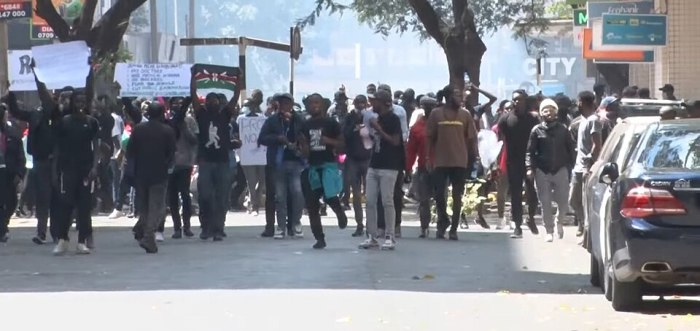
Since being impeached, the former deputy president has become a leading opposition voice, with the president and his allies now accusing him of corrupt practices when in government and inciting ethnic tensions.
Kenya is due to go to the polls in 2027, and by September 2025 eight candidates had already announced their intentions to run for presidency.
President Ruto remains unpopular following the anti-tax protests, especially among younger voters and Gen Z, who feel betrayed by his campaign promises to support young entrepreneurs and make the economy work for all. In reality, Ruto’s presidency has led to greater inequality, particularly through a tax burden that unfairly targets the creative and online industries that young people are often more heavily engaged in as they are unable to find secure employment.
Churches, including the Anglican Church, have issued guidance stating that politicians and political leaders are welcome to attend services and to greet congregations, but political statements should be issued outside the sanctuary after the service. This was done to reduce the politicisation of churches and as a safeguarding measure for places of worship.
Political tensions are not new to Kenya, and neither are accusations of incitement to violence. During the 2007 post-election violence the country was plunged into a political and constitutional crisis that led to a transitional administration and ultimately the drafting of a new constitution.
Especially in the post-election crisis, places of worship belonging to the country’s main religious traditions played an important and respected role in bringing communities together and calling for peace. Churches embarked on civic education programs to urge responsible citizenship and encourage their members to participate peacefully in elections, while also calling for peace and respect for the dignity of all persons. Places of worship and religious leaders garnered respect from political leadership.
In the last two years, Kenya has witnessed deepening political tensions, a consolidation of presidential power and oversight over the cabinet and institutions of state, and the growing unpopularity of, and dissatisfaction with the Ruto presidency. Simultaneously, there has been an increasing testing of the constitution, disregard for the rule of law and the use of lethal and disproportionate force on civilians and unarmed peaceful protesters. Additionally, the number of enforced disappearances has risen sharply, with allegations of security personnel in plainclothes and who do not identify themselves arresting civilians and detaining them in unknown locations.
With an election campaign in the next 18 months, the erosion of civil and political rights is a concerning development, but one that can be remedied with serious and concerted action to ensure that law enforcement and security services are working within the confines of the law and can be relied upon to protect rather than violate the rights of citizens.
The attack in Nyeri is also reminiscent of one of the worst incidents during the 2007 post-election violence in which 36 members of the Kikuyu tribe – most of them women and children – were killed when youth primarily from the Kalenjin community surrounded and set fire to the Kiambaa Assemblies of God Church in which they had sought shelter in the Eldoret area of the Rift Valley.
The incident was one of the violations that formed part of the prosecution case against President Ruto at the International Criminal Court (ICC). The ICC eventually dismissed the case due to insufficient evidence, whilst acknowledging serious witness intimidation and political interference. At the time of the 2007 election, President Ruto was the Member of Parliament for Eldoret North and supported the opposition party led by Raila Odinga, who ran against the incumbent president, Mwai Kibaki, who is from the Kikuyu ethnic group.
Several commentators have compared the Kiambaa church attack and the Witima Parish Church attack. The event is a stark reminder for many Kenyans of the threat of electoral violence and underscores the importance of a full, independent investigation into the police’s role as agents of the state.
FoRB violations are often the canary in the coalmine. As Kenya heads towards its 2027 elections, and with elections in two other key regional nations, namely Tanzania and Uganda, having already been marred by severe human rights violations, there is cause to be concerned about the political and human rights climate. However, there is still time to correct the path and ensure a full, independent investigation into this attack, making the results publicly available and holding those responsible to account. This would be a much-needed confidence building measure for upcoming elections, indicating that institutions of state will not be utilised against political opponents and the communities that support them.
By CSW’s Deputy Team Leader for Africa and the Middle East