‘It was terrifying for my children… they started crying and screaming.’
On Sunday 22 March, in Guanabacoa, Havana Province, Cuba worshippers, including several minors, at the Christ Center Missionary Alliance were attacked with stones and concrete blocks by a neighbour who reportedly works for the Ministry of the Interior, and who has a history of hostile actions targeting the church. The church’s Pastors Yoennis Cala and Dayana Gómez, along with their young children, experienced moments of panic when a neighbour hurled objects at their home.
The incident marked one of several indicators of a new wave of repression in Cuba – one marked by detentions, acts of violence, and actions targeting individuals linked to religious belief and public expression, and one that reflects a troubling pattern across different regions of the country.
One week before the attack in Guanabacoa, on Sunday 15 March Pastor Rolando Pérez Lora was detained in Peñas Altas, Matanzas Province, following his recording and posting of a biblical teaching video on YouTube. Due to strict controls on access to the internet in Cuba, the pastor was forced to do this in a park, one of two locations where the public are able to access WiFi. In footage circulated on social media, the pastor states: ‘They are mistreating me without cause; I have done nothing wrong,’ as he is forcibly shoved into a patrol car. The clergyman was released hours later, but he reported a history of surveillance and harassment stemming from his activities.
One day later, Jonathan Muir Burgos, a 16-year-old minor and son of independent pastor Elier Muir Ávila, was arrested along with his father, after participating in protests that broke out in the city of Morón, Ciego de Ávila Province on 13 and 14 March. The teenager remains deprived of his liberty after a writ of habeas corpus filed on his behalf was rejected by the court on 15 March. This has heightened concerns regarding his situation, especially given his age, the fact he has a chronic health condition, and the legal safeguards afforded to him.
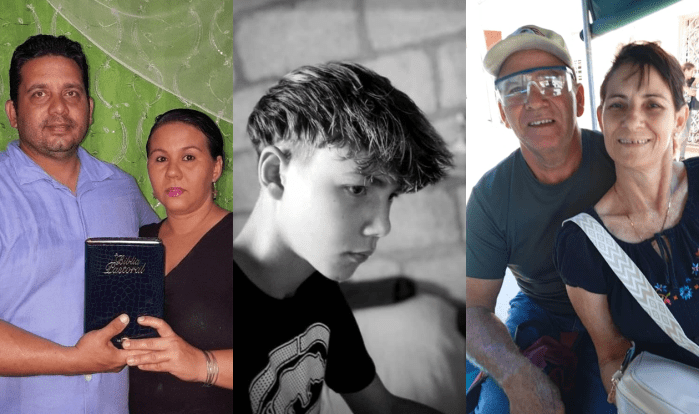
Beyond the facts themselves, these cases have a human face. In one instance, the voice of a father reflects the anguish of seeing his young son behind bars, even as he strives to uphold his faith amidst the uncertainty. In another, a pastor describes the moment he feared for his children’s lives when stones began raining down on the house where they were gathered—yet he never ceased affirming his trust in God in the face of danger. And in a third case, a religious leader maintains his faith even while recounting the mistreatment he endured during his detention.
These are individuals who experience fear, who live with the anguish of concern for their loved ones, and who confront extreme situations; yet the very manner in which they speak and recount these events simultaneously becomes a declaration of faith.
In response, Cuban religious leaders are raising their voices in support of the Cuban people, as well as the newly detained political prisoners and their families and others who have been victims of threats, acts of intimidation and physical attacks.
On 26 March the Alliance of Christians of Cuba — comprised of over 70 registered religious leaders, as well as Christian communities throughout the island that count thousands of congregants among their membership, issued a public statement denouncing the context of ‘hunger, misery, and helplessness’ in the country, and expressing their concern regarding the situation of detainees and their families. In the document, the signatories affirm that there is a moral duty to stand in solidarity with those suffering injustices; they call for the plight of prisoners to be brought to light, while simultaneously demanding the release of those unjustly detained.
From exile, Cuban religious leaders have also reacted to these events. Reverend Mario Félix Leonart Barroso, a Baptist pastor formerly affiliated with the Western Baptist Convention of Cuba and a long time defender of freedom of religion or belief (FoRB), warned that repression has intensified in recent days, while Pastor Alain Toledano Valiente, a leader in the Apostolic Movement, noted that it is impossible to separate social reality from the suffering of the people. Remaining silent in the face of such situations amounts, in practice, to aligning oneself with those who carry out the repression.
These statements stand in stark contrast to an official call for neutrality issued by the Western Cuba Baptist Convention, (WCBC) a large, registered denomination. This stance has also been echoed by some pastors on social media. Many have linked the WCBC statement to a countrywide tour in late 2025 undertaken by Caridad del Rosario Diego Bello, the head of the Office of Religious Affairs (ORA) of the Central Committee of the Cuban Communist Party.
During this tour, according to several consulted sources who requested anonymity, Ms Diego Bello actively promoted a stance of neutrality or alignment among religious leaders. According to these testimonies, messages were allegedly conveyed during these meetings that implicitly set conditions on a positive relationship between the churches and the government. These included references to previously granted privileges—such as the ability to travel abroad—despite the fact that such rights ought to be guaranteed as a matter of course. Against this backdrop, religious leaders were reportedly urged to refrain from taking critical stances and, failing that, to maintain a posture of ‘neutrality.’
Following the publication of the WCBC’s exhortation to neutrality, several Cuban religious leaders in exile again spoke out publicly. Reverend Leonart Barroso asserted: ‘Since the letter was made public, repression against [the WCBC] —the members of that convention—has intensified. To me, this is no coincidence…’ thereby suggesting a context of mounting pressure following the document’s dissemination.
For his part, Pastor Toledano Valiente remarked: ‘If the people are suffering, you cannot claim it is none of your business… When you say that one should not get involved in politics, you are denying the reality of your own congregation,’ underscoring the impossibility of separating faith from social reality.
These voices converge on one essential point: in contexts of crisis and human rights violations, neutrality ceases to be perceived as an intermediate stance and comes to be understood as a form of silence—one with tangible consequences for those who suffer.
For years, various sources and observers have noted that the relationship between the ORA and religious groups is not confined to a formal institutional framework, but rather encompasses informal mechanisms of influence and control. Religious leaders have reported facing pressure—whether direct or indirect—to refrain from making public statements that could be interpreted as critical of the government; instead, they are encouraged to adopt a stance of ‘neutrality’ which, in practice, curtails the expression of independent viewpoints.
This apparent, if coerced, neutrality raises fundamental questions: in an environment characterised by allegations of repression and human rights violations, institutional silence can, de facto, evolve into a form of alignment that renders these realities invisible. Thus, the debate centers not merely on the political engagement of religious institutions, but on the role they ought to play in the face of injustice—specifically, whether they should confine themselves solely to spiritual matters or if they also bear a moral responsibility toward the social suffering that surrounds them.
Can neutrality become a form of cowardice? Many in and outside of Cuba believe that religious institutions have a moral responsibility in the face of the crisis. Pastors and spiritual leaders owe their allegiance to their people. When one turns their back on their congregants in the name of apparent neutrality, one is, in reality, siding with the oppressors. It is not enough to simply pray; Cuba needs more than words.
By CSW’s Cuba Consultant Enrique de Jesus Fundora Perez, a Cuban pastor living in exile