Attacks on places of worship in Manchester and Peacehaven did not arise in a vacuum. Political leadership is urgently needed. 

A man drives a car into a crowd of people outside an Orthodox synagogue on the holiest day of the Jewish calendar. He proceeds to attack those gathered outside, fatally stabbing one before being shot dead by police, who also tragically killed another whilst attempting to neutralise the attacker. 

Two days later, two individuals in balaclavas set fire to the entrance of a mosque and a car parked outside it in what police are treating as a hate crime. Mercifully no-one was killed, with the two people who were inside the mosque able to escape.

At CSW, our work often involves reporting on attacks like these on places of worship in a number of countries – and often particularly in situations of conflict – around the world.  

Continue reading “Attacks on places of worship in Manchester and Peacehaven did not arise in a vacuum. Political leadership is urgently needed. “

Combating Hate Speech: The True Beginning of Peace and Human Dignity

This article by Ján Figeľ  and Sheikh Al Mafoudh bin Bayyah was originally published by The Diplomat Magazine on 30 July 2025.

‘Peace is built in the heart.’ Pope Leo XIV
‘War begins with words.’ – Sheikh Abdallah bin Bayyah

In an age marked by overlapping crises – from armed conflicts and ideological extremism to ethical breakdowns in public discourse – a need to return to the essence of words and their meaning is more urgent than ever. Words are not mere tools of expression; they are often sparks that ignite or extinguish fires. This is precisely what Sheikh Abdallah bin Bayyah, President of The Abu Dhabi Forum for Peace, warns of in his profound message: ‘War begins with words.’

With this statement he encapsulates an entire philosophy: that every physical war is preceded by a war of words, and every act of violence is rooted in a prior act of verbal aggression. Unless speech is restrained, purified of hatred, and founded on mutual respect, the path to peace will never begin.

Continue reading “Combating Hate Speech: The True Beginning of Peace and Human Dignity”

The UK government’s efforts to produce a definition of Islamophobia could prove counterproductive 

In February 2025 the UK’s Deputy Prime Minister Angela Rayner announced the convening of a working group chaired by Rt Hon Dominic Grieve KC to provide a definition of Islamophobia. She insisted that the definition would be non-statutory and align with the UK’s values of free expression, including the right to criticise a religion. Nevertheless, this action raises several concerns. 

While it can initially appear to be a useful tool for defining acts of religious hatred and incitement, in reality phobia terminology tends to hinder rather than assist efforts to address religion-related violations.  

It is imprecise, and is invariably used to shut down legitimate debate. Additionally, discussion about whether or not a given phobia is indeed occurring can often eclipse efforts to highlight and address the actual violations.   

Continue reading “The UK government’s efforts to produce a definition of Islamophobia could prove counterproductive “

For religious minorities in India, even tragedies turn into trials

Once again a terror attack has left Muslims across India not just shaken like all other Indians, but also defending their very existence. Someone, somewhere, with a gun and an agenda, committed a horrific act — but it was their name, their identity and their faith that suddenly became suspect.

Twenty-six people were killed when terrorists attacked tourists in Pahalgam in Jammu and Kashmir on 22 April. The attackers reportedly singled out non-Muslims, even asking some to recite the Islamic Kalima (Islamic prayers derived from hadiths that are often used to aid South Asia Muslim children to memorise key beliefs) to prove their faith.

It was horrifying. And yet, in the midst of the horror, ordinary Kashmiris—Muslim men and women—risked their lives to save strangers. People like Nazakat Ahmad Shah, a tour guide, and Rayees Ahmad Bhatt, President of the Pony Owners’ Association, pulled survivors from danger. A local pony guide Syed Adil Hussain Shah gave his life while trying to protect a little girl. But instead of being praised for their efforts, the Muslim community, especially the Kashmiri Muslim community, was vilified. Their bravery was quickly forgotten, the national mood shifted from mourning to suspicion—and the blame – as it so often does in India – landed on an entire community.

Continue reading “For religious minorities in India, even tragedies turn into trials”

What having an opinion can cost you in India

“Hate has won, the artist has lost…,” Indian stand-up comedian Munawar Faruqui tweeted hours after his Bengaluru show was cancelled. It marked at least the 12th time Mr Faruqui’s show had been cancelled after threats to the venue and the audience. Earlier this year, the 29-year-old Muslim artist spent a month in jail for allegedly joking about Hindu deities, an accusation that the police didn’t have any evidence for. That’s what a ‘joke’ can cost you in India today. 

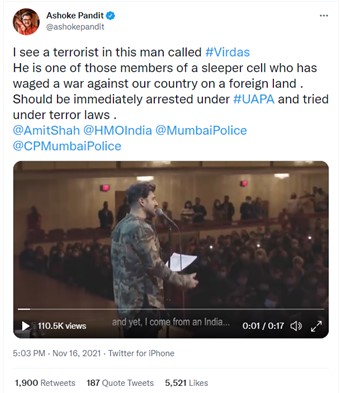
Or rather, in one of the two Indias that stand-up comedian Vir Das described in his Emmy-winning monologue which exposed the blatant hypocrisy prevalent in the country, including in relation to the plight of religious minorities, farmers, women and Dalits. The video went viral on social media, and immediately received a flurry of reactions, with right-wing activists calling for his arrest. 

One of the tweets issued in response to Vir Das’ monologue
Continue reading “What having an opinion can cost you in India”