The ‘Four Cuts’ strategy, designed to sever insurgents’ supplies of food, funds, information and recruits, is an approach that has been used for decades by a series of military dictatorships in Myanmar/Burma. This devastating tactic is once again being employed, but in one of its bloodiest forms yet.
Breaking society
In a remarkable piece of reporting, in a country where foreign journalists have no official access to the true story of Myanmar’s civil war, Sky News recently released details of an undercover mission deep into southeastern Myanmar. Chief correspondent Stuart Ramsay encountered first-hand the Myanmar military regime’s devastating campaign of violence.
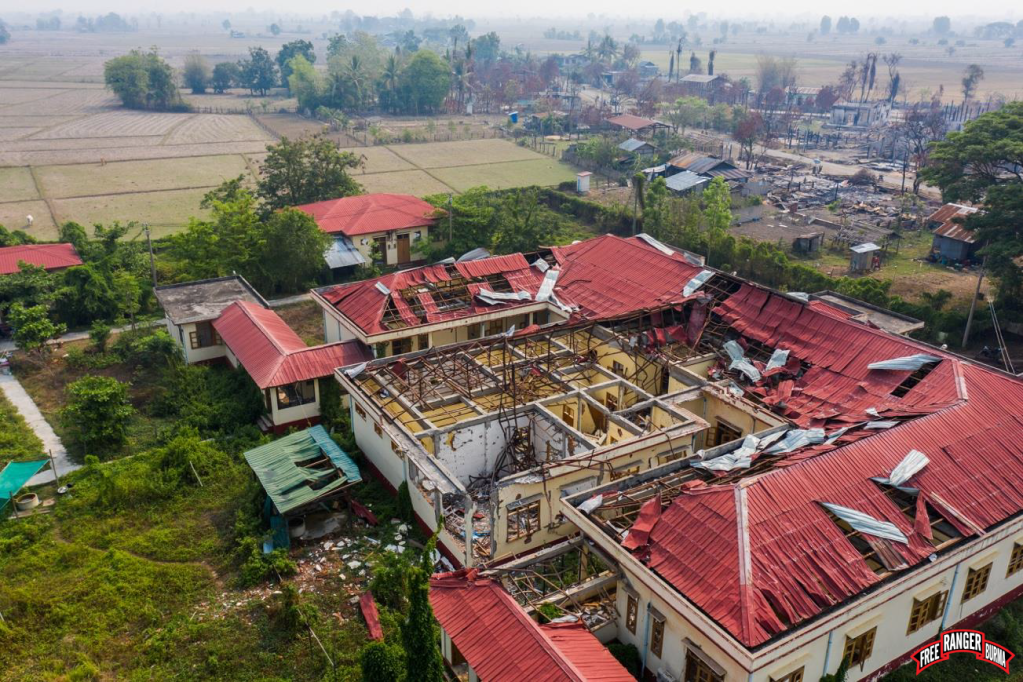
Ramsay and his team discovered shocking evidence of sustained attacks on civilian homes and infrastructure, including daily artillery and aerial bombardment as well as arson attacks, which are forcing people from their homes with over 1.5 million people currently displaced and in desperate need of humanitarian assistance.
Ramsay concludes that the military, known as the ‘Tatmadaw’, are pursuing a campaign of violence where: ‘The idea is to break down society… schools, hospitals, places of worship, shops, and even… rice fields are being destroyed in the military’s attempts to crush the resistance’.
Responding to this reporting, Myanmar’s pro-junta embassy in London categorically denied the current regime is indiscriminately killing its own people. They stated this was a ‘wrong narrative’ and that Myanmar is a ‘responsible member of the international community’.
The staggering statistics revealing the extent of the violence wrought on the people of Myanmar since the February 2021 coup testify to the contrary.
A festering catastrophe
According to a report published by the UN Human Rights Office in March 2023, from the beginning of the coup on 1 February 2021 until 31 January 2023, nearly 80% of the country’s 330 townships experienced armed violence. The systematic and widespread burning of villages, a core and longstanding tactic of the Tatmadaw, has increased 1,000-fold since February 2022 compared with the previous year, with nearly 39,000 houses nationwide burnt or destroyed in military operations.
Chan Thar village, a predominantly Catholic village in the worst-hit northwestern Sagaing Region has experienced continual assaults and arson attacks. In a raid on 14 January 2023, it was widely reported that a 129-year-old Catholic church and almost all of the few remaining houses in the village were set alight by regime troops. Myanmar Now recorded an anonymous villager stating: ‘They have raided over thirty times now and this is the fourth time our village has been torched…essentially nothing is left…’
The situation in Myanmar is so grave that the UN High Commissioner for Human Rights, Volker Türk, has termed what is happening a ‘festering catastrophe’. He also warns that the country is in a ‘deadly freefall into even deeper violence and heartbreak’.
The cruelty of ‘Four Cuts’
The reign of terror that the junta is inflicting on its people is in keeping with a longstanding counter-insurgency strategy that the Tatmadaw employs. This approach, known as ‘Pya Ley Pya’ or the ‘Four Cuts’ strategy, is designed to cut off sources of food, funds, information and recruits from any armed opposition.
This is not strictly a military strategy though; what makes the ‘Four Cuts’ approach so brutal is that it is largely aimed at villages of unarmed civilians, crushing them to prevent or deter locals from supporting or joining the resistance. The engagement of this strategy provides a cruel rationale for a number of gross human rights violations and dehumanising activities, including, but not limited to, killings, sexual violence, displacement, torture, arbitrary arrest and the aforementioned devastation of homes, civilian infrastructure and places of worship, alongside the blocking of humanitarian aid.
The Tatmadaw began utilising the ‘Four Cuts’ strategy in the 1960s to subdue armed resistance in Karen National Union (KNU) controlled areas of eastern Myanmar. The ensuing series of military dictatorships returned to these methods time and again, such as in Kachin State, after a failed ceasefire between the military regime and the Kachin Independence Organisation in 2011, and again in Rakhine State where fighting between the ethnic Arakan Army and the Tatmadaw led to 230,000 people feeling for their lives from 2018 onwards.
In this technological era the junta is adapting, blocking mobile internet data and networks in regions where the regime’s soldiers are clashing with armed resistance fighters and using social media to spread disinformation and to hunt those suspected of being involved with the resistance. Such tactics do not distinguish between civilian and armed persons.
Digital banking has now also been weaponised through changes to banking laws that are parting both pro-democracy forces and ordinary people from their money. Mobile money systems have been a lifeline to many small civilian-run businesses as they sought to adapt to survive under the current regime. Radio Free Asia quotes Sayar Kyaung, leader of Yangon UG Association explaining: ‘The junta knows that people will not be able to pay attention to the revolution if making ends meet become more and more difficult. The junta is trying to cripple people’s businesses so they will be less willing to support the revolution.’
An unbroken people
Despite catastrophic losses, severe repression and displacement, the ‘Four Cuts’ strategy is largely failing to deter the resistance. Far from it, Sky News’ Stuart Ramsay listened as most people he met described how the Myanmar military is emboldening their resolve.
The international community must act more decisively and with greater urgency to support the incredible efforts and bravery of the anti-junta resistance in Myanmar. Far from being the ‘responsible member of the international community’ that the current regime has characterised itself as, the Tatmadaw are committing war crimes and grave human rights abuses.

The slow, piecemeal efforts of the international community must transform into robust and comprehensive action. Kyaw Moe Tun, Permanent Representative of Myanmar to the UN urges: ‘Time is of the essence for us…we need to finish this fight as quick as possible…the military is using all means to kill people, to make the people [live] under fear…[we] need decisive action from the international community…’
Decisive and robust action is needed
The international community must ensure that humanitarian aid is getting to those who are in urgent need by providing agile, direct funding to local aid organisations.
The legal mechanisms of the international community must hold the illegal junta to account for its despicable crimes. All of the atrocities currently being committed in Myanmar must be referred to the International Criminal Court (ICC). The UN Security Council must refer the Myanmar junta officials to the ICC – and pressure must be placed on China and Russia to prevent them from vetoing any referral.
Echoing UN High Commissioner for Human Rights, Volker Türk’s call: the international community, the Security Council, ASEAN, and all Members States with influence over junta leader Min Aung Hlaing and the Tatmadaw have a responsibility to exert maximum pressure to end this crisis.
States must increase targeted sanctions and continue to pursue all sources of funds and resources that the regime is accessing in order to block them – including closing any loopholes that are being exploited to circumnavigate sanctions.
It is time for the international community to apply its own ‘Four Cuts’ strategy to stop the Tatmadaw’s atrocities against the people of Myanmar: cut the flow of funds that aid the military, cut the supply of arms and aviation fuel, channel aid through local community organisations, and end the culture of impunity by bringing the perpetrators of atrocity crimes to justice. The time for decisive and comprehensive action is now.
By CSW’s East Asia Team
Featured Image: Ruins of Nan Lan Village. Credit: Free Burma Rangers.
UN, US, UK, CANADA, EU should enact by law & enforce such that their lge. , wealthy corps operating out of those states, should become ethical & stop dealing w/corps in Myanmar which are controlled by & the m0omey earned support Myanmar military in their cruel unjust violence toward people in Myanmar. Our corps as complicit in the bombing & attacks against innocent people. They must put principle above profit. Some corps have Leery withdrawn. Francis Lavigne, Fort St John, B.C.