It was the end of 2015 when Rogelio Hernández Baltazar returned to his community in Rancho Nuevo in the Huejutla de Reyes Municipality of Hidalgo State. He had spent several months working in the fields of Coahuila in Northern Mexico, because there were no opportunities for work or to generate income to support his family in his own village.
This time things were different; he returned to his community transformed after having struggled for years with alcohol addiction and anger management. While he was working in Coahuila a colleague had invited him to the local Fundamental Baptist Church, where he made the decision to convert to Christianity. What he did not know was that it would have serious consequences within his community.
When Rogelio returned home things seemed not to have changed much, but something inside him had. He had only been attending the church in Coahuila for two months, but when he returned to his indigenous Nahuatl community, people noticed such a significant change in him that they began to wonder what had happened to him in his workplace. With the little understanding that he had, Rogelio began to explain that his radical change was due to what he had read in the Bible, so he invited people to Bible studies in his home.
By 2016, three families were already regularly attending the Bible studies that Rogelio led. Every week they met in a different house. They shared coffee and whatever was at home, without much preparation. With only a couple of months in his previous church, and although he had never been able to complete primary school, Rogelio became the pastor of a new local church in Rancho Nuevo which they called ‘The Great Commission’.
It was at that point that the situation began to become difficult for him, and for all those who were interested in the subject. Soon members of the community that attended the church began to experience threats. They were threatened with the suspension of their access to social programs and with being cancelled as members of the community. The village authorities considered Rogelio’s teachings to be contrary to their local traditions that required participation in Roman Catholic Church religious festivals and in the roles for the functioning of the church itself.
By 2018, as a means of pressure, the children of families that attended the Great Commission Church were prohibited from attending the local primary school. When a teacher on duty tried to intervene they were fired by the village leaders. From that moment on, members of the Great Commission Church began lodging a series of complaints at the Hidalgo prosecutor’s office and the state human rights office, but neither made any recommendations or requests for the authorities to take action to protect the rights of the religious minority group.
At this point, the Protestant Christian community in Rancho Nuevo and the neighbouring village of Coamila had grown to include 19 families; despite the discrimination they suffered they continued to congregate and face the difficulties that their religious beliefs had led to. In 2019 the church started a home school, supported with materials and resources from Protestant churches that knew about the case, so that the children of the religious minority families could have access to an education.
In the following years, violence and discrimination continued. It was normal for Rogelio and some of the leaders of the church to be confronted in the street, or for drunken men to bang on the fragile wooden doors of the church and its members’ houses with sticks and machetes, seeking to intimidate those they considered to be the cause of the disunity within the community.
By 2021, no member of the Great Commission Church was allowed to participate in the meetings of the Community Assembly, and they were no longer recognised as full members of the community. As a result, they could not register births or deaths, they were unable to access any social program. On top of this, they were accused of shirking the practical work to which all adult members of the community are expected to contribute, even though they had been forbidden from doing so.
In December 2022, the violence escalated when a woman from the church named María Concepción was beaten by several men from the community when she tried to address an issue raised by a neighbour on a piece of land she owned. She was in intensive care for four weeks but managed to recover after several months of treatment. She now struggles with complications from chronic diabetes which were exacerbated by the beating. The attack marked a before and after in the relationship between the leaders of the community and the Protestant families, as the longstanding threats of violence had finally been carried out, and it was clear that the village leaders were also prepared to target women.
By 2024, 35 families now formed part of the church. In March that year, a woman, the mother of one of the Protestant Christians, died and the leaders of the community refused to have her buried in the public cemetery because they claimed that only Catholics could be buried there.
The same month the church’s leaders, including Rogelio, were arbitrarily detained and fined 15,000 pesos (around 50 times the average daily salary) for continuing to visit non-Christian families to pray for them, and because two more families had joined the church.
The situation worsened weeks later on 26 April, as the village leaders’ frustration with the religious minority continued to grow and community members resorted to stealing the church’s electricity cables and blocking access to the church and some of the members’ homes. Community leaders threatened to use violence against all members of the church, including women, if they continued to speak about their faith in the community.
At this, the leaders of the church requested the support of the municipal authorities of Huejutla, who offered them a sports arena on a provisional basis for the families – made up of 176 people, more than half of them children – to take shelter while they waited for the conflict to be resolved. A dialogue with the village leaders of Coamila and Rancho Nuevo, who still deny that it is a religious issue, but rather a matter of rebellion against the decisions of the Community Assembly, went nowhere.
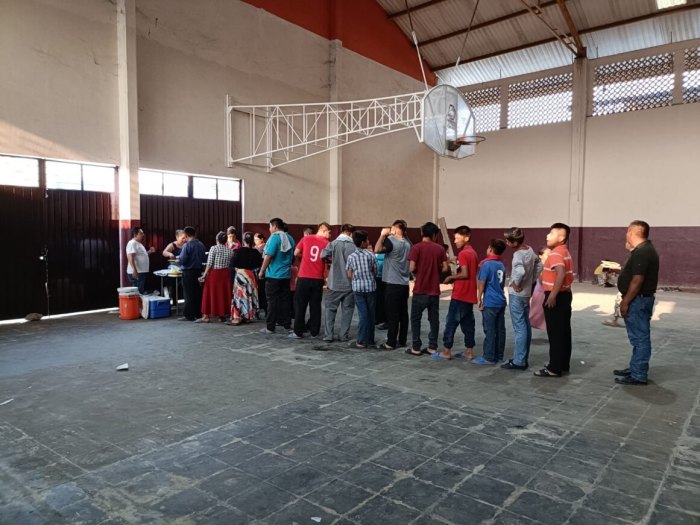
After more than six months of overcrowded living in the arena, having faced shortages of food and water and pressure from municipal and state government personnel who consistently downplayed the case, an agreement with the village authorities was signed on 19 September 2024. This should have allowed for the displaced Protestant Christians to return to their homes, but it was never fulfilled – despite the claims of the village leaders and the visits of the municipal authorities – as threats and attacks against the members of the religious minority continued within the community.
Upon the families’ return, villagers destroyed the doors of the church and several members’ houses, looting furniture and stealing the church’s electricity cables again. The families’ water tanks were pierced with machetes, their land was occupied, and a water well was appropriated. Village leaders made it clear that they had no intention of honouring the agreement because they were the ones who were in charge of the community. They told the religious minority families that if they wanted to return to their homes they had to submit to all the decisions of the community leaders and participate in all of the activities of the community, including those linked to the Roman Catholic Church.
For this reason, Rogelio and the religious minority group, faced with the pressure from the municipality to leave an arena that was never meant for habitation, and unable to return to their homes due to the dangers which facing them there, decided to move to the municipality of Chalma in Veracruz State where they decided they would start again. For the first few months, the community lived under tarps until materials for more adequate housing were provided by a donor. They named their new community ‘Peace’, a situation that has been their dream since 2015.
It has now been a year since the families were displaced, but violations of freedom of religion or belief have not ended in the municipality of Huejutla. A similar problem has arisen in Contepec, where three Protestant families have been pressured to participate in Roman Catholic activities or leave their community due to increased pressure, discrimination, threats and violence.
For this reason, one year since Rogelio and over 170 other Protestant Christians were forcibly displaced from their homes, CSW calls on Governor Julio Menchaca and the Municipal President of Huejutla José Alfredo San Román Duval, who have minimised these situations, to take action to end the suffering of an entire community of families who have committed no other crime than that of being a religious minority in their community.
By Pablo Vargas, National Director – Mexico for CSW/Impulso18 AC