On 12 May a community in rural El Salvador gathered for a peaceful protest demanding their land rights. Within hours, the government responded with riot gear and arrests, striking fear among the families present. This is how authoritarian tendencies manifest themselves, no matter the political branding.
In today’s polarised world, it is easy to label enemies by ideology. When we think of authoritarianism, our minds may leap to the right or the left. But beyond the party name or rhetoric lies something more universal: the impulse to silence those who question injustice.
In recent weeks, two cases from opposite ends of the ideological spectrum have brought this to light. In one, a pastor in a country with a right-leaning government was arrested while seeking to protect his community from an unjust eviction. In the other, two pastors living under a left-leaning government were detained for speaking of God’s justice in defence of their son at a military tribunal. Though the contexts differ, the charges were similar: ‘public disorder’ and ‘resisting arrest’ in the former, and “‘disrespect’ and ‘disobedience’ in the latter. Neither government would tolerate independent voices raising moral concerns.
Pastor José Ángel Pérez and the criminalisation of conscience
Pastor José Ángel Pérez joined a peaceful sit-in alongside families from El Salvador’s El Bosque Cooperative. They aimed to petition the government to halt an unjustified eviction order that threatened to displace the entire community of 297 families. The families had cultivated this land for over four decades — land originally granted through agrarian reform and was at risk of being auctioned off following a series of corrupt legal manoeuvres.
What followed was a brutal display of state repression. Police forces, backed by military units, violently dispersed the protest. Although the Salvadoran constitution guarantees freedom of expression, the Military Police threatened the community with fines, towed their vehicles, confiscated IDs, and detained leaders after requesting to ‘just talk.’
Pastor Ángel Pérez, a respected spiritual leader and elected president of the cooperative, was arrested without a warrant. He remains in custody today.
The impact of his detention has been profound. For over 25 years, Pastor Ángel Pérez has served as the pastor of a church affiliated with the Elim Christian Mission and as a steadfast advocate for his community, speaking out against the fraudulent land deal that threatens their displacement and challenging the unjust legal rulings that have enabled it. Now, fear hangs over El Bosque. Some residents have gone into hiding after police came looking for them, while many others are too afraid to attend church. With their most trusted leader detained, the community has been left shaken and uncertain about what comes next.

For weeks, the state barred even Pastor Ángel Pérez’s lawyers from visiting him. It was only on Friday 30 May that they were finally allowed to speak with the pastor during a court hearing in which a judge formally presented the charges against him. Despite his lawyers presenting ample legal justification for his release, the judge denied the request.
On 3 June, Pastor Ángel Pérez was transferred from a local police cell to La Esperanza Penitentiary Centre in San Salvador. La Esperanza, a maximum-security prison, is emblematic of El Salvador’s harsh approach to crime and has been widely criticised for severe overcrowding, inhumane conditions, and reports of deaths in custody.
He now finds himself hours from his family, who must deliver food and hygiene supplies in person. His transfer is not an isolated incident—it reflects a broader pattern under President Nayib Bukele’s ongoing ‘state of emergency’, declared in 2022 in response to a spike of homicides allegedly committed by gangs. This policy has led to the mass incarceration of more than 85,000 people and has drawn international criticism for arbitrary detentions, overcrowding, and reports of torture and deaths in custody.
Pastor Pérez, a community leader with no criminal record, now faces up to six months in pretrial detention while the investigation continues. His lawyers continue to appeal, requesting alternatives such as house arrest.
All this—for peacefully defending his community.
Repressive reflexes, regardless of political affiliation
El Salvador today positions itself as a bastion of law and order under a populist right-wing president. However, the repression of faith leaders is not unique to the country. While the context and ideology may differ, just days after Pastor Pérez’s arrest, a similar story unfolded in Cuba, this time under a government that has had decades-long one-party rule and presents itself as socialist and revolutionary. There too, a pastoral couple was punished not for any act of violence, but for invoking their religious beliefs in the face of state injustice.
On 19 May Cuban pastors Luis Guillermo Borjas and Roxana Rojas were detained after referencing God during a military tribunal for their son, who was being tried for attempting to evade obligatory military service despite having a medical exemption. The couple was charged with disrespect and disobeying authorities, for which prosecutors are seeking an eight-year prison sentence. Their trail has been postponed indefinitely, with no reason provided by the Cuban authorities, leaving the threat of a potential prison sentence looming over them. Their 19-year-old son was transferred to Guayao Maximum Security Prison, one of Cuba’s most restrictive prisons and where it is almost impossible for his parents to visit him, and was sentenced to four years in prison on 9 June.
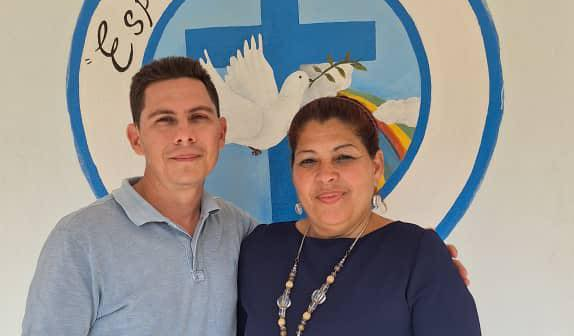
Ideologically, El Salvador and Cuba could not appear more different. Yet both exhibit the same reflexes when confronted by peaceful dissent, particularly from religious actors. The same tactics—surveillance, legal harassment, criminal charges for ‘public disorder’, and the use of police to send a message—are deployed with chilling consistency.
We must be careful not to assume that government repression takes only one political form. Whether it presents itself in the language of nationalism or socialism, any government that punishes peaceful protest and suppresses independent voices must not go unchallenged.
Freedom of religion or belief goes beyond the right to worship, it includes the freedom to live out one’s beliefs in daily life. When pastors are imprisoned for standing with their communities, all who value human rights and democracy must respond—not with political allegiance, but with compassion and unity.
By CSW’s International Advocacy Volunteer Becky Oswalt