A ‘New’ India? From a Secular to a Hindu Nation.

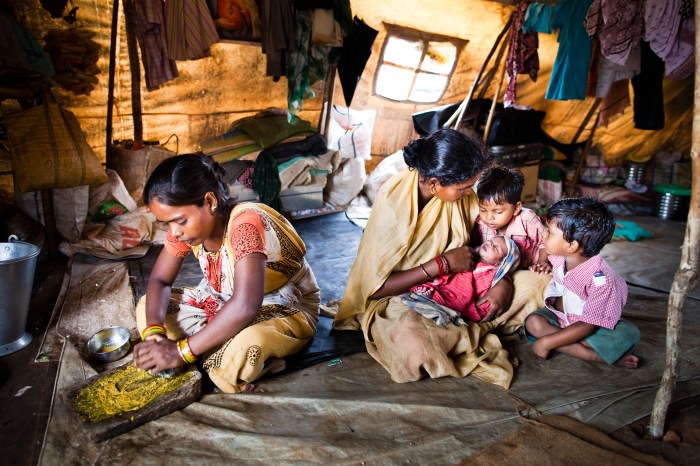
Featured Image: These women and their families are among several who share a single tent in a displacement camp housing 45 Catholic families. These families had been accommodated in five separate places since being displaced by the communal violence in August 2008. Kandhamal District, Orissa. Marcus Perkins/CSW 2009.

Rising religious intolerance is increasingly visible; be it from ghar wapis (Hindu home coming ceremonies) of religious minorities to the open incitement of hate against Muslims and Christians by senior government officials; from mob lynchings over beef consumption to attacks on places of worship; and from the distortion of historical facts in text books to the murder of renowned rationalists such as Narendra Dabholkar, Govind Pansare and M. M. Kalburgi, who questioned certain Hindu practices in their writings.

The debate about the religious intolerance sweeping India is mainstream and has drawn international news coverage as India’s distinguished scientists, rationalists, actors, academics, and historians have voiced their concerns. Some have even returned their national awards in protest, including scientists, who unlike artists are not routinely engaged in public cultural critique and protest.

A Historically Secular State

One year after the Universal Declaration on Human Rights was adopted by the United Nations General Assembly, declaring in its preamble the universality of the innate nature of human dignity, the Constitution of India was written in 1949.

The founding fathers envisioned an India where freedom of conscience would be respected by all citizens and that every Indian would live freely and without fear according to their conscience, exercising the choice to adhere to a religion or not.

The Constitution in its 42nd amendment established India as a secular state. In India, religion was intended to be kept separate from the body politic, although today the reality on the ground is starkly different as communal and religious politics are being used to polarise society.

The influence of Hindutva nationalist ideology

At the centre of this polarisation is the Hindutva ideology, which was coined by V.D Savarkar, a Hindu nationalist leader who propagated an exclusionary political ideology and promoted religious nationalism of “majoritarianism”. The aim: to make India a Hindu ‘rasthra’ (nation).

Continue reading “A ‘New’ India? From a Secular to a Hindu Nation.”
Vietnam: Social Media as a Catalyst For Change

“What do you think is religious freedom?”

That’s the question posed in a video by the Association to Protect Freedom of Religion (APFOR), a Vietnamese organisation which aims to help “everyone in Vietnam fulfil their right to freedom of religion”.

By Hội Bảo Vệ Quyền Tự Do Tôn Giáo – What do you think is religious freedom

“A fundamental human right,” says one young interviewee.

“People have the right to express their beliefs and live according to certain religious doctrines,” comments another, this time a mechanic.

“True freedom of religion means different religions can be spread,” adds a construction worker.

The video goes on to include comments from independent researchers, legal professionals and religious followers, ending with an invitation to the viewer to share her or his own thoughts on Facebook.

APFOR have since produced another video, equally well-made and insightful, this time looking at a new draft law on religion and belief which is likely to be passed in Vietnam in 2016.

By Hội Bảo Vệ Quyền Tự Do Tôn Giáo – The right to religion, have to wait for approval?

Vietnam’s controversial draft Law on Belief and Religion

This second video was posted on Facebook in November 2015, just as the draft law was being debated at the National Assembly. It’s already proving to be a controversial issue. In a welcome move towards some degree of engagement, the government solicited feedback on the fourth draft of the law from religious organisations in spring 2015. The Government Religious Committee held several meetings with registered religious groups to discuss the law, and unregistered or independent groups have also publicised their analysis of the draft law, as have Vietnamese lawyers and international civil society organisations.

Continue reading “Vietnam: Social Media as a Catalyst For Change”

Burma’s Election: Winning is Just the Beginning

For anyone who has worked on Burma for any length of time, Aung San Suu Kyi’s overwhelming election victory is a cause for hope and celebration. A quarter of a century after winning a mandate in Burma’s last freely contested elections, her party – the National League for Democracy (NLD) – has shown that no amount of repression could drive it away. The military-backed government and the current President, former general Thein Sein, appear to have finally heard the voice of the people and pledged to honour the result. It would be very easy to think that our work in Burma was done and that all is well.

The entrenched power of the military

In reality, the military remain extremely powerful and the new government will face many grave challenges. The NLD’s election victory is certainly a step forward but, as Aung San Suu Kyi has said, it is just the beginning.

Continue reading “Burma’s Election: Winning is Just the Beginning”