CSW relies extensively on the documenters, journalists, experts and activists that gather first-hand evidence of violations of the right to freedom of religion or belief (FoRB) in the countries we work on.
Last month, our Advocacy Intern Anna Shannon spoke with CSW’s India Researcher, whose name has been withheld for security reasons, to discuss what her work entails, the state of FoRB in India, and where she sees hope for the future.
As CSW’s India Researcher, what does your work entail?
My work entails documenting and reporting on violations of religious freedom across India, particularly against Muslims and Christians. So, whenever there are any attacks or any instances of discrimination against Muslims or Christians, I speak to victims, eyewitnesses, sometimes the lawyers who are working on these cases and I write the report.
What made you want to start working on FoRB, what got you interested in the work?
It’s a long story. My parents were Christian missionaries. They started out in a very remote tribal belt in North India and then of course they were transferred to many other places across India. But growing up I was very connected, very aware of the ground reality of people living in rural areas, the sufferings, the discrimination they face.
I also had family members and several family friends who faced persecution and discrimination on account of their faith. The most prominent incident was several years ago when my aunt was almost killed. She had a Hindu extremist neighbour who didn’t like the fact that they had prayer meetings in her house. One day, when she was walking outside her house, he got into his car and deliberately ran her over. She fell and when she tried to get back on her feet, he backed the car up and ran her over again. She had severe injuries, but her life was miraculously saved.
However, what I observed in urban areas surprised me. I noticed how disconnected people were from the rest of the country, how unaware they were of the sufferings of other people, and I just felt that somebody needs to create that awareness. We need to make people aware of the sufferings of others, especially those who have influence or hold positions of power. So, that is really why I took to writing and journalism, so that I can create that awareness, and help others see what they can do to help.
What do you feel like are the most pressing FoRB issues today?
One of the biggest challenges we’re having is the anti-conversion laws that are currently in 11 states. These laws officially claim to protect freedom of religion but in reality they’re punishing people who want to practice a religion of their choice. So, for example, Christians who are propagating their religion or just gathering to worship are being charged under these laws and sentenced to imprisonment. Sometimes they are eventually bailed out but the whole trial process itself becomes the punishment for them because it can take years. So even if they eventually are acquitted, they have already lost so much.
That is one of the most pressing concerns, apart from that, there’s a lot of hate speech that is being spread by political leaders themselves. And so, another concern I see is just this environment of hate against religious minorities that is spreading like wildfire across the country. That stems from the dissemination of false narratives that Christians and Muslims are out to destroy Hinduism or to lessen their population and so even secular Hindus are starting to believe that false narrative, and they’re starting to have hatred against religious minorities. So that is a huge concern.
The radicalisation of youth is another huge concern, and something that not a lot of people are talking about. In many communal clashes between Hindus and Muslims, it is mostly the youth that are involved. Most extremist Hindu nationalist groups have student wings that act as the hands and feet of the organisations. The Rashtriya Swayamsevak Sangh (RSS), the ideological arm of the ruling Bharatiya Janata Party (BJP), even has training camps for children.
It starts out as very unassuming, but they gradually introduce literature that naturally develops anti-Muslim/Christian sentiments or hatred towards beef eaters, such as asking children to take pledges to protect cows which indirectly means go against those who eat cows. It’s a very well thought-out strategy.
[Another issue is] censorship. Journalists like me who are trying to report on these issues, I have worked in mainstream media and I can tell you that the agenda of many of these media organisations is [that of] the political parties that own these newspapers. They’re always going to write in support of them. In India almost all the media organisations are owned by political parties, so there’s very little chance of the truth coming out. There are independent media houses that stick to journalistic ethics and want to report the truth but then again, the problem is that they don’t have funding because even the businesses are affiliated to political parties, so there’s almost no scope for them to get funding. And they eventually die out or they succumb to the pressure and compromise their values.
The last thing is the security of human rights defenders, journalists, advocates, activists, social workers, they’re always under the radar of the government, they’re being scrutinised. Several journalists , activists and politicians have had their phones hacked. There’s always this fear that we’re being watched. So, we need systems that will protect us so that we can continue to report the truth.
Are there any particular states in India where violations of FoRB are more prevalent?
Yes, Uttar Pradesh is one of the states that has the highest number of crimes against religious minorities, but particularly Muslims. Again it’s because it’s one of the largest states and it has a huge Muslim population, as well as a huge Hindu population and the state government is ruled by the BJP which is also the central government and the chief minister of that state is very vocal about wanting to form a Hindu nation in all of his talks and in all of his decisions, actions. It’s always very evident that he wants this country to be a Hindu nation. Although there may not be enough evidence that these crimes are committed directly by the government, the fact that the perpetrators enjoy complete impunity [and face] absolutely no action by the government shows that they are backing it up or they are encouraging it.
Chhattisgarh, which forms part of the tribal belt in India, is a state that is run by the BJP. The attacks there are mainly carried out members of tribal communities themselves against their own villagers who have converted to Christianity. These Christian converts are persecuted by their fellow villagers who don’t want anyone to go outside their religion and they’re afraid of losing their religious identity if more and more people convert. Even when there was a Congress government there, they didn’t do anything, they just ignored it. Many pleas made by the Christian leaders to protect their community fell on deaf ears. The government may not have necessarily encouraged those crimes, but they ignored it because they were afraid of the backlash from the villagers and to appease the majority for votes.
There is also the issue of Naxalites. There have been incidents where police officials don’t take any action against those who attack Christians because many of these areas are Naxalite-controlled areas. [Editor’s Note: Naxalites are left-wing extremists. They have been declared as terrorist groups in India and have been in an ongoing conflict with the Indian government since the 60s]. I reported on a case where about 40 families were beaten up and had to flee for their lives but when they called the police not even one police official came to rescue them because they scared of the Naxalites.
Do you think this opposition to conversion among tribal communities could be influenced by outside forces, such as religious right-wing groups?
Yes, without a doubt. Right wing groups like VHP have foot soldiers in remote tribal areas. They recruit them and mobilise mobs through media like WhatsApp. They convince members of tribal communities that any conversion to Christianity or Islam, which they consider foreign religions, would mean moving away from their indigenous culture and heritage. When the villagers are convinced of this, it is easy for them to justify violence and discrimination. We’ve seen instances of how when a Christian tribal convert plans to bury their dead, the information is immediately spread through these informants and mobs arrive at the scene, threaten to stop the burial unless the Christian reconvert to their own religion. They have structured WhatsApp groups for each village and use them to incite violence and coordinate attacks.
What has been the most impactful story that has inspired you, not necessarily one that you’ve written about yourself, but a story that you’ve heard that’s been impactful in terms of FoRB in India?
In 1999 there was a very famous case of persecution that caught attention globally. There was this Australian missionary couple Graham Staines and Gladys Staines who came to India several years before that and started working among the leper community in a state called Odisha, they were just doing great work trying to rehabilitate these lepers, treat them and just spread the Gospel to them and again it was a tribal area and like I mentioned in the earlier question the other religious [communities] didn’t like that. So, there was a group of Hindu fanatics who didn’t like the work they were doing and one day when Graham Staines and his two sons were travelling to another village for a camp, they slept that night in the car, and the group burnt that car and burned Graham and his two sons alive. That was such a gruesome murder of people who were trying to help their own people, people they didn’t care about, and it was just so tragic.
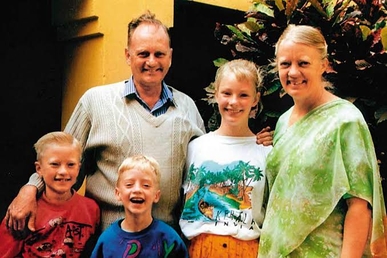
I remember I was about 9 or 10 years old when I saw that on the news the next morning. It just shook everyone so much but the very next day there was some press that interviewed the widow Gladys Staines, when they asked her about it she said she forgives the people who carried out that crime and that again shook the whole country, shook the conscience of all of us and we were like how could she choose to forgive the people who did such a brutal act to her husband and two young children. And many years later, two years ago, I actually met her and her daughter, and just to see how someone can be so loving and forgiving, she said that that only comes because you know that God loved you the same way and forgave you the same way and if not for that she could not do what she did.
I remember her saying that because of that act of forgiveness a lot of people in that village, they chose to change their ways and that story just has stuck with me because a lot of times in the FoRB space we think about fighting for justice. It is important but we also need to think about forgiveness and engaging with the enemies themselves because eventually if you want peace, you should also think about reforming the people who commit those crimes.
What should the international community be doing in your opinion?
One is obviously as everyone says, put pressure on the Indian government to abide by their own constitution and to protect the rights of their citizens to profess and propagate their religion of their choice. But sometimes this pressure by the international governments may not always work because especially in India, if you see our government knows that everybody needs them because we are one of the largest trading partners for many countries and all our neighbouring countries are against the West. We have communist countries, authoritarian regimes like China, Afghanistan and Myanmar. So, our government knows that everyone needs them and other governments like the US also know that it’s a very diplomatically complicated relationship.
I don’t know how much that can impact the situation in India but apart from governments what the international community at large can do is, one big challenge we have is funding. If you look at all the arrests of the Christian missionaries, these happen in remote rural areas and often they don’t have the resources to hire a lawyer. Forget hiring a lawyer, they don’t even have the resources to survive on a daily basis so hiring a lawyer is almost impractical so things like that.
For the activists, people working on the ground, they need resources, they need funds and like I mentioned the economy in our country is really bad and it’s very difficult to get funds even for me. If I have to I’ll cover a story in Manipur or something, I really want to but I need the funds to travel there. That’s something the international community can help with. Second is training, we can definitely use the international community’s help to empower the people in our country to use their skills to help religious communities.
Where do you see hope in the situation, and maybe how do you bring that into the FoRB space, what do you hope for in the next few years in India to happen?
Honestly, the situation doesn’t look too hopeful. It’s really getting worse year after year, it doesn’t look too hopeful at all. Hope is resistance, if you choose to stop hoping and you give up that means you’re letting the bad guys win, so you’ve got to hope against all hope and keep doing what you need to. My hope is definitely in the next generation, not even the youth because I feel like they’ve already had their attitudes and mindsets set but I really want to focus on children because I really think that there is hope there.
One thought on “‘Hope is resistance’: An interview with CSW’s India Researcher”
Comments are closed.