It is no secret that for 67 years the Cuban people have been oppressed under a deceptive discourse of victory and prosperity, which with each decade has only drifted further from the dream, revealing the true nightmare of the failure and misery of their so-called revolution.
While many in earlier generations accepted the illusory utopia to survive, today’s generation has awakened to the advance of technology, connectivity and the cyber world in a way that not even a dictatorship can contain. And, although failure has been tolerated and its reality evaded for almost seven decades, in just eight years young Cubans have become the protagonists of a new revolution on the island; their only weapons the truth and a mobile phone.
This snowball effect became internationally visible with the San Isidro Movement (MSI), which emerged in September 2018 in response to Decree 349, a law requiring artists to obtain prior permission for public and private exhibitions and performances, meant to control artistic expression. Many of the most prominent critics of that law – such as performance artist Luis Manuel Otero Alcántara and rapper Maykel Castillo Pérez, better known as Maykel Osorbo – unknowingly paved the way for their future arrests.
Three years later, in 2021, a group of Cuban musicians living in exile and on the island produced, released, and won a Latin Grammy for the song “Patria y Vida” (Homeland and Life). Despite the detention and imprisonment of Maykel Osorbo on 18 May 2021, this anthem of freedom awakened a dormant volcano, which on 11 July of that same year erupted as Cubans across the country took to the streets of the country in a unanimous cry of “Freedom.” The other artists who had participated in the production of Patria y Vida who were still living on the island were also targeted by the government. Otero Alcántara was arrested and imprisoned in July 2021, and a third, rapper Eliecer Márquez Duany, aka ‘El Funky’, was forced into exile.
Although more than 2,000 people —journalists, religious leaders, opposition members, government critics, and ordinary Cubans— were detained and imprisoned, no one could silence the critical voices that exposed, both inside and outside the country, the appalling actions of the Cuban regime, as it trampled on human rights, including freedom of religion and belief.
Those voices multiplied, grew, and became more visible. Five years later, they have not been silenced. Quite the opposite; they think, they have faces, followers, likes, opinions, influence, consistency, reactions, and a message: the truth sets you free. Many were active before the July 2021 protests, but others emerged from the confines of churches, congregations, houses of worship, and social work.
The regime did not see this coming, having invested 67 years in weakening the religious sector by dividing it into different categories: registered and unregistered, and in or outside the Cuban Council of Churches. This division functioned for decades, offering some privileges in exchange for the silence of some; but it failed to take into account young people and their increased access to a global and interconnected world.
Little by little, the consciences of younger Cubans, accustomed to bread and circuses, began to awaken, motivating them to listen, express their opinions, and support the idea that Cuba can change. Although vigilant, for some years the authorities downplayed the impact of these messages on social media. Criticism of their repressive system is an issue the Cuban Communist Party has skillfully navigated for over half a century. But that was about to change. Christian influencers ignored the divisions and found their pulpit and altar through the screen of a smartphone.
In September 2025, 20-year-old Christian influencer Anna Sofía Benítez Silvente, known online as Anna Bensi, who has been involved in a Pentecostal church in Havana,1 began to gain visibility on Facebook and then on Instagram. On 14 December one of her videos critiqued the ideology of the dictatorship, contrasting it with a Bible verse from Isaiah 10:1-2: ‘Woe to those who enact unjust laws and prescribe tyranny, to deprive the poor of justice and to withhold justice from the afflicted of my people.’ It quickly went viral; gaining over 94,000 views on her Facebook account and 143,000 on another.
In January 2026 Ernesto Ricardo Medina, who has attended a small house church since childhood,2 broadcast from his Instagram account @el4tico (the little room) —a project openly critical of the government since 2024— that ‘Jesus is Lord, not the Communist Party of Cuba.’ Shortly afterward, he was arrested along with a fellow content creator and accused of ‘propaganda against the institutional order’ and ‘incitement to commit crimes’. Since his arrest, he has rejected pressure from State Security to record a video expressing repentance for his actions. A source close to him told CSW they doubted Medina would comply, because his intention is aligned with the ‘spiritual revolution’ that Cuba needs.
Shortly after, in support of Medina’s El 4tico project, Anna Bensi posted a video showing the phrase ‘new creature… Free Cuba’ written on a chalkboard, where she stated categorically that ‘neither the [Cuban Communist] Party nor the Cuban government represents me; I am represented by the people who are dying in the garbage waiting for change; I am represented by Christ, who never remained passive in the face of injustice and oppression…’
On 13 March, 38-year-old Christian influencer David Espinosa, a multimedia audiovisual producer for his church and youth leader at Calvary Baptist Church, of the Western Cuban Baptist Convention (WCBC), was summoned for the fifth time to a National Revolutionary Police (PNR) station. There, he was told that his actions constituted a crime, as he was allegedly helping other influencers produce counterrevolutionary material. He was warned that he could be prosecuted as the leader and head of this entire struggle against the state. PNR officers threatened to confiscate all his equipment, to apply Decree Law 370 against him,3 and fined him 3,000 Cuban pesos (CUP).4 In response and believing he is doing nothing wrong, Espinosa told them that he loves his country, loves God above all else, and that what he does is based on his principles.
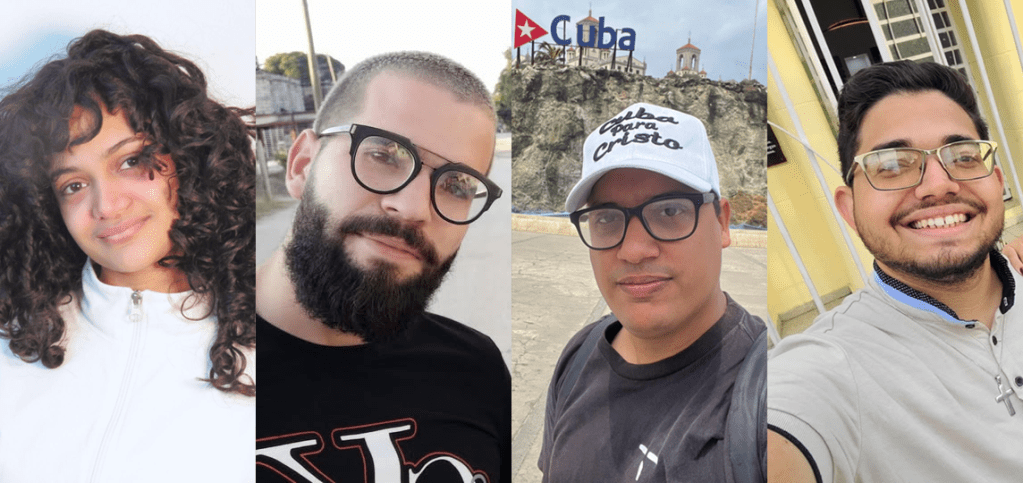
It is important to point out that up until these content creators publicly identified with Christianity and its influence in bringing freedom to the country, their posts on social media were tolerated. In a recent interview with CSW, 23-year-old Iván Daniel Calás Navarro, who at age 15 created the Christian YouTube channel ‘Voz de Verdad’ (Voice of Truth) and is a member and leader at the WCBC Nazareth Baptist Church in Havana, said: ‘What motivates us to create this Christian content is precisely our faith; what we believe, what is in the Bible, what our parents, pastors, and churches have taught us about freedom of conscience, religious freedom, and freedom of expression. Because God has given us a mind and a mouth so that we can express ourselves, so that we can think, and precisely because we are Christians, we are against injustice, and the Church cannot remain silent.’
The results? Medina is imprisoned; Calás Navarro is in exile in Spain; Anna Bensi and her mother, Caridad Silvente, are under house arrest and without internet access; Espinosa is under surveillance and threatened with reprisals against his children and wife. The attacks on these Christian content creators – the arrests, threats, summonses, internet cutoffs and house arrests – are acts of repression in retaliation not only for raising their voices for freedom for Cuba, but also for pointing to Christianity as the solution.
All of this is happening in full view of the international community. The effects of the harassment of these influencers have generated dozens of publications around the world and have heightened interest on social media for a definitive end to the decades long dictatorship.
In 2025, CSW documented 505 verified cases of violations of freedom of religion or belief (FoRB) in Cuba, and 120 so far this year. It is in this volatile context that many young Cuban Christians have risen up, takingtheir faith as their banner and their mobilie phones as their only weapon against the system. And, while the world is focused on the reported talks between the Trump administration and Cuban government officials and members of the Castro family, a Christian remnant continues to trust in the only real hope for genuine social change and spiritual transformation in the nation. They are not armies; they are not legions. They are a generation determined to change their history – and their future.
By CSW’s Cuba Project Coordinator
- Taken from the article ‘Jóvenes evangélicos, las voces más visibles en Cuba contra la tiranía socialista’” by Yoel Suárez, journalist, author and contributor for CSW. ↩︎
- Ibid. ↩︎
- Decree Law 370, approved in 2019, establishes provisions for the development and control of the computerisation process in Cuba. Although it presents measures to promote the use of information technologies in economic and social sectors, Article 68 Section i penalises the dissemination of information ‘contrary to social interest, morality, good customs, and the integrity of individuals’ through social networks or other digital platforms. This has been used as a legal basis to fine, intimidate, and silence independent journalists, activists and citizens who express critical opinions online. ↩︎
- According to Cuba’s National Office of Statistics and Information, the average monthly salary in Cuba was 6,989 CUP in 2025. Religious leaders do not receive a state wage and therefore are likely to earn less. ↩︎