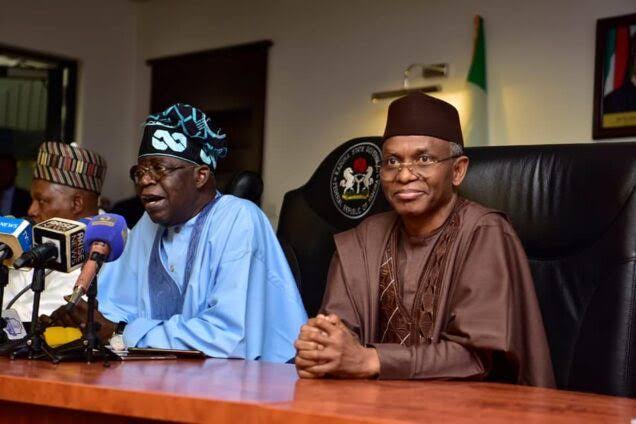
Former governor of Kaduna State Nasir El-Rufai with current Nigerian president Bola Ahmed Adekunle Tinubu.

We must not let Nigeria slide any further into failed statehood

‘Of course, we do consider religion, but I would not tell them that…’. It seems that Nasir El-Rufai, governor of Nigeria’s Kaduna State from May 2015 until May 2023, is no longer hiding his biases.

Addressing a group of Muslim clerics on his penultimate day in office after his party, the All Progressives Congress (APC), was declared the winner of the Kaduna State gubernatorial election, El-Rufai spoke extensively about how the APC had capitalised on religion, including by running on a Muslim-Muslim ticket, to secure electoral victory.

‘What we are able to achieve in Kaduna, we’ve now achieved on the national level,’ he added – a reference to the controversial and disputed victory of the APC in the presidential elections in February this year, also via a Muslim-Muslim ticket.
Continue reading “We must not let Nigeria slide any further into failed statehood”
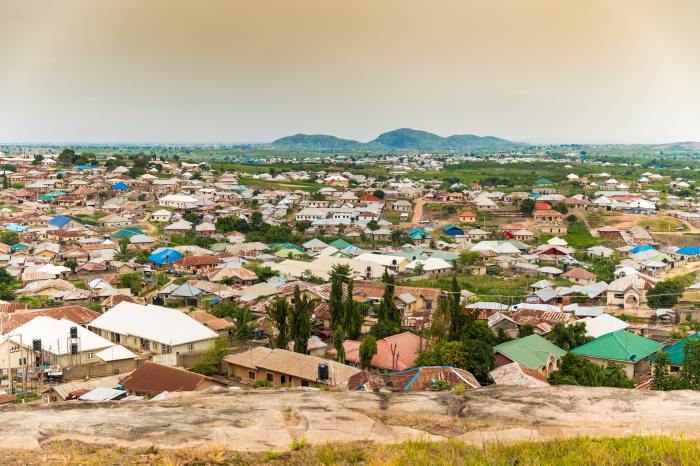
Assorted houses in Abuja, Nigeria.

“We do not sleep with our eyes closed” – how long will the international community fail the people of southern Kaduna?

“We do not sleep with our eyes closed; we take a nap, then wake up and keep watch… we are just depending on the grace of God.”

These are the words of a villager from the Maro Ward of Kajuru Local Government Area (LGA) in the southern part of Nigeria’s Kaduna state. In the absence of effective security or government assistance, this is what targeted communities across the state have been forced into: spending their days and nights on alert patrolling, living in fear of terrorists who destroy their crops, take their lives, and abduct hundreds, if not thousands, for ransom.

Kaduna has been an epicentre of violence and banditry for several years now, with attacks on non-Muslim farming communities in the south increasing exponentially with the advent of the current administration amid a general deterioration in security.

Continue reading “We do not sleep with our eyes closed” – how long will the international community fail the people of southern Kaduna?

A helicopter’s alleged involvement in Kaduna terrorist attacks could mean one of two things

5 June brought with it familiar agony for four villages in southern Kaduna state, Nigeria. According to local reports, attackers of Fulani ethnicity are said to have descended on the villages of Dogon Noma, Maikori, Ungwan Gamu and Ungwan Sarki at around noon, with violence continuing for approximately six hours.

In consistency with previous reports of militia attacks in the region, the assailants were reportedly grouped three to a motorcycle, with one man to drive, and two others to shoot to the right and left respectively.

At least 32 people were killed across the four villages, while an unknown number remain missing following the latest attack to specifically target the Adara people, who have suffered violence at the hands of Fulani assailants for several years now.

Continue reading “A helicopter’s alleged involvement in Kaduna terrorist attacks could mean one of two things”

The US no longer considers Nigeria a ‘Country of Particular Concern’, but what has changed?

In December 2020, the United States’ (US) State Department designated Nigeria a Country of Particular Concern (CPC), finding that the government was responsible for engaging in or tolerating “systematic, ongoing, egregious violations of religious freedom.”

The rather belated decision marked the first time Nigeria had been placed on the State Department’s list, despite having been recommended for designation since 2009, and was also the first time a nominally secular democracy had been designated a CPC.

It reflected the severity of an ongoing crisis in the country,  which includes longstanding systemic and systematic violations of the rights of religious minorities in the north and central regions, and violence in which thousands of vulnerable citizens – many of them Christians – have been killed, while hundreds of thousands more have been forcibly displaced by armed non-state actors, including assailants of Fulani origin, and members of the Boko Haram, Islamic State West Africa Province (ISWAP) and Ansaru terrorist organisations.

Continue reading “The US no longer considers Nigeria a ‘Country of Particular Concern’, but what has changed?”

On freedom of religion or belief, the UK government needs to turn its rhetoric to reality

“The fact is that we simply can’t afford to be religiously illiterate in today’s world. To be religiously illiterate in today’s world is simply to fail to understand how and why others act as they do.” – These are the words of Bishop Philip Mounstephen, the Bishop of Truro, speaking at the deferred 175th anniversary celebration of The National Club earlier this month.

Bishop Mounstephen has been a friend of mine, and of CSW, for a number of years now, so it will come as little surprise that we fully support his assertion. As the bishop outlined so eloquently in his speech, freedom of religion or belief (FoRB), cannot be seen as a “side-bar” or “special interest” issue. In fact, it is a fundamental human right, the abuse of which so often leads to wider human rights violations as it intersects with issues such as poverty, race and gender.

Fortunately, the UK government appears to agree. Last year, upon the appointment of Fiona Bruce MP as the Prime Minister’s Special Envoy for FoRB, Boris Johnson said: “The UK is absolutely committed to protecting the inalienable right to freedom of religion and belief, at home and around the world.”

Continue reading “On freedom of religion or belief, the UK government needs to turn its rhetoric to reality”