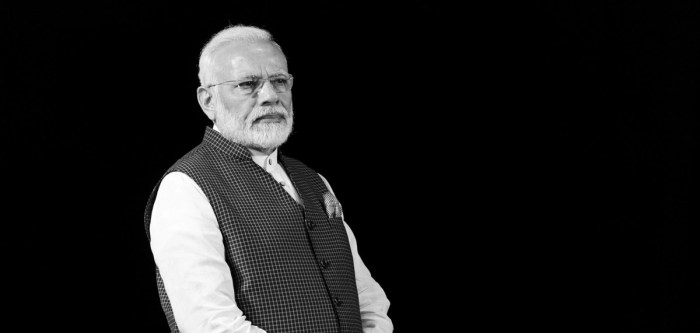
‘Emperor of Hindu hearts’: Narendra Modi rebranded

Millions of Hindus in India and across the world watched with pride as India’s Prime Minister Narendra Modi inaugurated the grand Ram Mandir (Ram temple) in Ayodhya, Uttar Pradesh on 22 January.

It was a historic moment that many devotees had been waiting to witness for decades. This is the site that is believed to be the birthplace of one of the most revered Hindu deities, Ram, and the inauguration of the temple or the Pran Pratishta ceremony (the act of consecrating the idol in the temple and bringing it to life) held deep religious significance.

More than 7,000 people were invited as guests, including top Bollywood celebrities, cricketers, large business owners and about 4,000 Hindu priests. There were seas of saffron not just in Ayodhya but across the country where people gathered in smaller local temples to celebrate the occasion.

Continue reading “‘Emperor of Hindu hearts’: Narendra Modi rebranded”
A sign prohibiting the entry of Protestants into the community of Cuamontax in Huazalingo Municipality of Hidalgo State, Mexico.

Chhattisgarh: A state where religious minorities live in fear

Five months after the mob violence that forced hundreds of Christians from Chhattisgarh’s tribal belt to flee their homes, victims say they are back home and safe for now, but they continue to live in fear.

On 18 December 2022, more than 20 incidents of anti-Christian violence were reported in various villages of Chhattisgarh’s Kondgaon and Narayanpur districts. Locals claimed that they were pressured to leave their religion and if they refused, they were beaten up badly, their homes were vandalised and their crops were destroyed.

According to reports that emerged later, close to a thousand Christians were forced to flee their homes and seek shelter in neighbouring districts. Some had to walk hundreds of kilometres to seek shelter in an indoor stadium.

Continue reading “Chhattisgarh: A state where religious minorities live in fear”
A restricted area in Chhattisgarh, India.

Chhattisgarh’s tribal Christian communities continue to live in fear

For tribal Christian communities in India’s Chhattisgarh State, the new year hasn’t really come with hopes of a better or safer future.

On 2 January a Hindu nationalist mob barged into the Vishwa Dipti Christian School campus in Narayanpur district and vandalised a church located within the premises of the school. Videos of the mob repeatedly hitting statues of Jesus and Mary, and scattering furniture surfaced on the internet. Both members of the mob and the churchgoers belonged to local tribes in Narayanpur, the two most prominent of which are the Gond and Muria tribes.

But what grabbed national headlines and went viral on social media was the image of a bleeding senior police official who was attacked by the mob when he tried to intervene. Narayanpur’s Superintendent of Police Sadanand Kumar was soon rushed to the hospital after suffering a serious head injury. Christians in Chhattisgarh have suffered attacks like these for several months with hardly any interest from the media, but it was only when a person of power was injured that anyone paid any attention.

Continue reading “Chhattisgarh’s tribal Christian communities continue to live in fear”
Police contain protesters following an outbreak of communal violence between Hindus and Muslims in Leicester, UK.

“Jai Shri Ram” on the streets of Leicester as India’s Hindu nationalism stretches beyond its borders

“Jai Shri Ram”, translating from Hindi as “hail Lord Ram” or “victory to Lord Ram”, is meant to be a harmless informal greeting, a proclamation of one’s faith and an expression of praise for a well-known Hindu deity.

Sadly, the expression has taken on far more sinister connotations in recent years. For far-right Hindu nationalists in India, who have been significantly emboldened over the past eight years under Prime Minister Narendra Modi and his ruling Bharatiya Janata Party (BJP), the slogan has been appropriated as a rallying cry for violent extremists.

CSW receives regular reports of communal violence in which the perpetrators have either chanted those three words while carrying out their attacks, or in some cases pressured their victims to declare them, forcing them to contradict their own religion or belief.

Continue reading “Jai Shri Ram” on the streets of Leicester as India’s Hindu nationalism stretches beyond its borders

India at 75: A nation under siege

India celebrates its 75th year of independence from the British on 15 August. Every year this day is commemorated by remembering the innumerable sacrifices Indians made in their pursuit of freedom and self-rule. But year after year the question of whether this is the vision of India that the nation’s forefathers and freedom fighters gave their lives for becomes ever more pressing.

Even as there was much to celebrate on 15 August 1947, independence came with a heavy price. Just a day before, on 14 August, India was torn into two; the painful partition of India and Pakistan along the lines of religion has continued to have profound effects on the lives of people on both sides.

If anything, 75 years later, these communal divides seem to be growing bigger. There has been much debate on the partition in the intervening decades – who is to blame, what went wrong and what could have been done. But just as the debates continue, the hatred continues to grow.

Continue reading India at 75: A nation under siege