Control of Khartoum may have changed hands, but Sudan’s nightmare is far from over

In late March the Sudan Armed Forces (SAF) claimed a significant victory. After months of fighting, the army declared that it had seized full control of the Sudanese capital Khartoum from the Rapid Support Forces (RSF) militia.

Visiting the presidential palace for the first time since conflict broke out between the two forces almost two years ago, the leader of the SAF Abdel Fattah al-Burhan said, ‘Khartoum is free, it’s done.’

Some residents of the city may have even breathed a small sigh of relief. While both the RSF and SAF stand accused of the gravest of international crimes, it is generally accepted that conditions are marginally better in areas under SAF rule, perhaps because it is the party to the conflict that currently occupies Sudan’s seat in international arenas.

But the country’s nightmare is far from over.

Continue reading “Control of Khartoum may have changed hands, but Sudan’s nightmare is far from over”
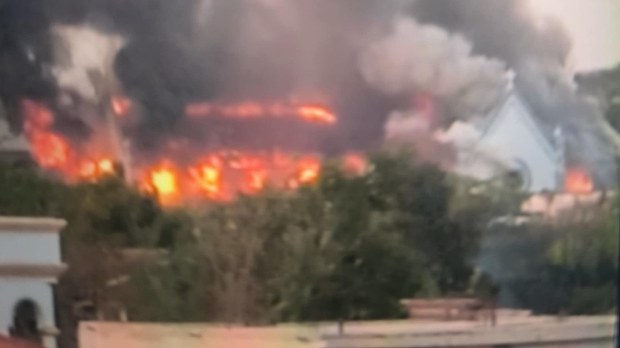
MYA Video footage shows St Patrick's Cathedral on fire on 16 March. CREDIT RVA Kachin Facebook

An attack on St. Patrick’s Cathedral the day before St. Patrick’s Day is yet another indicator of the remorselessness of the Myanmar military

17 March is a significant date for the community of St. Patrick’s Cathedral in the Banmaw diocese of Myanmar/Burma’s Kachin State.  

It is, of course, the feast day of the church’s patron saint – a day of prayer and celebration in honour of one of the most revered figures in Catholic Church history.  

This year, however, the community was unable to mark the occasion as they normally would have done, as on the evening of 16 March the cathedral was set on fire by soldiers from the State Administration Council (SAC), which falls under the authority of Myanmar’s ruling military junta. 

Continue reading “An attack on St. Patrick’s Cathedral the day before St. Patrick’s Day is yet another indicator of the remorselessness of the Myanmar military”

The case for EU sanctions on Sudan’s military leaders

With over 14 million people displaced, the world’s largest humanitarian crisis is currently taking place in Sudan. Abdel Fattah al-Burhan (“Burhan”), leader of the Sudan Armed Forces (SAF, i.e. the national army); and Mohamed Hamdan Dagalo (“Hemedti”), leader of the Rapid Support Forces (RSF) militia, have vested interests in the continuation of conflict, and were this larger one to settle, there would likely be other domestic conflicts with armed groups in Darfur, South Kordofan and Blue Nile which have not taken a side in this war. Additionally, the current conflict has seen the formation of a coalition of militias that have joined with either the SAF or RSF.  

The international community must therefore seek concertedly to secure a lasting ceasefire, and to bring an end to this war in such a way that neither Burhan nor Hemedti is in a position to play a role in the country’s future governance. There have been moments in recent history when the international community has fallen for compromises that appeared to offer  stability in the short-term, for example the civilian-led transitional government that gave both Burhan and Hemedti prominent positions in a power sharing Sovereign Council following the ouster of President Omar al-Bashir in 2019, only for their October 2021 coup to remove civilian leaders and effectively install a military-controlled government, which has been in place since then. The only path toward a viable and stable future for Sudan is through an unencumbered civilian leadership. 

Continue reading “The case for EU sanctions on Sudan’s military leaders”

A year of conflict in Sudan – the international community must act now

This week marks one year since war broke out between the Sudanese Armed Forces (SAF) and the Rapid Support Forces (RSF), in the culmination of tensions and contradictions that have existed between the two groups since they seized power from the transitional government in October 2021.

What has been unusual about this war is that it started in the capital, Khartoum, and spread throughout the country. Since Sudan gained independence in 1956, conflicts and even revolutions have originated outside of the capital, which has often led to the insulation of communities in the centre, and arguably the north, of Sudan from the worst ramifications of the instability. Today however, few places in the country have been spared the large-scale hostilities between the two groups, and its impact on civilians has been catastrophic.

As the conflict enters its second year, it has claimed the lives of at least 13,000 people, and more than 33,000 have been injured. With the war intensifying in populated cities, the number of internally displaced persons (IDPs) has risen to more than nine million, and the number of those facing hunger is now estimated to be as high as 20 million. In addition, there are over two million refugees, half of them Darfuri, also facing hunger. Tragically, for the second time in 20 years, there are also credible reports of atrocity crimes, with the Prosecutor of the International Criminal Court (ICC) noting that the situation now in Darfur is worse than when the Security Council referred Sudan to the court.

Continue reading “A year of conflict in Sudan – the international community must act now”
The Episcopal/Evangelical Church in Omdurman, which was shelled on 1 November 2023.

No se debe permitir que Sudán quede fuera de la agenda internacional

“La tierra es valiosa y será más fácil apoderarse de ella si los edificios han sido destruidos por la guerra”.

Esta fue la reacción de una fuente de CSW ante el bombardeo de iglesias y propiedades en Omdurman y Jartum El-Shajara en Sudán a principios de mes.

El 1 de noviembre, las Fuerzas Armadas Sudanesas bombardearon y destruyeron por completo una iglesia utilizada por las denominaciones episcopal y evangélica en Omdurman. Era la iglesia más grande y la segunda más antigua de la zona, y su destrucción se produjo apenas tres semanas después de que también fueran bombardeadas la Escuela Comercial Evangélica y la Escuela Secundaria Evangélica.

Continue reading “No se debe permitir que Sudán quede fuera de la agenda internacional”