Crucial Response: The Significance of Information Inflow into North Korea

By Ju Il-Lyong (North Korean Defector & Chair of Tong-il Majoong (TIMJ), a non-profit organisation dedicated to North Korean human rights and evangelisation).

Have you ever considered how a fragile chick comes into the world? When a fertilised egg is kept at the right temperature, it begins to develop quietly under the hen’s warmth. After about three weeks, the moment of hatching arrives. From inside the shell, the tiny creature starts to gently tap with its beak. But for the chick to break free and be born into life, something more is needed: the mother hen must hear that subtle sound and respond from the outside, pecking the shell in unison. Only through this simultaneous action—inside and out—can life emerge.

In many ways, this mirrors the journey of the North Korean people in their pursuit of freedom—freedom that is their inherent right. For nearly 80 years, they have lived under the iron grip of the Kim dynasty, isolated from the world by a regime-built shell of fear, deception and control. To the outside world, their voices have been muted, heard only faintly through the distorted lens of state propaganda.

And yet, while the world has not always seen it, something remarkable has been happening within. The North Korean people, through their own quiet resilience, have created spaces of resistance—building grassroots markets within a planned economy, shifting the economic balance from state to citizen. In some instances, the state has even been forced to apologise for failing these very people.

Continue reading “Crucial Response: The Significance of Information Inflow into North Korea”
Why don’t they just come here legally?

They are called illegals, migrants, aliens, refugees, immigrants, asylum seekers, invaders, displaced – each word carrying with it a subtext of who they are, what they want, and where they fit. They have been accused of bringing disease, ‘poisoning the blood’ of a nation, participating in a massive invasion that aims to bring about violent anarchy, and even eating people’s beloved pets. In this discourse each of ‘them’ rarely has a face, a name, and much less their own story (unless they do something terrible that pushes their name and face into the headlines).

The question ‘Why don’t they just come here legally?’ is asked over and over. Again, there is a subtext to that question – an implication that if ‘they’ were good people, they would seek out and follow the rules. The question also assumes that there are legal, and presumably safe, channels for those in genuine distress to request and receive asylum in a safe country, as allowed for under international law, primarily under the UN Refugee Convention. However, the reality is that even those countries that recognise and uphold the Refugee Convention, (and there are many which do not), maintain byzantine systems, set up to make it as difficult as possible for someone, especially an asylum seeker, to petition for and be granted the right to start a new life in a safe country.

The vast majority of those ‘safe’ countries require visas for individuals traveling there from much of the world. The quickest way to ensure that a visa is denied, is to respond truthfully – that the motive for travelling is to request asylum upon arrival – and when a visa is denied on those grounds, the individual is almost always put on a blacklist for future requests.

Continue reading “Why don’t they just come here legally?”

North Korea: We cannot look away

‘Our vision remains one of a North Korea in which everyone is free to exercise their rights and freedoms, including the right to freedom of religion or belief, and today we reaffirm our commitment to ensuring that this vision becomes a reality.’

– CSW’s CEO Scot Bower

A CSW delegation recently travelled to Seoul, South Korea to launch a report summarising the condition of freedom of religion or belief (FoRB) in North Korea over the past ten years. The report – titled North Korea: We Cannot Look Away was commissioned to commemorate the 10th anniversary of the United Nations High Commission on Human Rights Commission of Inquiry (COI) into crimes against humanity in the country.

In 2014, when the initial report of the COI was published it concluded that the situation in North Korea was one ‘without parallel’ in the world.  The COI found evidence of ‘unspeakable atrocities’ against the North Korean people. They found evidence of ‘widespread, systematic and gross’ violations of human rights occurring across the country. And they found these state actions qualified as crimes against humanity – among them execution, enslavement, starvation, rape, re-education, forced labour and forced abortion.

Continue reading “North Korea: We cannot look away”
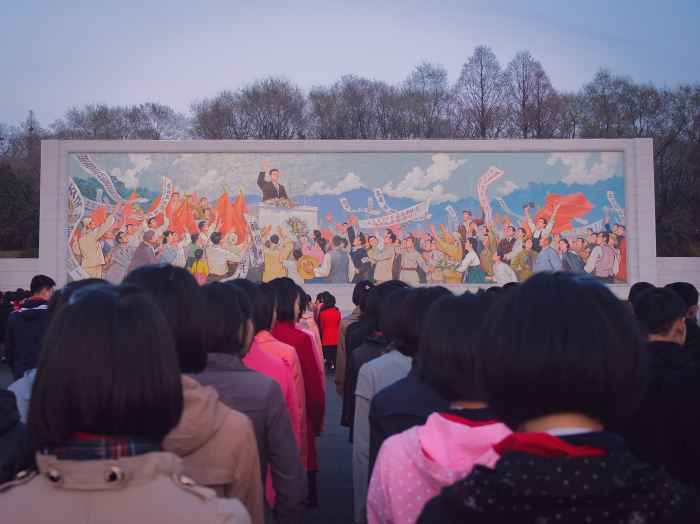
Women in front of a mural in North Korea.

Sisters separated for decades – the story of Kyu Li and Cheol-Ok

‘Every day I just miss her, I will find her. One day I will find her. If she’s alive.’

Kyu Li Kim hasn’t seen her younger sister Cheol-Ok since 1997. Like so many others who have fled rampant poverty, starvation and human rights violations in North Korea, her family has been separated for decades, often with little or no idea as to their whereabouts or wellbeing.

Kyu Li was just 20 years old when she left North Korea. She fled to China where she was sold to a Chinese Korean man for 3,000 Yuan. She told CSW that she was lucky that the family she was sold to were kind to her and had some money, and that they lived further from the border which meant she was less likely to be caught and returned to North Korea.

Continue reading “Sisters separated for decades – the story of Kyu Li and Cheol-Ok”
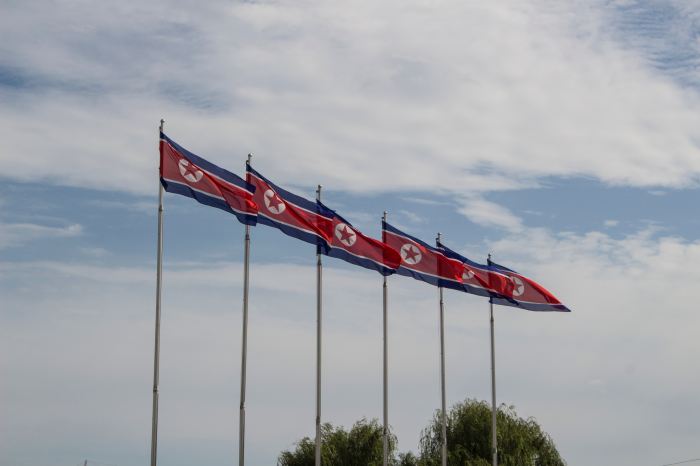
North Korea flags.

With echoes of ‘the most difficult time in North Korean history’, the international community must do more to bring about change

Earlier this month, the BBC released information gathered from exclusive interviews with three individuals living inside North Korea. Their reports have brought the country back into the headlines, revealing the devastating reality of the situation for North Korean citizens since the COVID-19-triggered border closure in January 2020. They describe widespread starvation and brutal repression, without feasible means of escape.

Hanna Song from the North Korean Database Centre for Human Rights (NKDB) said in an interview with the BBC ‘This [report] takes us back to the most difficult time in North Korean history.’

Song is referring here to the widespread famine of the 1990s known as the arduous march.

The Democratic People’s Republic of Korea (DPRK) was founded in 1948 under the leadership of Kim Il-Sung. The communist nation’s economy was built on a system of state control: a public distribution system for food and material goods, and a state-assigned job system dictating citizen employment.

Continue reading “With echoes of ‘the most difficult time in North Korean history’, the international community must do more to bring about change”