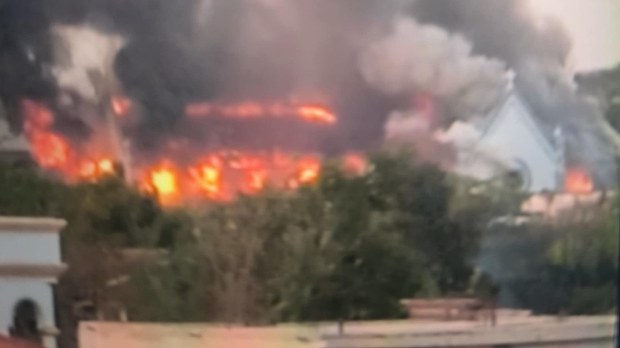
MYA Video footage shows St Patrick's Cathedral on fire on 16 March. CREDIT RVA Kachin Facebook

An attack on St. Patrick’s Cathedral the day before St. Patrick’s Day is yet another indicator of the remorselessness of the Myanmar military

17 March is a significant date for the community of St. Patrick’s Cathedral in the Banmaw diocese of Myanmar/Burma’s Kachin State.  

It is, of course, the feast day of the church’s patron saint – a day of prayer and celebration in honour of one of the most revered figures in Catholic Church history.  

This year, however, the community was unable to mark the occasion as they normally would have done, as on the evening of 16 March the cathedral was set on fire by soldiers from the State Administration Council (SAC), which falls under the authority of Myanmar’s ruling military junta. 

Continue reading “An attack on St. Patrick’s Cathedral the day before St. Patrick’s Day is yet another indicator of the remorselessness of the Myanmar military”

‘Hope is resistance’: An interview with CSW’s India Researcher

CSW relies extensively on the documenters, journalists, experts and activists that gather first-hand evidence of violations of the right to freedom of religion or belief (FoRB) in the countries we work on.

Last month, our Advocacy Intern Anna Shannon spoke with CSW’s India Researcher, whose name has been withheld for security reasons, to discuss what her work entails, the state of FoRB in India, and where she sees hope for the future.

As CSW’s India Researcher, what does your work entail?

My work entails documenting and reporting on violations of religious freedom across India, particularly against Muslims and Christians. So, whenever there are any attacks or any instances of discrimination against Muslims or Christians, I speak to victims, eyewitnesses, sometimes the lawyers who are working on these cases and I write the report.

Continue reading “‘Hope is resistance’: An interview with CSW’s India Researcher”
CHN Tongxin Great Mosque in Wuzhong, Ningxia Hui Autonomous Region. FREE TO USE

When the facts and the law don’t matter, a guilty verdict is only a matter of time

‘There has been a powerful hand behind the scenes interfering and manipulating the trial of my case.’

– A quote from Ma Yanhu’s appeal letter, seen by CSW

For two decades, Ma Yanhu worked as a tour organiser for hundreds of Chinese Muslims looking to make the Hajj pilgrimage to the Islamic holy city of Mecca in Saudi Arabia.

Based in the Ningxia Hui Autonomous Region in north-central China, and originally trained as an Islamic theologian, Ma’s work involved booking flights, arranging essential travel documents, and even leading private tour groups to the city until the Chinese Communist Party (CCP) prohibited it.

Continue reading “When the facts and the law don’t matter, a guilty verdict is only a matter of time”

Why don’t they just come here legally?

They are called illegals, migrants, aliens, refugees, immigrants, asylum seekers, invaders, displaced – each word carrying with it a subtext of who they are, what they want, and where they fit. They have been accused of bringing disease, ‘poisoning the blood’ of a nation, participating in a massive invasion that aims to bring about violent anarchy, and even eating people’s beloved pets. In this discourse each of ‘them’ rarely has a face, a name, and much less their own story (unless they do something terrible that pushes their name and face into the headlines).

The question ‘Why don’t they just come here legally?’ is asked over and over. Again, there is a subtext to that question – an implication that if ‘they’ were good people, they would seek out and follow the rules. The question also assumes that there are legal, and presumably safe, channels for those in genuine distress to request and receive asylum in a safe country, as allowed for under international law, primarily under the UN Refugee Convention. However, the reality is that even those countries that recognise and uphold the Refugee Convention, (and there are many which do not), maintain byzantine systems, set up to make it as difficult as possible for someone, especially an asylum seeker, to petition for and be granted the right to start a new life in a safe country.

The vast majority of those ‘safe’ countries require visas for individuals traveling there from much of the world. The quickest way to ensure that a visa is denied, is to respond truthfully – that the motive for travelling is to request asylum upon arrival – and when a visa is denied on those grounds, the individual is almost always put on a blacklist for future requests.

Continue reading “Why don’t they just come here legally?”

Citizenship and conflict: How the militaries of Israel and Myanmar are taking advantage of displaced persons

There are currently around 30,000 asylum seekers in Israel. Most have fled severe repression, including religious persecution, under a government responsible for decades of widespread crimes against humanity in Eritrea, or come from Sudan, where a gruelling 18-month conflict between the Rapid Support Forces and Sudan Armed Forces is the latest in a series of calamities to cause a severe humanitarian crisis.

Most will have travelled through Egypt before arriving there, typically with the help of people smugglers, and at great risk of assault, extortion, gender-based violence, or arrest and possible refoulement. The majority of those who complete this journey are young men, together with some young women who have likely endured unimaginable atrocities en route.

Upon their arrival, these asylum seekers find themselves in legal limbo; according to the Hotline for Refugees and Migrants, Israel’s leading refugee advocacy organisation, Israel approves less than 1% of the asylum claims it receives, with many cases pending for over five or even ten years.

Continue reading “Citizenship and conflict: How the militaries of Israel and Myanmar are taking advantage of displaced persons”