‘Emperor of Hindu hearts’: Narendra Modi rebranded

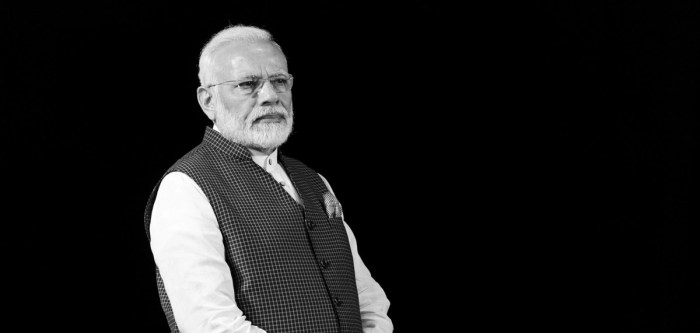
Millions of Hindus in India and across the world watched with pride as India’s Prime Minister Narendra Modi inaugurated the grand Ram Mandir (Ram temple) in Ayodhya, Uttar Pradesh on 22 January.

It was a historic moment that many devotees had been waiting to witness for decades. This is the site that is believed to be the birthplace of one of the most revered Hindu deities, Ram, and the inauguration of the temple or the Pran Pratishta ceremony (the act of consecrating the idol in the temple and bringing it to life) held deep religious significance.

More than 7,000 people were invited as guests, including top Bollywood celebrities, cricketers, large business owners and about 4,000 Hindu priests. There were seas of saffron not just in Ayodhya but across the country where people gathered in smaller local temples to celebrate the occasion.

Continue reading “‘Emperor of Hindu hearts’: Narendra Modi rebranded”
Police van and cyclist in Beijing, China

Vague definitions and arbitrary crackdowns make the struggle of China’s religious minorities that much harder

‘I have asked investigative officers, prosecutors and judges: Where can you find me a document in which a department has designated, let’s say, the Shouters as a xie jiao or a xie jiao organisation? I have asked the prosecution dozens of times in court whether there is such a thing. No one has ever said “Yes, I can find it for you” or showed me such a document.’

Chinese human rights lawyer

To be designated xie jiao is to be openly pursued and persecuted by the Chinese Communist Party (CCP). Under the rule of Xi Jinping the situation for almost every religion or belief community in China has deteriorated amid a worsening picture for human rights across the country, but for groups labelled xie jiao, this has been a reality for decades.

What is xie jiao?

Xie jiao – usually translated into English as ‘heterodox teachings’ or ‘evil cults’ – has been illegal in China since October 1997. It is criminalised under Article 300 of the Criminal Law, which prohibits ‘organizing/using xie jiao to undermine implementation of the law’ and carries a punishment of three to seven years imprisonment, ‘or more’.

Continue reading “Vague definitions and arbitrary crackdowns make the struggle of China’s religious minorities that much harder”
A Christmas service in the Sacred Heart Cathedral in Lahore, Pakistan.

Celebrating in silence: The Christians in Pakistan under pressure this Christmas

Life is not easy for Christians in Pakistan. Many are economically marginalised, struggling to find work, at the mercy of those who wish to make life difficult for them. And they tend to experience an increase in adversity during periods of celebration.

This includes Christmas.

In some parts of Pakistan, Christians will be asked by their neighbours not to light their homes with decorations. Others who decide to invest in a tree may be asked to take them down by those who don’t want such symbols of Christianity in their community. Sometimes, neighbours will even forcibly remove decorations from the outside of Christian houses themselves.

Continue reading “Celebrating in silence: The Christians in Pakistan under pressure this Christmas”
Women in front of a mural in North Korea.

Sisters separated for decades – the story of Kyu Li and Cheol-Ok

‘Every day I just miss her, I will find her. One day I will find her. If she’s alive.’

Kyu Li Kim hasn’t seen her younger sister Cheol-Ok since 1997. Like so many others who have fled rampant poverty, starvation and human rights violations in North Korea, her family has been separated for decades, often with little or no idea as to their whereabouts or wellbeing.

Kyu Li was just 20 years old when she left North Korea. She fled to China where she was sold to a Chinese Korean man for 3,000 Yuan. She told CSW that she was lucky that the family she was sold to were kind to her and had some money, and that they lived further from the border which meant she was less likely to be caught and returned to North Korea.

Continue reading “Sisters separated for decades – the story of Kyu Li and Cheol-Ok”
Daffodils in front of the UK Houses of Parliament

Combatting impunity is essential for the realisation of the right to freedom of religion or belief 

Violations of freedom of religion or belief (FoRB) take many forms: harassment, discrimination, threats, imprisonment or even death on account of one’s religion or belief. The impunity that generally surrounds these violations undercuts the rule of law, denies justice to victims, and perpetuates an environment conducive to further violations. The issue is multifaceted and nuanced, with socio-political, legal, and psychological dimensions.

Socio-political implications

When state or non-state actors perpetrate FoRB violations without facing repercussions, it critically erodes public trust in the institutions responsible for upholding the rule of law. This erosion of trust threatens social cohesion and contributes to societal fragmentation.

Continue reading “Combatting impunity is essential for the realisation of the right to freedom of religion or belief “