The Cuban Family Code two years on

22 July 2024 marked two years since the Cuban Family Code was approved by the National Assembly, and, just as CSW warned, the legislation has extended far beyond equality for the LGBT+ community. Although this aspect was the focus of the government’s efforts to encourage a ‘yes’ vote in the public referendum that followed, only a handful of the 474 articles were relevant to that subject.

Implementation of the legislation has pressured entire families into emigrating, to protect their children and not lose parental custody as is a real possibility under Article 191 of the code. The legislation allows for minors to be transferred into the care of the state, if the parents fail to fulfil the responsibilities detailed in Article 138 of the code including ‘inculcating love for the family, for the homeland, respect for its symbols… the norms of social coexistence [based on the ideology of the Cuban Communist Party] and respect for the authorities’.   Parents are at risk if they demonstrate behaviour that ‘induces their daughter or son to commit a criminal act…’ (191 (c)) and/or ‘[are responsible for] vicious, corrupt or criminal conduct that is incompatible with the proper exercise of parental responsibility…’ (151 (e)).

At first glance the code may appear harmless, however, it is necessary to understand that all the concepts of homeland, family, respect for patriot symbols, criminal act, and vicious or corrupt conduct are interpreted within the framework of the socialist system on which the 2019 constitution is founded. However, continuing protests, such as that of 11 July 2021 and other smaller scale social uprisings since then,1 indicate that the population is rejecting the system that the constitution obligates Cuban citizens to defend, even with their life.2
Continue reading “The Cuban Family Code two years on”

In the eyes of the Cuban government, leading a church can make you a threat to national security

Pastors Mario Jorge Travieso Medina and wife Velmis Adriana Mariño González just want to be allowed to visit their daughters in the United States. They long to attend an international conference for leaders affiliated with their religious network. They would very much like to be able to accept an offer, made by friends, to send them on a long overdue and well-deserved holiday. But they are unable to do any of these things, because since 2020, the Cuban government has prohibited them from leaving the island for ‘reasons of national security’.

It would be logical to assume that in order to be considered a threat to national security, the couple must be guilty of criminal activity. In the eyes of the Cuban government, this is so. Though they have never been charged or tried, Pastors Travieso Medina and Mariño González founded and have led an illegal association for over 20 years. Rather than an organised criminal organisation, however, their association is religious in nature, peaceful, and provides much needed humanitarian aid to those in the surrounding community. This is the kind of work that the Cuban government considers to be a threat to national security.

Pastor Travieso Medina graduated with a teaching degree in 1980, after completing his studies in physical education. Ten years later, he decided on a change of career, and took a full-time position as a pastor at a church associated with a legally recognised Protestant Christian denomination. In 1998, he completed post-graduate work via distance learning with a US-based seminary, earning a master’s degree and a doctorate in theology, neither of which was recognized by Cuban institutions.

Continue reading “In the eyes of the Cuban government, leading a church can make you a threat to national security”

The growing cost of standing up for human rights in Nicaragua and Cuba  

Olesia Auxiliadora Muñoz Pavon is a choir director for the Santa Ana Parish in Niquinohomo in Nicaragua’s Masaya Department. Age 52, she has been imprisoned on false charges since 6 April 2023, having previously served a sentence from August 2018 until June 2019 – also on false charges. 

Since the middle of January this year, like several others in the Women’s Holistic Penitentiary System commonly known as La Esperanza, Ms Muñoz Pavon has been denied any time outdoors where before she was allowed out once a week. 

Her crime? Praying out loud. 

Continue reading “The growing cost of standing up for human rights in Nicaragua and Cuba  “

A life of struggle and survival: the reality of religious oppression in Cuba

Father Alberto Reyes Pías is a Roman Catholic priest in the Archdiocese of Camagüey, Cuba. He is one of the most articulate voices on freedom of religion or belief in Cuba and continues to courageously speak out about the Cuban government’s systematic violations of this right. This is a transcript of a presentation he gave as part of a panel discussion moderated by CSW, at the 2024 International Religious Freedom Summit in Washington, DC.

In Cuba, one of the most subtle mechanisms of evil is what we call “normalisation” which is nothing more than evil becoming a habitual part of our life. We not only take its presence for granted, but also focus our energies not on eliminating it and freeing ourselves from it, but on figuring out how to continue walking, despite it hindering our steps, tying our hands, and oppressing our throat.

In appearance, religious freedom is respected in Cuba. In general, churches are open, worship is allowed, catechesis exists, young people gather, one can openly talk about God, possess a Bible, and wear religious symbols. Yet, in Cuba, there is a thirst for God. Pastoral agents focus on serving those seeking an experience with God that touches their lives, even at the cost of accepting as “normal” what is not.

Continue reading “A life of struggle and survival: the reality of religious oppression in Cuba”
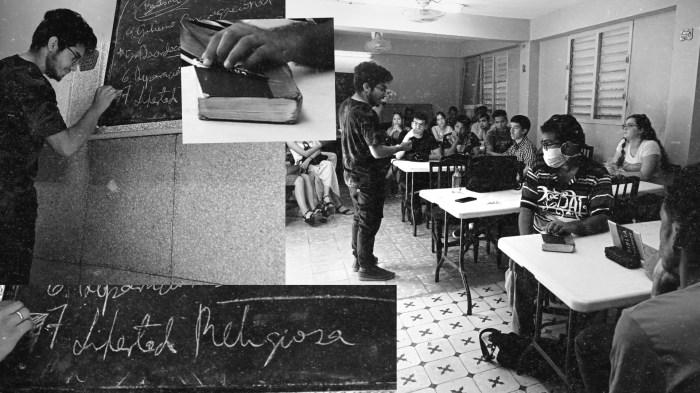
Iván Daniel Calás Navarro teaching a class on freedom of religion or belief in Cuba.

Cuba’s political police threaten young evangelical Christian because of his leadership

By Yoe Suárez

7 September, the day on which 19-year-old YouTuber Iván Daniel Calás Navarro was to celebrate his 20th birthday was going to be an unforgettable day, and it was, but in a very different way. That day, he received a summons, delivered to his house in Havana, for 8 September 2023, to present himself at a police station known for imprisoning and punishing political dissidents.

Although this was the first time he had received an official summons, Calás Navarro is certain that he became a target of the political police beginning in 2017, when, at the age of 14, he decided to share his faith and created the ‘Voz De Verdad’ [Voice Of Truth]’ YouTube channel – which now has 7000 followers – and when a few years later he began to work as a youth leader in his congregation, the Nazareth Baptist Church, which is part of the Baptist Convention of Western Cuba, a registered denomination with a historic presence on the island.

Surveillance of Calás Navarro became even more intense after the peaceful protests of 11 July 2021 when, in less than a month, the Cuban regime announced Legal Decree 35, which regulates social media. According to FRANCE 24, the law prompted concern in Cuba because of its implication for freedom of expression. The law punishes any content that is critical of the government, or which the authorities deem to be ‘fake news’, or which incites protests. The government maintains that the law is meant to fight cyber-terrorism, however members of Cuban independent civil society believe that the law is nothing more than the formalisation of the censorship that has spread across the island since internet use has grown more widespread.

Continue reading “Cuba’s political police threaten young evangelical Christian because of his leadership”