Bridging the gap: The importance of finding common ground between religious groups and secular human rights organisations 

Oppressive governments depend, in part, on two things: unity among those who support them and divisions within the communities that do not. One of the greatest challenges in addressing freedom of religion or belief (FoRB) in countries where that right is regularly violated is bridging divisions between different groups within the religious sector, as well as the gap that often exists between the religious sector and secular human rights and other independent civil society organisations. 

Religious groups often occupy a unique position within larger independent civil society. They are networked and organised, to different extents, with members who regularly attend and participate in their activities. They often possess a dedicated physical space, where they are able to hold their activities with minimal outside interference. Some religious groups will run outward focused activities, providing social services. In many cases, religious leaders not only hold a significant decree of influence within their respective community – they may also be perceived as moral adjudicators more widely even by people who do not share their religious beliefs.  

Oppressive regimes are sensitive to the danger posed to them by a socially engaged religious sector and outspoken religious leaders who are willing to work hand in hand with larger civil society in defending civil and political rights. Division, therefore, is deliberately encouraged and stoked, often by intelligence and security agencies, with the goal of neutralising or coopting organised independent civil society, including the religious sector.  
Continue reading “Bridging the gap: The importance of finding common ground between religious groups and secular human rights organisations “

Pastor Rudy Palacios Vargas dared to speak out against injustice in Nicaragua. For that he has been labelled a murderer and a terrorist. 

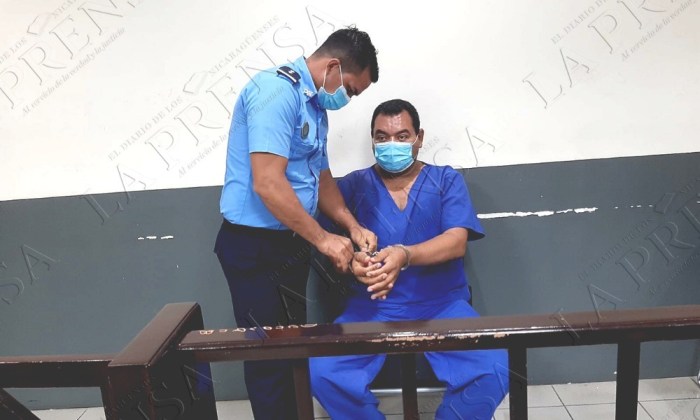
On the evening of Thursday 17 July, armed police officers – some in uniform and others dressed in black or blue and with their faces covered – arrived in a coordinated operation at the homes of Pastor Rudy Palacios Vargas and several of his friends and family in Jinotepe Municipality, Carazo Department, Nicaragua. 

The police, who did not show any arrest warrants, broke down the doors of each house using their rifle butts and a tool called a ‘pig’s foot’ before proceeding to arrest Pastor Palacios Vargas, his sister Jéssica Palacios Vargas and brothers-in-law Pedro José López and Armando José Bermudez. Mauricio Alonso Petri, a political activist and friend of the pastor, and his adult son of the same name, who is a part of the worship team at Pastor Palacios Vargas’ church were detained as well. Family friend Olga María Lara Rojas, a former political councillor, who is a Protestant Christian but not a member of Pastor Palacios Vargas’ church, was also arrested at her home. 

The officers confiscated the detainees’ cell phones and other electrical devices and were reported to have taken them to the 3rd Police District, though the authorities initially refused to provide their family members with any information as to their whereabouts. 

Continue reading “Pastor Rudy Palacios Vargas dared to speak out against injustice in Nicaragua. For that he has been labelled a murderer and a terrorist. “

Pope Francis leaves a legacy of standing up for freedom of religion or belief. His successor must build on it. 

‘There can be no peace without freedom of religion, freedom of thought, freedom of expression and respect for the views of others.’ 

It is both fitting and moving that Pope Francis included these words in what was to be his final public address, delivered on his behalf by Master of Liturgical Ceremonies Archbishop Diego Ravelli to a crowd of over 20,000 people at the Vatican’s St. Peter’s Square on Easter Sunday. 

Throughout his 12-year papacy, Francis was a committed friend to the poor and the marginalised, a vocal advocate for freedom of religion or belief (FoRB) and other fundamental human rights, and a man who spoke truth to power right up to the final days of his pontificate. 

At a time when leaders of such humility and integrity appear to be in increasingly short supply, it is essential that his successor follows his example. 

Continue reading “Pope Francis leaves a legacy of standing up for freedom of religion or belief. His successor must build on it. “

No matter how hard it tries, the Nicaraguan government cannot make the evidence of its human rights violations disappear

On 24 February, the United Nations Group of Human Rights Experts on Nicaragua (GHREN) published its latest report to the UN Human Rights Council (HRC).  

The GHREN, tasked with conducting thorough and independent investigations into all alleged human rights violations and abuses committed in Nicaragua since April 2018, focused its report on the institutions and individuals responsible for violations in Nicaragua, complete with an annex of 10 functional diagrams ‘illustrating the de jure and de facto connexions between different State and non-State entities.’  The report also drew attention to the four-phase strategy of the Ortega-Murillo regime designed to gain absolute control of the country and to how the regime’s recent constitutional reforms provide unchecked executive authority.  

The findings of the GHREN’s report are supported by a total of more than 1,500 interviews and 7,500 documents, and are also backed by reports by civil society organisations (CSOs) who have consistently and independently documented human rights violations. CSW, for example, documented 222separate cases involving violations of freedom of religion or belief (FoRB) in 2024 alone, with most involving multiple violations and some affecting thousands of people. 

Continue reading “No matter how hard it tries, the Nicaraguan government cannot make the evidence of its human rights violations disappear”

Pastor Efrén Antonio Vílchez López is one of hundreds of independent voices the Nicaraguan government is desperate to silence

On 15 May 2022 Protestant Christian Pastor Efrén Antonio Vílchez López was beaten and detained as he was leaving the funeral home where he worked in San Rafael del Sur, a town and municipality 50km south-west of the Nicaraguan capital Managua.  

He was not told on what charges he was being arrested, and his family were kept unaware of his whereabouts for three days. He was held at the San Rafael del Sur National Police Station for over two weeks, and then transferred to the notorious Jorge Navarro National Penitentiary System known as ‘La Modelo’. 

While he was in detention the authorities did not provide Pastor Vílchez López, who is diabetic and hypertensive, with his required daily insulin, which ultimately proved life-threatening and resulted in him being sent to a clinic for urgent medical treatment.  

Continue reading “Pastor Efrén Antonio Vílchez López is one of hundreds of independent voices the Nicaraguan government is desperate to silence”