State repression knows no ideology

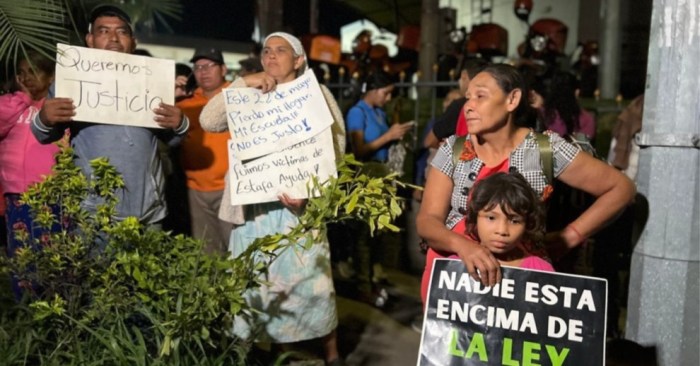
On 12 May a community in rural El Salvador gathered for a peaceful protest demanding their land rights. Within hours, the government responded with riot gear and arrests, striking fear among the families present. This is how authoritarian tendencies manifest themselves, no matter the political branding. 

In today’s polarised world, it is easy to label enemies by ideology. When we think of authoritarianism, our minds may leap to the right or the left. But beyond the party name or rhetoric lies something more universal: the impulse to silence those who question injustice. 

In recent weeks, two cases from opposite ends of the ideological spectrum have brought this to light. In one, a pastor in a country with a right-leaning government was arrested while seeking to protect his community from an unjust eviction. In the other, two pastors living under a left-leaning government were detained for speaking of God’s justice in defence of their son at a military tribunal. Though the contexts differ, the charges were similar: ‘public disorder’ and ‘resisting arrest’ in the former, and “‘disrespect’ and ‘disobedience’ in the latter. Neither government would tolerate independent voices raising moral concerns. 

Continue reading “State repression knows no ideology”

Prayer, outreach, free expression – the Cuban government won’t tolerate the truth

A mid-size church located in a population facing significant economic and social challenges organises a weeknight, evening prayer service. Members of the church attend and participate in a series of structured times of prayer. At times they pray silently, at others the pastor leads them in prayer, and in one session they gather around the national flag to pray for the needs facing those in their community and country. Their prayers speak of fundamental needs – for food, for medicine, for a reduction in crime, for the provision of basic services to all.  

In another part of the country, the pastor of a church takes steps to address a specific need in his community, which is also enduring hardship. Together with the church leadership, he coordinates a general collection to meet the needs. Members of the church, and many in the larger community, join in the effort and together they are able to put together packages of essential goods to give away to the most desperate.  

Neither of these scenarios would attract much notice in many parts of the world. Those who did not share the faith of those involved might think some of the practices a little strange, but not harmful. Not so in Cuba, however, where the simple act of praying for the country – especially in conjunction with the use of the national flag – and any effort by a religious group to meet the acute needs of the population, are met with hostility by the government, which is increasingly threatening religious leaders who organise such activities with criminal charges.

Continue reading “Prayer, outreach, free expression – the Cuban government won’t tolerate the truth”

Pope Francis leaves a legacy of standing up for freedom of religion or belief. His successor must build on it. 

‘There can be no peace without freedom of religion, freedom of thought, freedom of expression and respect for the views of others.’ 

It is both fitting and moving that Pope Francis included these words in what was to be his final public address, delivered on his behalf by Master of Liturgical Ceremonies Archbishop Diego Ravelli to a crowd of over 20,000 people at the Vatican’s St. Peter’s Square on Easter Sunday. 

Throughout his 12-year papacy, Francis was a committed friend to the poor and the marginalised, a vocal advocate for freedom of religion or belief (FoRB) and other fundamental human rights, and a man who spoke truth to power right up to the final days of his pontificate. 

At a time when leaders of such humility and integrity appear to be in increasingly short supply, it is essential that his successor follows his example. 

Continue reading “Pope Francis leaves a legacy of standing up for freedom of religion or belief. His successor must build on it. “

A year since over 170 Protestants were forced from their homes, authorities in Mexico’s Hidalgo State must take action to protect religious minorities 

It was the end of 2015 when Rogelio Hernández Baltazar returned to his community in Rancho Nuevo in the Huejutla de Reyes Municipality of Hidalgo State. He had spent several months working in the fields of Coahuila in Northern Mexico, because there were no opportunities for work or to generate income to support his family in his own village. 

This time things were different; he returned to his community transformed after having struggled for years with alcohol addiction and anger management. While he was working in Coahuila a colleague had invited him to the local Fundamental Baptist Church, where he made the decision to convert to Christianity. What he did not know was that it would have serious consequences within his community. 

When Rogelio returned home things seemed not to have changed much, but something inside him had. He had only been attending the church in Coahuila for two months, but when he returned to his indigenous Nahuatl community, people noticed such a significant change in him that they began to wonder what had happened to him in his workplace. With the little understanding that he had, Rogelio began to explain that his radical change was due to what he had read in the Bible, so he invited people to Bible studies in his home.  

Continue reading “A year since over 170 Protestants were forced from their homes, authorities in Mexico’s Hidalgo State must take action to protect religious minorities “

No matter how hard it tries, the Nicaraguan government cannot make the evidence of its human rights violations disappear

On 24 February, the United Nations Group of Human Rights Experts on Nicaragua (GHREN) published its latest report to the UN Human Rights Council (HRC).  

The GHREN, tasked with conducting thorough and independent investigations into all alleged human rights violations and abuses committed in Nicaragua since April 2018, focused its report on the institutions and individuals responsible for violations in Nicaragua, complete with an annex of 10 functional diagrams ‘illustrating the de jure and de facto connexions between different State and non-State entities.’  The report also drew attention to the four-phase strategy of the Ortega-Murillo regime designed to gain absolute control of the country and to how the regime’s recent constitutional reforms provide unchecked executive authority.  

The findings of the GHREN’s report are supported by a total of more than 1,500 interviews and 7,500 documents, and are also backed by reports by civil society organisations (CSOs) who have consistently and independently documented human rights violations. CSW, for example, documented 222separate cases involving violations of freedom of religion or belief (FoRB) in 2024 alone, with most involving multiple violations and some affecting thousands of people. 

Continue reading “No matter how hard it tries, the Nicaraguan government cannot make the evidence of its human rights violations disappear”