Protestant, Catholic, Critic, Ally: No-one is safe in Nicaragua 

The government decides to whom to extend its hand and to whom to close it, the Protestant churches that today shake the hand of the dictatorship could tomorrow be strangled by the same hand.  

A Nicaraguan human rights defender 

On Tuesday 12 December 2023, Nicaraguan security forces carried out an operation that would see 11 Protestant leaders arrested and detained across the country by the end of the day. The organisation with which the leaders were affiliated, Mountain Gateway, a Protestant organisation based out of Texas, and which has operated legally in Nicaragua since 2015 under the name Puerta de la Montana, was stripped of its legal status, and its assets, including 47 vehicles and four properties, were confiscated by the government.  

One month later, the government announced that it was pursuing criminal charges against those detained as well as three United States citizens (in absentia), on accusations of money laundering and organised crime. Show trials, in which the government produced no evidence to back up the charges, were held, and in March 2024, the 11 detainees were sentenced to between 12 and 15 years in prison and fined $80 million US dollars.  

Continue reading “Protestant, Catholic, Critic, Ally: No-one is safe in Nicaragua “

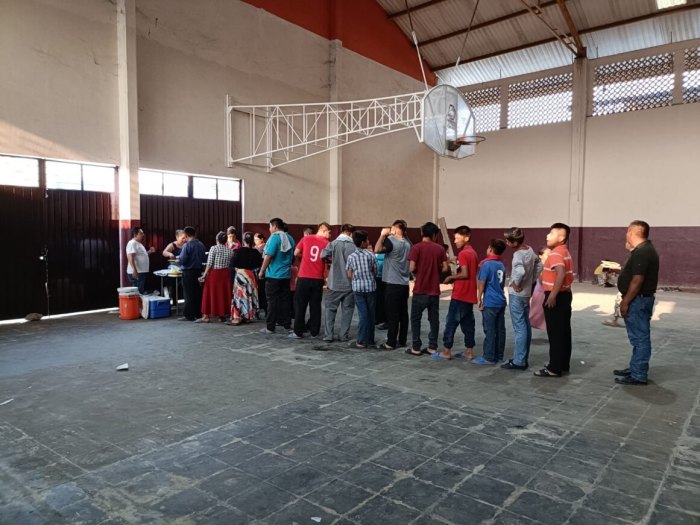
139 Protestant Christians are now living in an auditorium because the Mexican government has not done its job

In 2015, members of a religious minority living in neighbouring villages in the Huasteca region of Hidalgo State, Mexico were informed by their village leaders that they would no longer be permitted to perform their assigned acts of community service.  

To outsiders, this might seem insignificant, especially when compared to violations of freedom of religion or belief (FoRB) elsewhere in Mexico and the world. Being told to do less work might even seem like a positive development. Those in the villages of Rancho Nuevo and Coamila, both located in the municipality of Huejutla de los Reyes, however, understood that the non-completion of this work would mean the loss of recognition as members of the community. And, associated with that recognition are rights, including access to health care, government benefit programmes and education.  

The situation grew worse in 2016, as members of the religious minority were warned against accessing or using their land for cultivating crops, their main source of sustenance and income. Individuals who helped the group, who all belong to the Great Commission Baptist Church, to build a place of worship on privately owned land were threatened and violently assaulted. The Baptists were repeatedly forced to attend community meetings where local leaders demanded that they take part in Roman Catholic festivals including by making financial contributions and actively participating in acts of worship. The leaders warned them that more severe punishment, including permanent removal from the community membership rolls, would follow if they did not comply. 

Continue reading “139 Protestant Christians are now living in an auditorium because the Mexican government has not done its job”

The growing cost of standing up for human rights in Nicaragua and Cuba  

Olesia Auxiliadora Muñoz Pavon is a choir director for the Santa Ana Parish in Niquinohomo in Nicaragua’s Masaya Department. Age 52, she has been imprisoned on false charges since 6 April 2023, having previously served a sentence from August 2018 until June 2019 – also on false charges. 

Since the middle of January this year, like several others in the Women’s Holistic Penitentiary System commonly known as La Esperanza, Ms Muñoz Pavon has been denied any time outdoors where before she was allowed out once a week. 

Her crime? Praying out loud. 

Continue reading “The growing cost of standing up for human rights in Nicaragua and Cuba  “

From faith to exile in Guerrero, Mexico 

Damián and his family live on the outskirts of the centre of Ayutla de los Libres1 in south-western Mexico. In May 2022, they and two other families bought the land after they were expelled from their village because they belong to a religious minority.  

On 25 March 2021, Damián, age 38 at the time, was called before the Ahucachahue community assembly in Ayutla de los Libres Municipality, located in the Costa Chica region of Guerrero. The people of Ahucachahue are Mixteco, and the majority practice Roman Catholicism. At the meeting, community leaders informed him that he had been appointed to lead the festivals in honor of San Isidro Labrador,2 their patron saint. Damián would be responsible for contracting musical groups and suppliers of alcohol and food, in addition to the administrative tasks that accompany the rituals specific to the Roman Catholic saint.  

However, Damián had converted to Protestant-Evangelical Christianity four years earlier, in 2017, as had many others. He refused the position.  

Continue reading “From faith to exile in Guerrero, Mexico “

A life of struggle and survival: the reality of religious oppression in Cuba

Father Alberto Reyes Pías is a Roman Catholic priest in the Archdiocese of Camagüey, Cuba. He is one of the most articulate voices on freedom of religion or belief in Cuba and continues to courageously speak out about the Cuban government’s systematic violations of this right. This is a transcript of a presentation he gave as part of a panel discussion moderated by CSW, at the 2024 International Religious Freedom Summit in Washington, DC.

In Cuba, one of the most subtle mechanisms of evil is what we call “normalisation” which is nothing more than evil becoming a habitual part of our life. We not only take its presence for granted, but also focus our energies not on eliminating it and freeing ourselves from it, but on figuring out how to continue walking, despite it hindering our steps, tying our hands, and oppressing our throat.

In appearance, religious freedom is respected in Cuba. In general, churches are open, worship is allowed, catechesis exists, young people gather, one can openly talk about God, possess a Bible, and wear religious symbols. Yet, in Cuba, there is a thirst for God. Pastoral agents focus on serving those seeking an experience with God that touches their lives, even at the cost of accepting as “normal” what is not.

Continue reading “A life of struggle and survival: the reality of religious oppression in Cuba”