Seven years since Colombia’s peace agreement, but violence against the religious sector continues

On 30 November 2016, the Colombian Congress ratified a peace agreement between the government and the Revolutionary Armed Forces of Colombia-Army of the People (FARC-EP), a Marxist-Leninist guerrilla group.

It was hoped that the agreement would mark the beginning of the end of the complex internal conflict which has engulfed Colombia since 1958 and involves multiple far-left and far-right illegal armed groups, criminal groups, and government forces. However, seven years later peace remains elusive; the violence continues.

Undelivered promises

At first, things seemed to be improving; from 2016 to 2017, violence related to freedom of religion or belief (FoRB) appeared to decrease. However, from 2018 to 2022, and especially since 2019, the numbers have been on the upswing once again.

Continue reading “Seven years since Colombia’s peace agreement, but violence against the religious sector continues”
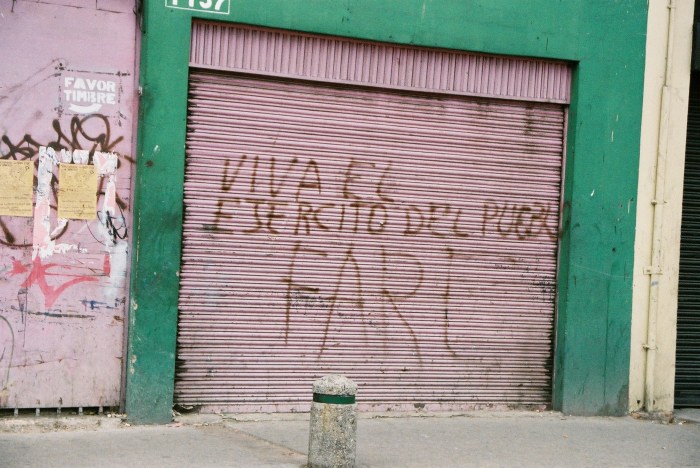
Graffiti in Colombia reads 'Viva el ejercito del pueblo FARC' i.e. 'Long live the army of the people, FARC'

Colombia must finally reckon with the religious element of its decades long internal conflict

Darkness falls quickly in Colombia due to its proximity to the equator, and it was no different on the night of Thursday 5 July 2007. As night closed in, Joel Cruz Garcia, a 27-year-old pastor, heard banging on the front door of the small home he shared with his wife Yuvy and their nine-month-old daughter in the village of El Dorado in the department of Huila. When the pastor opened the door, he was faced with a heavily armed group of individuals dressed in the uniform of the 17th Brigade of the Revolutionary Armed Forces of Colombia, better known as the FARC, who demanded that he come with them.  

The pastor was given no choice, and his wife later recounted how even as the guerrillas manhandled him and ridiculed his faith, Joel quoted a Bible verse to them, saying, ‘To live is Christ and to die is gain.’ 

‘Good,’ the guerrillas responded. ‘Then you will die.’ 

Continue reading “Colombia must finally reckon with the religious element of its decades long internal conflict”
A street with flags flying in Michoacán, Mexico.

Religious minorities in Michoacán, Mexico just wanted to be treated equally

Michoacán is a state located in central Mexico. This region of mountains and forests is inhabited by the P’urhépecha indigenous populations, whose language P’urhe is still spoken today and who are renowned for their fine work with the different types of wood found in the area. The P’urhépecha are concentrated in 22 municipalities across the breadth of the state.

Michoacán is also known for its natural beauty and the richness of its land and climate, making it a favourable place for the cultivation of different fruits exported internationally, including the avocado. Mexico is the largest producer worldwide of this precious product which has an annual economic impact of billions of dollars.

The P’urhépecha Plateau is home to around 70% of Mexico’s national avocado production. This has given rise to clashes in Michoacán between organized crime groups as they vie for control of the territory and avocado market. The situation has led, in turn, to the formation of community militias and self-defence groups who, fed up with the extortion and the abuses committed by the organized crime groups, have taken up arms to protect their lands. In some cases, however, these community militias and self-defence groups have also been involved in the violation of human rights.

Continue reading “Religious minorities in Michoacán, Mexico just wanted to be treated equally”
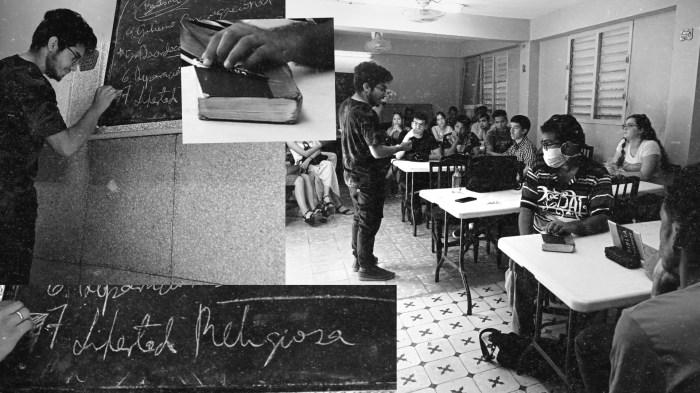
Iván Daniel Calás Navarro teaching a class on freedom of religion or belief in Cuba.

Cuba’s political police threaten young evangelical Christian because of his leadership

By Yoe Suárez

7 September, the day on which 19-year-old YouTuber Iván Daniel Calás Navarro was to celebrate his 20th birthday was going to be an unforgettable day, and it was, but in a very different way. That day, he received a summons, delivered to his house in Havana, for 8 September 2023, to present himself at a police station known for imprisoning and punishing political dissidents.

Although this was the first time he had received an official summons, Calás Navarro is certain that he became a target of the political police beginning in 2017, when, at the age of 14, he decided to share his faith and created the ‘Voz De Verdad’ [Voice Of Truth]’ YouTube channel – which now has 7000 followers – and when a few years later he began to work as a youth leader in his congregation, the Nazareth Baptist Church, which is part of the Baptist Convention of Western Cuba, a registered denomination with a historic presence on the island.

Surveillance of Calás Navarro became even more intense after the peaceful protests of 11 July 2021 when, in less than a month, the Cuban regime announced Legal Decree 35, which regulates social media. According to FRANCE 24, the law prompted concern in Cuba because of its implication for freedom of expression. The law punishes any content that is critical of the government, or which the authorities deem to be ‘fake news’, or which incites protests. The government maintains that the law is meant to fight cyber-terrorism, however members of Cuban independent civil society believe that the law is nothing more than the formalisation of the censorship that has spread across the island since internet use has grown more widespread.

Continue reading “Cuba’s political police threaten young evangelical Christian because of his leadership”
A church in Araucania, Chile.

‘The only church that enlightens is the one that burns’: The glowing embers of Chile’s Latin American success story

Today marks 50 years since Augusto Pinochet’s coup d’état forever changed the course of Chilean history. His rule brought about years of egregious human rights violations, during which many Chileans were tortured, murdered or forcibly disappeared, and their bodies never found. The trauma still scars the population today.

Pinochet was removed from power in 1990 after 17 years of brutal military dictatorship, and as President Patricio Aylwin took office on 11 March 1990, he declared, ‘Chile doesn’t want violence or war; it wants peace’. Whilst Chile has enjoyed relative peace and human rights have generally been respected since 1990 compared with the 17 years preceding it, Aylwin’s words still ring true more than 30 years later.

Success wearing thin

Chile has largely been heralded for its stability for the last decade or so; prosperous and peaceful, largely untouched by the levels of violence experienced by other countries in the region. The Latin American success story is largely backed up by statistics, such as those of the Global Peace Index, which ranked Chile at 58 out of 163 countries for its levels of peace in 2023.

Continue reading “‘The only church that enlightens is the one that burns’: The glowing embers of Chile’s Latin American success story”