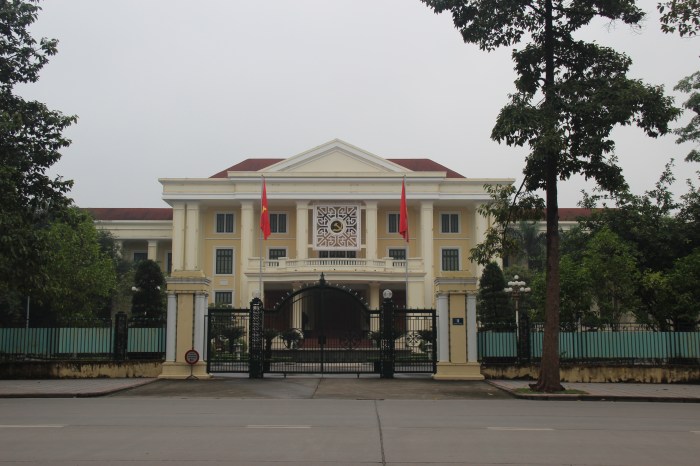
Vietnam’s government restructuring: Streamlining or strongarming?

In April this year the Vietnamese government formally introduced sweeping reforms during the 11th Plenum of the 13th Party Central Committee. The meeting laid the groundwork for the restructuring plan, which was later affirmed at the first Congress of the Government Party Organisation for the 2025–2030 tenure held on 13 October. 

At the April plenum, Party General Secretary Tô Lâm described the reforms as part of a long-term vision for national development, stating: ‘The restructure is a strategic decision without precedent, aimed at ensuring fast, stable, and sustainable national development, and at better serving the lives of the people.’ 

The reforms have been hailed by officials as a bold step toward modernisation and efficiency, but behind the rhetoric of ‘streamlining’, human rights advocates warn that these changes may deepen state control, restrict freedoms further, and marginalise vulnerable communities—most of whom are ethnic and religious minorities. 

Continue reading “Vietnam’s government restructuring: Streamlining or strongarming?”
Combating Hate Speech: The True Beginning of Peace and Human Dignity

This article by Ján Figeľ  and Sheikh Al Mafoudh bin Bayyah was originally published by The Diplomat Magazine on 30 July 2025.

‘Peace is built in the heart.’ Pope Leo XIV
‘War begins with words.’ – Sheikh Abdallah bin Bayyah

In an age marked by overlapping crises – from armed conflicts and ideological extremism to ethical breakdowns in public discourse – a need to return to the essence of words and their meaning is more urgent than ever. Words are not mere tools of expression; they are often sparks that ignite or extinguish fires. This is precisely what Sheikh Abdallah bin Bayyah, President of The Abu Dhabi Forum for Peace, warns of in his profound message: ‘War begins with words.’

With this statement he encapsulates an entire philosophy: that every physical war is preceded by a war of words, and every act of violence is rooted in a prior act of verbal aggression. Unless speech is restrained, purified of hatred, and founded on mutual respect, the path to peace will never begin.

Continue reading “Combating Hate Speech: The True Beginning of Peace and Human Dignity”

The UK government’s efforts to produce a definition of Islamophobia could prove counterproductive 

In February 2025 the UK’s Deputy Prime Minister Angela Rayner announced the convening of a working group chaired by Rt Hon Dominic Grieve KC to provide a definition of Islamophobia. She insisted that the definition would be non-statutory and align with the UK’s values of free expression, including the right to criticise a religion. Nevertheless, this action raises several concerns. 

While it can initially appear to be a useful tool for defining acts of religious hatred and incitement, in reality phobia terminology tends to hinder rather than assist efforts to address religion-related violations.  

It is imprecise, and is invariably used to shut down legitimate debate. Additionally, discussion about whether or not a given phobia is indeed occurring can often eclipse efforts to highlight and address the actual violations.   

Continue reading “The UK government’s efforts to produce a definition of Islamophobia could prove counterproductive “

A change in government in Venezuela can only benefit the religious sector

Over the past 11 years of President Nicolas Maduro’s leadership, Venezuelan religious leaders have increasingly practiced a form of self-censorship when it comes to preaching or speaking on topics like social justice, peace, poverty, or any topic that might be perceived negatively by the dictatorship. While they may appear to have imposed this censorship on themselves, it comes from a very real fear having witnessed the cruelty that President Maduro has unleashed against those he and his regime identify as political enemies.

Elections are due to be held on Sunday, 28 July. In the run up, the Maduro regime has dedicated itself to attacking the opposition and creating an environment of terror with warnings of a ‘bloodbath’ and ‘civil war’ if Maduro does not win a third six-year term. It has been heavily implied that he could refuse to recognize the victory of Edmundo González Urrutia, the most popular candidate according to several polls.

In response to Maduro’s threats, the Inter-American Court of Human Rights (IACHR) warned that ‘this type of discourse by the highest authority of the State and the security forces has the effect of intimidating and curtailing the political freedom of the electorate… These actions affect democratic institutions and the freedoms of association, assembly, and expression, as they discourage the political participation of opposition individuals, their electorate, and the general public.’

Continue reading “A change in government in Venezuela can only benefit the religious sector”

Un Cambio de Gobierno en Venezuela podría beneficiar al sector religioso

Durante los últimos 11 años de liderazgo del presidente Nicolás Maduro, los líderes religiosos venezolanos han practicado cada vez más una forma de autocensura en sus predicaciones o discursos sobre temas como la justicia social, la paz, la pobreza, o cualquier tema que pueda ser percibido negativamente por la dictadura. Aunque puede parecer que se han impuesto esta censura a sí mismos, proviene de un temor muy real al haber presenciado la crueldad que el presidente Maduro ha desatado contra aquellos que él y su régimen identifican como enemigos políticos.

Las elecciones se celebrarán el domingo 28 de julio. En el período previo, el régimen de Maduro se ha dedicado a atacar a la oposición y a crear un ambiente de terror con advertencias de un “baño de sangre” y “guerra civil” si Maduro no gana un tercer mandato de seis años. Se ha insinuado fuertemente que podría negarse a reconocer la victoria de Edmundo González Urrutia, el candidato más popular según varias encuestas.

En respuesta a las amenazas de Maduro, la Corte Interamericana de Derechos Humanos (CIDH) advirtió que “este tipo de discurso por parte de la máxima autoridad del Estado y las fuerzas de seguridad tiene el efecto de intimidar y coartar la libertad política del electorado… Estas acciones afectan las instituciones democráticas y las libertades de asociación, reunión y expresión, ya que desalientan la participación política de las personas opositoras, de su electorado y de la ciudadanía en general.”

Continue reading “Un Cambio de Gobierno en Venezuela podría beneficiar al sector religioso”