‘The guards told us not to pray. We did it in silence because God heard us.’
Santos Julio Sevilla Rivera was born in San Sebastián de Yalí, Jinotega, Nicaragua on 9 January 1969. He was born with an irreversible visual impairment due to severe advanced myopia. His vision was very limited even with corrective lenses, but this did not prevent him from being very active, cheerful and well-known in his community.
He moved to Estelí in 1983 because of the armed conflict between the government of the Sandinista National Liberation Front (FSLN) and the insurgent groups known as the Contras, In 1998 he was invited to a spiritual retreat by Father Sixto Muñoz Ilario Rodriguez. The experience was very positive and inspired him to become involved in volunteer service to the Catholic Church through music. He volunteered in four parishes, primarily in the Saint Francis of Assisi parish. He formed friendships with the local priests, and he dedicated himself to supporting the choir committedly.
In 2000 a priest invited him to work at the Estelí Diocese’s Caritas office. He started as part of the security and surveillance team at the institution’s entrance.

In 2010 he was transferred to the general services area, where he worked in cleaning and maintenance. Throughout this time with the organisation, he continued to sing in the choirs at the parishes of Estelí, working under the direction of Father Francisco Valdivia.
He told CSW: ‘My work was within the church; I was never involved with violent groups. I had a good relationship with bishops and priests in general, always connected to music; I always supported the parish music groups. I spent most of my time at the Saint Francis of Assisi parish. The Bishop of Estelí, Juan Abelardo Mata Guevara, resigned in 20211 and we moved under the apostolic administration of Bishop Rolando Álvarez. He had two dioceses under his charge. Monsignor Álvarez was our new boss. He came to the institution frequently; we only worked together, sharing the same space to celebrate the Eucharist in the parish.’
Changing tides
In April 2018 Nicaragua was swept by nationwide protests, to which the government of President Daniel Ortega responded with force. Churches in Estelí, as in many other parts of Nicaragua, have been routinely surrounded by National Police (PN) officers ever since, with patrol cars stationed in front of the churches.
During Holy Week, police officers followed Easter processions until the government banned them altogether. Mr Sevilla Rivera recalls hearing the choir mention that police officers would enter and record during the religious service and that the rectory was always under surveillance since very early in the morning.
‘Many people stopped going to church out of fear. I thought, “God is my strength…” I remember that during my time working at Caritas, starting in 2022, they would send me to pay electricity bills of 10,000 to 15,000 Córdoba’s. It was incredibly expensive compared to other years, even though the institution was large; we had never paid such amounts, not to mention the water bill. The government required all parishes to hire accountants to pay taxes [on offerings]. Parishes were legally exempt from taxes, but then they changed the law.’
In 2022 he began noticing that plainclothes men followed him home after leaving the diocesan Caritas office and his parish. Some acquaintances told him to stop going to church and to avoid the company of priests. They also told him that people were assigned to report his every move to the government. They warned him that one day he would be arrested if he continued working with the church, but he responded:
‘I won’t abandon my religion; I serve God, not people. God’s will be done… I wanted to continue singing in the choirs to the Lord; I taught vocal harmony to the choirs. I was the singing teacher; I was in the music ministry.’
‘I knew I had no choice’
During this period, the Diocese of Estelí and the neighbouring Diocese of Matagalpa were among the most attacked in the country. Even before the high-profile arrest of Bishop Rolando Álvarez in August 2022 the PN had begun harassing churchgoers and arresting and imprisoning priests, seminarians, deacons and Caritas workers. Mr Sevilla Rivera did not escape the crackdown.
‘The priest called me the day before my arrest to ask for help with the music at the Saint Francis of Assisi parish, to sing a thanksgiving mass for the sick on 20 May 2023. The service began at 9.00am that Saturday. We finished at 1.00pm, and I arrived home very tired.
Suddenly, I was told that someone was looking for me, and I thought they wanted me to sing at another mass, but it was the General Commissioner of the National Police, in civilian clothes, with three other men in civilian clothes. They tricked me, saying they were taking me to a meeting for an hour and then returning me home. I knew I had no choice; I couldn’t refuse, so I went with them.
Once at the police station, they held me there until 23 May without explanation, and at 2.00pm they transferred me to District III in Managua [Editor’s note: During these three days Mr Sevilla Rivera was denied any communication with his family]. There were also five other people with me, from Caritas Estelí: three women and two men. The police officers stole my cell phone, my wallet, my watch—everything I had with me.
Afterward, they transferred me to La Modelo, a maximum-security prison, to isolation in Gallery 16, on 9 June 2023.
They gave me a summary trial [on 18 December 2023] that lasted one hour via videoconference, and that same day the prosecution sentenced me to seven years in prison.2 They said we religious people were coup plotters, terrorists, that all priests were the same. For ten days they interrogated me day and night, and then they took me to cells as filthy as toilets. Those days were very hard. A priest, imprisoned with me, gave me a word of encouragement: “During the interrogations, may the Lord speak through you”.
I think they arrested me because I was associated with Pastor Eugenio Benavides. He was making strong statements in his homilies; he spoke of defending justice and human rights, and the government didn’t like that because they want to control what the clergy say. Finally, he was sent into exile in Rome.
In prison, they didn’t give us enough water. Every eight days, my family would bring me something to eat, but in jail, they only gave me a tiny spoonful of gallo pinto [rice and beans]. It wasn’t enough; we were hungry. Inside, we weren’t allowed to have a Bible. The guards mocked my faith, telling me that God had abandoned me. But all the Catholics prayed the Rosary and the Hail Mary. It was forbidden, but we did it anyway. The guards tried to silence us and told us not to pray. We did it in silence because God heard us.
My wife, my two sisters, my mother, and my daughter visited me in prison, taking turns for eight to ten minutes once a month. On the 15th of each month, they delivered packages left by our families: food, soap, toothpaste, oatmeal, bread, toilet paper; and occasionally, soda.
My family told me that there were national police officers walking past my house in a threatening manner while I was still imprisoned.’
During his time in prison, Mr Sevilla Rivera’s visual impairment progressively worsened due to lack of medical attention, poor nutrition and stress. His family feared that without access to specialized treatment, he would develop total and irreversible blindness.
Into exile
In the early hours of 5 September 2024, 135 Nicaraguan political prisoners were put on a plane to Guatemala. Mr Sevilla Rivera was among them. During medical examinations, he learned that he was prediabetic and hypertensive. He had left prison already ill.
His wife traveled to join him in Guatemala and act as his guide due to his visual impairment. They completed the paperwork to travel to the United States and arrived in Atlanta, Georgia on 12 December 2024. They had to leave their three children behind.
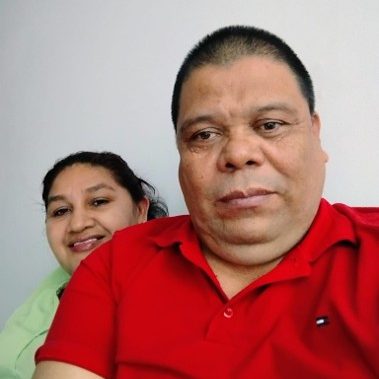
Mr Sevilla Rivera and his wife work to support themselves and pay their rent. Now the nearest Catholic church is a three-hour walk away; it’s not like in Nicaragua where they could walk to the parish for every Mass. Without a car, going to church is almost impossible; however, a priest friend sends them daily Bible reflections.
Of the 135 people sent to Guatemala, Mr Sevilla Rivera and 76 others were accepted as refugees in the United States, while 47 were denied refugee resettlement. Another 11 chose not to seek asylum in the US and sought refuge in various countries. Those who owned homes or land in Nicaragua lost them along with their nationality, and their families remain under police surveillance and harassment within Nicaragua.
While sheltering exiles is important, the international community must not stop there. It must push for an end to the conditions that have forced people like Mr Sevilla Rivera and his wife from the country in the first place. Their efforts to restore democracy and justice for all within Nicaragua should be strengthened and supported, and efforts should be made to help connect them with those who continue to do the same even from beyond its borders.
By CSW’s Research and Advocacy Officer for Nicaragua
- The legal status of the Caritas Diocesana Association of Estelí was cancelled on 2 February 2022, along with three other organizations linked to the Diocese of Estelí. ↩︎
- According to the Mechanism for the Recognition of Political Prisoners, Mr. Sevilla Rivera was charged with money laundering-related offenses alongside Father Eugenio. Authorities never granted access to the judicial file or the evidence used to substantiate the charges against him; furthermore, he was fined 144,000 córdobas. ↩︎