‘Sorry guys, horrible stat incoming.’
I was on a call with two of my colleagues to discuss potential poster designs that would catch people’s attention at a Christian festival, and encourage them to participate in our ‘Eyes on Sudan’ campaign, about the war in Sudan.
I had been Googling various facts and figures relating to the ongoing conflict in the country and had come across one that I found so upsetting that I felt I should at least give my friends – neither of them strangers to hearing distressing information – a moment’s warning so that they could steel themselves for what I was about to say:
‘More than 5,000 children have been killed or maimed since the war in Sudan began.’
The figure had been shared by Hannah Sulieman, Deputy Executive Director of UNICEF, during a briefing at the United Nations (UN) General Assembly in June, in which she acknowledged that ‘the real figure is undoubtedly much higher’, given that the 5,000 number refers only to those deaths that the UN has verified.
We were already aware that children were among the estimated 150,000 civilian lives claimed over the course of the conflict. On 20 December 2024, for example, the Sudan Armed Forces (SAF) launched an airstrike on the Al Ezba Baptist Church and its neighbouring nursery in Khartoum North. The nursery was open at the time, with eight children among the 11 killed. On 10 October 2025 the Rapid Support Forces (RSF), with whom the SAF is in conflict, killed 22 children and 38 adults in airstrikes on the Dar al-Arqam camp for internally displaced persons (IDPs) in El Fasher city in Darfur, just weeks before the forces captured the city after 18 months of brutal siege.
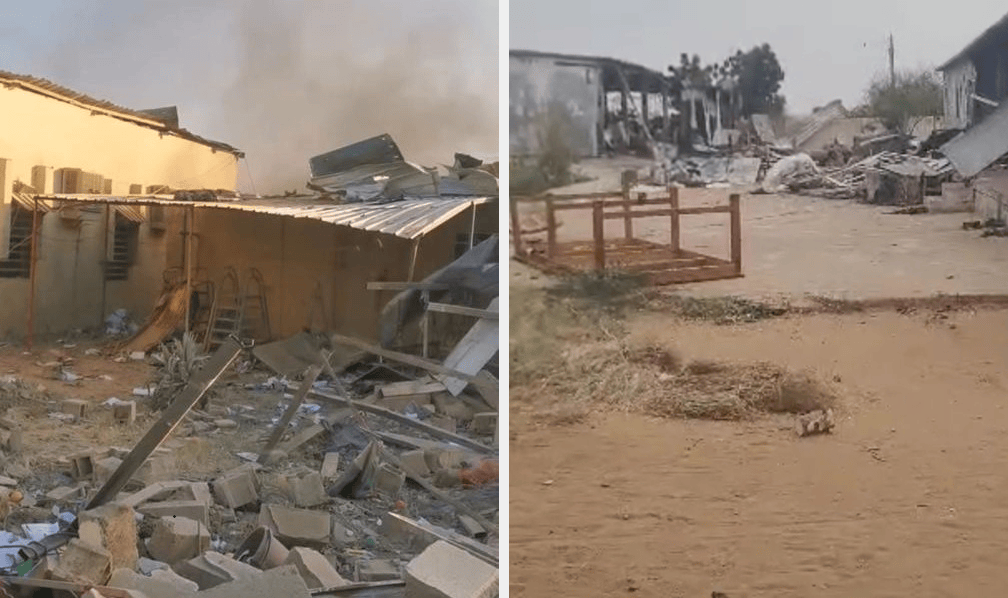
Our dilemma was whether this figure, emblazoned on a poster without more context, would be too confronting for the audience at a family festival. The fact that we had to question this made me want to scream it from the rooftops. Those children were not protected from what happened to them, so why should anyone else be protected from hearing about it?
Isn’t an inability or unwillingness to engage with the staggering human toll of this conflict part of the reason why there has not yet been a public outcry and sense of urgency to end it? Is it that the suffering seems so remote that it’s easy to ignore – when in fact this war is being fuelled by several states and the looted riches of the country are found in so many of the products we use every day that they probably feature in most of our weekly shops?
Other statistics on the war are no less staggering: the fact that it has driven an estimated eight million children out of school, that it has displaced over 14 million people, or that the British Red Cross reported in April this year that over 33 million people are in need of humanitarian assistance, with 3.2 million children under the age of five and 1.2 million pregnant and breastfeeding women experiencing acute malnourishment.
Over the next few days, however, I found I couldn’t get that particular figure out of my head. I found myself thinking – insofar as I could – about the stories behind such a number: the quiet homes and empty playgrounds, the birthdays never celebrated and the clothes never grown into. And I found myself growing even more incensed as I reflected on how the world has let this happen.
The RSF and SAF may be the ones firing the guns and dropping the bombs, but both are strongly supported by a range of external actors, including Egypt, Ethiopia, Türkiye, and, as there is particularly strong evidence for, the United Arab Emirates (UAE). These states aren’t so much ‘letting it happen’ as actively enabling it to continue.
And then there are those who just have other priorities.
Last month a human rights investigator at Yale University reported that the British government prioritised its relationship with the UAE over acting on warnings of mass atrocities in Sudan, particularly in and around El Fasher. In February 2026 the UN Independent International Fact-Finding Mission for the Sudan found that the RSF’s actions following its October 2025 capture of El Fasher bore the ‘hallmarks of genocide’, with supplementary reporting concluding that at least three of the material elements of genocide were present in the forces’ conduct in the city.
Damningly, the same Yale human rights investigator suggested that ‘the war could end in two weeks if the international community cut off the supply line to the RSF from the UAE.’
Two weeks.
This is where ordinary people come in. Only we can put this on the agenda of our governments, by showing policymakers that we care about it and demanding a response. That’s what CSW has done at the European Parliament, at the UK Parliament, at the UN Human Rights Council and beyond.
That’s why we’re calling on the English Premier League to take action over the fact that its most successful club of the last 25 years is owned by a man with well-documented ties to the leader of the RSF. That’s why we have supported similar efforts to arrest the UAE’s sportswashing campaigns in the NBA and competitive cycling.
You can add your voice to these efforts and refuse to look away. As another of my colleagues put it: ‘Those who shout here will make the difference there.’
We want to make the difference there.
By CSW’s Press & Public Affairs Officer Ellis Heasley