The Importance of China’s Rights Lawyers to the Chinese Church

In October 2014, the Chinese Communist Party announced that rule of law would be a top priority for the country. However, just one year later, over 150 lawyers and 150 more colleagues, family members and other activists had been questioned, detained, or disappeared in a crackdown which began on 9 July 2015.

Journalists and legal experts have speculated about what ‘strengthening rule of law’ might mean for China’s ruling Party: whatever it means, it doesn’t seem to include rights lawyers.

Continue reading “The Importance of China’s Rights Lawyers to the Chinese Church”

Crackdown on the Cuban Church

CSW’s 2015 report on violations of freedom of religion or belief (FoRB) in Cuba detailed an unprecedented crackdown on churches across the denominational spectrum.

Figures compiled by CSW, which are not exhaustive but which serve as an indicator of the level of FoRB violations, reveal a tenfold increase – with 2,300 separate violations recorded in 2015 compared to 220 in 2014.

Many incidents involved entire churches or, in the case of arrests, dozens of victims.

Continue reading “Crackdown on the Cuban Church”

The Elephant in the Room: Raising Human Rights in Bilateral Talks

Since October 2015, the UK has hosted a state visit for the President of China and the first official UK visits of the President of Egypt and the Prime Minister of India.

While it is the responsibility of any government to foster good bilateral relationships, this should include full and frank discussions about human rights. The Conservative party committed to this in its 2015 manifesto where it stated:

“Our long-term security and prosperity depend on a stable international system that upholds our values… We will stand up for the freedom of people of all religions – and non-religious people – to practise their beliefs in peace and safety, for example by supporting persecuted Christians in the Middle East… and we will continue to support universal human rights.”  2015 Conservative Party Manifesto

During these visits, CSW made calls for the Prime Minister and his Government to honour their manifesto commitment and to raise the religious freedom situation in all three countries as part of bilateral talks. The Government was disappointingly quiet on human rights during all three visits, prompting many to question whether trade was being prioritised above human rights.

Continue reading “The Elephant in the Room: Raising Human Rights in Bilateral Talks”

Will the Foreign Office’s New Approach Strengthen the UK Government’s Human Rights Work?

Following the Conservative party’s election win in 2015, the Foreign and Commonwealth Office (FCO) took the opportunity to ‘re-configure’ their work in order to ensure the UK’s promotion of Universal Human Rights had the most impact.

Focus on Freedom of Religion or Belief under the Coalition Government

Under the Coalition Government in 2010-2015 the FCO undertook encouraging work on human rights, with freedom of religion or belief (FoRB) forming a significant part of the overall human rights programme as one of eight main thematic priorities.

Baroness Warsi, then the Minister responsible for Human Rights at the FCO, established the advisory group on FoRB, a group of experts from all faiths and none to advise the Minster on how to best protect and promote FoRB worldwide. After Baroness Warsi left her post, FoRB remained a human rights priority and the advisory group continued to meet and advise the new Minister.

Human Rights Work Reconfigured

The most significant part of the FCO reconfiguration was changing the eight thematic human rights priorities to three human rights ‘themes’. The rationale behind this was not to relegate nor promote any of the existing priorities, but instead to create overarching themes that encompassed everything the FCO human rights work does, while allowing for that work to be prioritised and developed in locally appropriate ways.

The themes are:

  • Democratic Values and the Rule of Law,
  • Strengthening the Rules Based International System,
  • Human Rights for a Stable World.
Continue reading “Will the Foreign Office’s New Approach Strengthen the UK Government’s Human Rights Work?”

Casto’s Choice: Forced Conversion or Forced Displacement

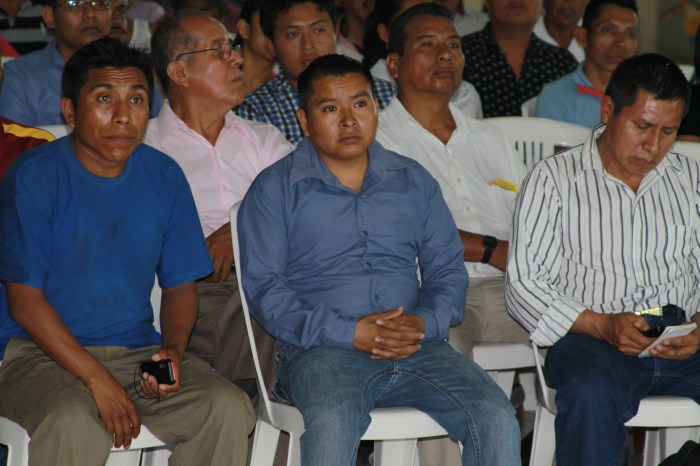
Casto sat at the table with other Christian leaders from the Huasteca region of Mexico. In April he had been talkative and his face had been animated. Now, in October, he was quiet and rarely looked up. One of the other leaders approached me privately and expressed concern about him. During the five-hour road trip to attend the workshop, he had told the other participants that he was so depressed that he hadn’t been able to attend church in a month.

This was the same man who, seven months earlier, had energetically defended his right to practice his religious beliefs at great cost. In March, he was summoned from his fields to appear at his community assembly in the village of Chichiltepec. Casto stopped his work and went to the assembly, accompanied by his cousin Juan. There, the village delegate (leader), Jesús Domínguez Hernández, told him to sign a document obligating him to renounce his Protestant beliefs – in violation of Mexico’s constitution, which protects freedom of religion or belief, and its international obligations, including the Inter-American Covenant on Human Rights which explicitly upholds the right to maintain or change ones religious beliefs.

Casto refused and Juan stood with him. The community assembly took the two young men by force and put them in a rustic jail cell carved into the side of a hill, with the bars of the door open to the chilly and damp weather. The two men were held there, with no sanitary facilities, for 30 hours. Casto was removed periodically to see if he would sign the document. He continued to refuse.  Finally the village delegate realised their pressure tactics were not going to work, released the men,  and gave Casto eighteen hours to leave the village – declaring it to be a ‘Catholic-only village’.

Continue reading “Casto’s Choice: Forced Conversion or Forced Displacement”