The Power of Personal Testimony: A Mexican Delegation Visits Congress

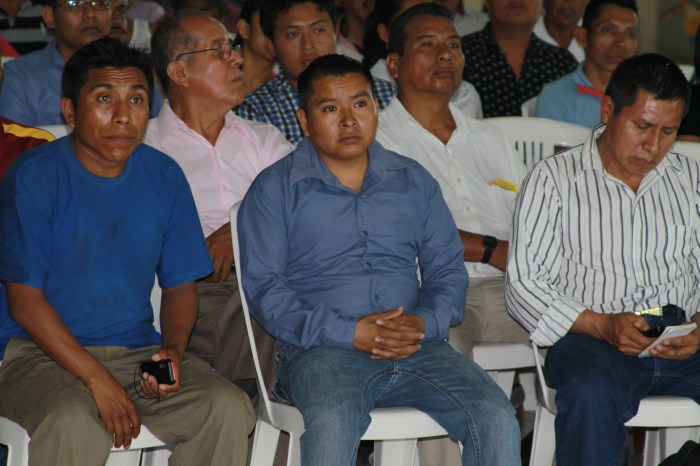
Casto Hernandez Hernandez and Fidel Lopez Hernandez are from indigenous ethnic groups in Mexico, speak Spanish as second language and live in remote, subsistence farming communities. Both were forcibly displaced because of their religious beliefs. This year, they made an unprecedented trip to Washington DC, facilitated by CSW, to give their testimony to Congress in person – the first time victims of similar offences from Mexico have done so.

Their stories are depressingly similar. Fidel Lopez Hernandez was one of a group of 47 protestant Christians violently expelled from their village by the Roman Catholic majority in July 2012. In March 2015 the group were able to return to their homes and only then under an agreement which included a fine of 10,000 pesos per family (equivalent to 530 US dollars). Additionally, in their absence, the villagers had used their homes as rubbish dumps and the government did not follow through with promised funds to restore their houses.*

Casto’s case will be familiar to regular readers of this blog; read more about him here and here. Casto and his cousin were illegally arrested in their town in Hidalgo State in March 2015 by the local authorities and held for 30 hours with no water, food or access to sanitary facilities in an effort to pressure them to renounce their faith. Although an agreement established by the Hidalgo State Public Ministry allowed the men to return home in February 2016, they, like Fidel, are still subject to illegal restrictions on their right to freedom of religion or belief (FoRB) in their hometown.

Continue reading “The Power of Personal Testimony: A Mexican Delegation Visits Congress”

On the Road with Cardinal Bo, a Personal Reflection

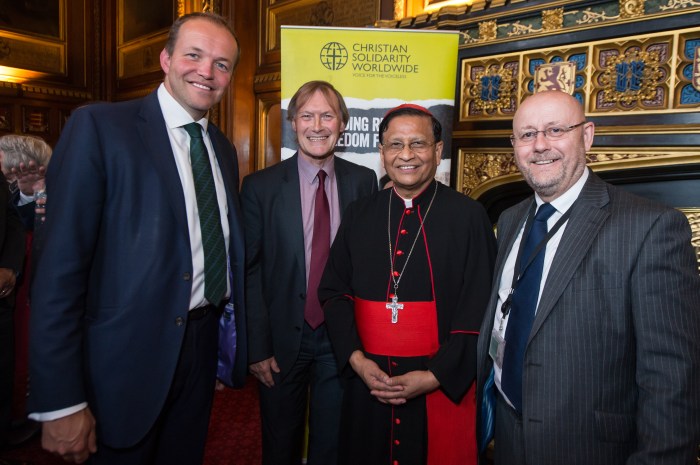
Featured image left to right: David Burrowes MP, Sir David Amess MP, Cardinal Bo, and CSW’s Chief Executive Mervyn Thomas. Photo Credit: mazur/catholicnews.org.uk

In the Chapel of St Mary Undercroft, the parliamentary chapel just underneath Westminster Hall in the Houses of Parliament, Burma’s first-ever Cardinal celebrated Mass.

“Coming from a country, Burma, that is just emerging from over half a century of cruel, brutal military dictatorship, a country torn apart by war, ravaged by religious and ethnic persecution, with rampant corruption and dire poverty, into a new Easter dawn of democracy, to stand here in this chapel with all that it symbolises and represents is an immense joy,” Cardinal Charles Bo said. “Britain and the British Parliament has a long history with Burma; many of you have been with us in our darkest hour, stretching out a hand of friendship and solidarity in our time of need, raising a voice for us when we were voiceless.”

It was just one of many beautiful and significant moments during Cardinal Bo’s almost three-week tour of the United Kingdom and Brussels, which began with Mass in St Andrew’s Cathedral, Glasgow, with a piper on the door. The tour then took us the length and breadth of the UK, and to Westminster and the European Union.

Continue reading “On the Road with Cardinal Bo, a Personal Reflection”

The Refugee Crisis: “What caused them to flee in the first place?”

On World Refugee Day, CSW explores one of the major root causes of the refugee crisis.

Syrian refugees cross from Turkey to land on a beach on the Greek island of Lesvos. Image shot 06/2015. Exact date unknown.
Syrian refugees cross from Turkey to land on a beach on the Greek island of Lesvos.

The current refugee crisis has become a major news story with much of the focus placed on asking, “Where will they go?”

A seeming backlash against the unprecedented influx into Europe in particular has led some to respond: “Anywhere but here”, and has unleashed what UN High Commissioner for Human Rights Zeid Ra’ad Al Hussein has termed  “widespread anti-migrant rhetoric”, which in turn has fostered “a climate of divisiveness, xenophobia and even… vigilante violence.”

Yet very few people have asked, “What caused them to flee in the first place, and how can we best address this?”

One key reason is the increase in violations of the right to freedom of religion or belief (FoRB) around the world. *Persecution and violence targeting religious communities is resulting in exceptionally high levels of population displacement, contributing to the worldwide refugee crisis.

Persecution and violence targeting religious communities is resulting in exceptionally high levels of population displacement, contributing to the worldwide refugee crisis.”

These violations often take place in societies where other human rights are being abused and in situations generally characterised by an absence of rule of law, corruption, economic disparity and authoritarian rule.

Issues of race, ethnicity, political opinion and gender usually intersect with religious persecution; consequently, religion-based asylum claims often include other grounds as well.

Religious persecution takes many forms

Continue reading “The Refugee Crisis: “What caused them to flee in the first place?””

The Plight of the Rohingya – His Eminence Cardinal Charles Maung Bo Addresses the Houses of Parliament, London, 25 May 2016

On May 25th Cardinal Charles Maung Bo of Burma, spoke before a meeting chaired by Lord Alton and hosted by the All Party Parliamentary Group on Burma, the All Party Parliamentary Group on International Freedom of Religion or Belief, and the Catholic Legislators Network. Below are sections from that speech, on freedom of religion or belief (FoRB) in Burma and the plight of Rohingya Muslims in Burma. Please contact CSW‘s office for a copy of the full speech and further recommendations. 


My country, Myanmar, now stands on the threshold of hope. We were once a Good Friday people, enduring our crucifixion as a nation on the cross of inhumanity and injustice, with five nails: dictatorship, war, displacement, poverty and oppression. Easter seemed a distant dream. My country was buried in the tomb of oppression and exploitation for six decades.

But today, we can perhaps begin to say that we are an Easter people. A new dawn has arisen. But it brings with it fresh challenges: reconciliation and peace-making, religious intolerance, land grabbing, constitutional limitations, and the fragile nature of a nascent democratic transition. And the old dangers have not gone away: the military remains powerful, corruption is widespread, and ethnic conflict continues in some parts of Myanmar.

“We were once a Good Friday people, enduring our crucifixion as a nation on the cross of inhumanity and injustice (…) But today, we can perhaps begin to say that we are an Easter people. A new dawn has arisen.”

Despite winning an enormous mandate from the people, Aung San Suu Kyi is barred by the Constitution from becoming President. The military, under the Constitution, retain control of three key ministries – Home Affairs, Border Affairs and Defence – and 25% of the seats in Parliament reserved for them. One of the two Vice-Presidents is a military appointee. So the new government is constrained, the military is still very powerful, and the country continues to face enormous challenges. Our journey has not ended; we are simply entering into a new chapter in our continuing struggle for freedom, democracy, human rights, human dignity and peace.

Continue reading “The Plight of the Rohingya – His Eminence Cardinal Charles Maung Bo Addresses the Houses of Parliament, London, 25 May 2016”

A Welcome Surprise: The First EU Special Envoy on Freedom of Religion or Belief Outside the EU

On Friday 6 May, whilst Brussels was enjoying a bank holiday, European Commission president Jean-Claude Juncker announced the appointment of ex-Commissioner Jan Figel as the first EU Special Envoy on Freedom of Religion or Belief (FoRB) outside the EU.

Why has this appointment been made?

This appointment followed a little noticed paragraph in the European Parliament (EP) resolution on the systematic mass murder of religious minorities by the so-called ‘ISIS/Daesh’, which had called in paragraph 10 for such a posting. Calls made in EP resolutions are notoriously under-implemented; even the European External Action Service (EEAS) staff seemed to be taken by surprise by the announcement, which as it concerns FoRB outside the EU, falls under their remit.

The appointment, thus, has left many in Brussels wondering what it will actually mean in practice.  During his speech to the Vatican, President Juncker said that “Freedom of religion or belief is a fundamental right which is part of the foundation of the European Union.” This is consistent with a growing importance being given to FoRB over the past couple of years; the EU Guidelines on this topic emerged in June 2013. In 2015, the European Parliament established an EP Intergroup on Freedom of Religion or Belief and Religious Tolerance and the commission appointed coordinators on anti-Semitism and anti-Islamophobia within the EU.

What is clear is that Jan Figel will act as a special advisor to Neven Mimicia, the European Commissioner for International Development. Whereas other advisors to commissioners have clearly defined mandates on the EC website, the fact that Jan Figel only has a title indicates that he will have some flexibility to shape his work.

Why is it important?

The will to mainstream freedom of religion or belief into the EU’s wider external agenda is a very welcome sign. Given the increasing number of FoRB violations taking place both inside and outside of Europe, there needs to be a push for an increased awareness of the need for FoRB and the way that it benefits communities. Pew’s most recent study on religious hostility worldwide found that 5.5 billion people worldwide live in countries with high or very high overall restrictions on religion. Several of these countries are recipients of EU development aid.

Continue reading “A Welcome Surprise: The First EU Special Envoy on Freedom of Religion or Belief Outside the EU”