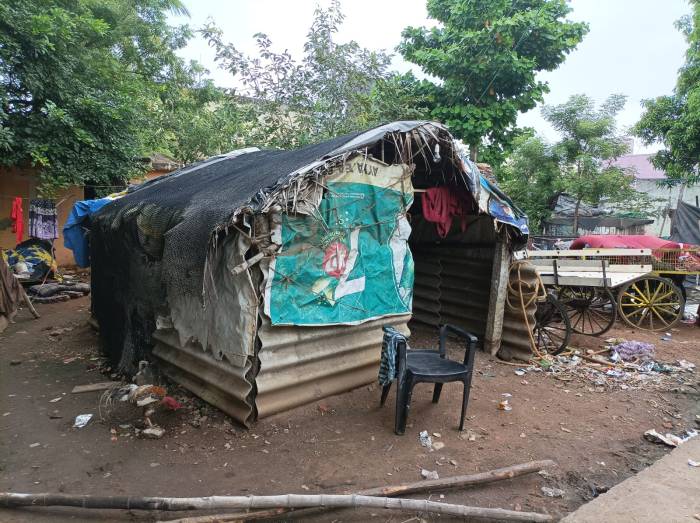
A hut in Mappedu, on the outskirts of Chennai, India.

The Narikuravar: A community in need of protection

In January 2023, CSW visited the Narikuravar community in Mappedu, on the outskirts of Chennai, and met with members of a community who for decades have suffered discrimination on the grounds of gender, and more recently on the grounds of religion as well. The following blog offers some reflections on the visit. Please note that the names have been changed for security reasons.

Radhika, a mother of three young girls, sat inside a little room with a thatched roof. With folded hands and a scarf over her head, she knelt down and prayed earnestly before turning to speak with me.  As a woman from a disregarded community who is also subject to restrictive gender-specific traditions, she would be excused for lamenting her circumstances but says that her new-found faith gives her the hope to live each day.

Radhika belongs to the Narikuravar community, a semi-nomadic tribe who were originally hunters and gatherers. She lives with around 30 other Narikuravar families in a tiny colony in Mappedu on the outskirts of Chennai. The Narikuravars have faced and continue to face discrimination in all spheres of life, including education, employment and even in securing accommodation.

Continue reading “The Narikuravar: A community in need of protection”
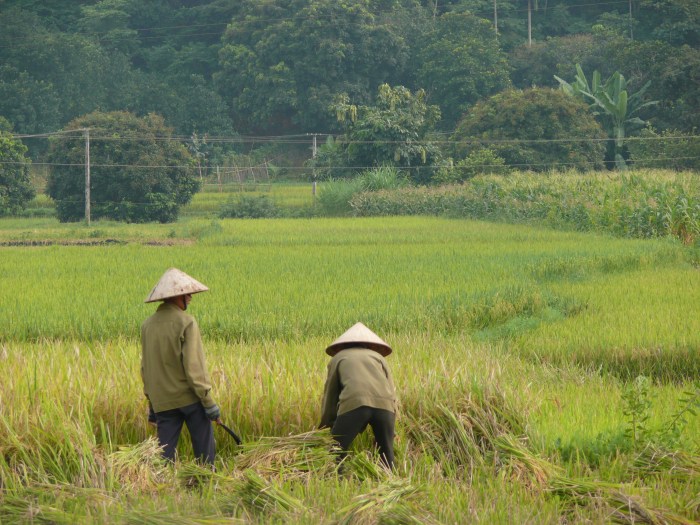
Farmers in Vietnam.

A gap between policy and practice: In Vietnam, many indigenous communities are forbidden to use their own language

‘We had a Christmas celebration with banners in different languages such as Jarai [and] Ede. The authorities did not like it, so they forbade us from using the banners in our languages.’

Christian from an indigenous people group in Vietnam

Article 5 of Vietnam’s constitution states that ‘every ethnic group has the right to use its own language and system of writing, to preserve its national identity, and to promote its fine customs, habits, traditions and culture’.

And the International Covenant on Civil and Political Rights, to which Vietnam is a party, states that persons belonging to minority groups ‘shall not be denied the right, in community with the other members of their group, to enjoy their own culture, to profess and practise their own religion, or to use their own language’.

Continue reading “A gap between policy and practice: In Vietnam, many indigenous communities are forbidden to use their own language”
Protesters with Myanmar/Burma flag painted on their wrists.

Two years after the coup, we must do all we can to stop the carnage in Myanmar

By Benedict Rogers

Two years ago today, the Commander-in-Chief of Myanmar/Burma’s military, Senior General Min Aung Hlaing, shattered the dream of a democratic, free Myanmar and plunged the country back into bloody, brutal repression. When he seized power in a coup d’etat on 1 February 2021, overthrowing the country’s democratically elected civil leader Aung San Suu Kyi and her National League for Democracy (NLD)-led government, he tore up a decade of the military’s own reform process and returned Myanmar to pariah status in the international community.

The coup unleashed a new war on this beautiful but benighted country that has already endured 76 years of civil war. The impoverished country which had been beginning to emerge into the world economy, attracting foreign investment as it liberalised politically, has been consigned to even harsher levels of poverty, and a humanitarian and human rights crisis even more severe than under previous military regimes.

According to the Assistance Association for Political Prisoners (AAPP), 17,492 people have been arrested in the past two years since the coup, and 13,689 are still in prison. The junta has killed at least 2,894 people, including 282 children. At least 143 people have been sentenced to death, including 42 in absentia. But these are only the figures recorded – the real death toll, taking into account the military’s offensives in the ethnic regions, is likely to be much, much higher. Indeed, in his September 2022 report, the United Nations special rapporteur for human rights in Myanmar Thomas Andrews estimated that more than 13,000 children have been killed, while 1.3 million people have been displaced and 28,000 homes have been destroyed. He said Myanmar’s crisis was spiralling from ‘bad to worse to horrific.’

Continue reading “Two years after the coup, we must do all we can to stop the carnage in Myanmar”
A restricted area in Chhattisgarh, India.

Chhattisgarh’s tribal Christian communities continue to live in fear

For tribal Christian communities in India’s Chhattisgarh State, the new year hasn’t really come with hopes of a better or safer future.

On 2 January a Hindu nationalist mob barged into the Vishwa Dipti Christian School campus in Narayanpur district and vandalised a church located within the premises of the school. Videos of the mob repeatedly hitting statues of Jesus and Mary, and scattering furniture surfaced on the internet. Both members of the mob and the churchgoers belonged to local tribes in Narayanpur, the two most prominent of which are the Gond and Muria tribes.

But what grabbed national headlines and went viral on social media was the image of a bleeding senior police official who was attacked by the mob when he tried to intervene. Narayanpur’s Superintendent of Police Sadanand Kumar was soon rushed to the hospital after suffering a serious head injury. Christians in Chhattisgarh have suffered attacks like these for several months with hardly any interest from the media, but it was only when a person of power was injured that anyone paid any attention.

Continue reading “Chhattisgarh’s tribal Christian communities continue to live in fear”
Vehicles carry ballistic missiles in a Victory Day parade in North Korea.

Kim Jong-Un cares more about his weapons than the people of North Korea

Last year, North Korea launched over 90 ballistic, cruise and hypersonic missiles – more than any other year in the country’s history. 

Its annual volley of weapons testing began on 5 January 2022 with the successful launch of a hypersonic missile. By 30 January, the state had conducted its biggest missile launch since 2017, and in September, it passed a law declaring itself to be a nuclear weapons state.

In November, North Korea launched an intercontinental ballistic missile into the Sea of Japan, 210km west of the island of Hokkaido. Japan’s defence minister declared that, launched at a lower trajectory, the missile had the range to hit the US mainland carrying nuclear warheads.

Continue reading “Kim Jong-Un cares more about his weapons than the people of North Korea”