Chinese human rights lawyer Jiang Tianyong and his wife Jin Bianling and daughter. Source: Twitter @jinbianling

‘Worse than physical torture’ – how China uses exit bans to inflict suffering on human rights defenders and their loved ones

‘Today, I received terrible news that our dream of reunion has once again been dashed.’

On 22 May 2023, Jin Bianling learnt that her husband Jiang Tianyong’s applications for a passport and a travel pass for Hong Kong and Macau had been turned down again. It had been ten years since the disbarred award-winning human rights lawyer was separated from his wife and daughter.

Being blocked from leaving China by the authorities has become common under Xi Jinping’s rule. Some have had their passport applications or renewals turned down, others have been stopped at the airport by police, such as the exiled activist Lin Shengliang’s 12-year-old daughter, while still others have had their boarding passes torn up by airport security guards. In the case of 80-year-old historian and writer Zhang Yihe, just a word from one of the government departments was enough to bar her from leaving China. She revealed on 8 June 2023 that she had become ‘a prisoner of the state’ as of the day before, unable to travel abroad.

Continue reading “‘Worse than physical torture’ – how China uses exit bans to inflict suffering on human rights defenders and their loved ones”
Chinese human rights lawyer Lu Siwei. Credit: Radio Free Asia

China, stop targeting overseas human rights defenders

‘Three policemen have come. They want to take me away. I can’t send you messages anymore.’

Zhang Chunxiao recalled these as the last words her husband left her before his detention in Laos on Friday 28 July 2023.

Lu Siwei was taken by Lao police while trying to travel to Thailand, where he would board a flight to the United States to reunite with Zhang and their 14-year-old daughter.

Mr Lu is a well-known Chinese human rights lawyer, whose license was revoked by authorities in 2021 following years of representing clients deemed to be dissidents by the authorities.

Continue reading “China, stop targeting overseas human rights defenders”
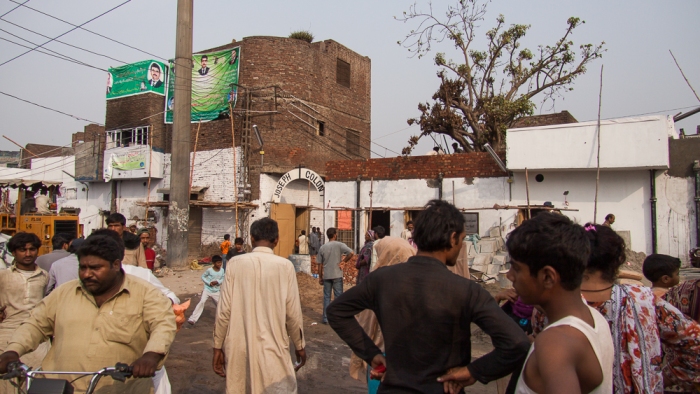
Joseph Colony in Lahore, Pakistan, which was infamously attacked in March 2013 after Sawan Masih was accused of blasphemy.

Pakistan needs to wake up to its blasphemy law crisis before it is too late

Last month, the desecration and burning of the Quran in Stockholm, Sweden sparked worldwide condemnation. Pakistan witnessed widespread protests and termed the act as blasphemous and deeply damaging to the sentiments of the Muslim community. A banned extremist group in the country, Lashkar-e-Jhangvi, labelled it as an attack by Christians on Muslims and called on their followers to attack Christian settlements and kill Christians, while further vowing that they will make Pakistan a ‘hell for Christians’.

Last week, in the city of Sargodha, in Punjab province, a blasphemous poster was found near a local mosque. It prompted locals to gather in protest and demand that the police find a Christian from the nearby Christian settlement of Maryam Town. Since then, tensions in the area have been high with most of the 3,000-4,000 Christian families fleeing their homes due to fear of a mob related attacks.

Tensions over blasphemy have already had devastating consequences in Pakistan this year. On 6 May, a local cleric in the city of Mardan, Khyber Pakhtunkhwa province, was killed by a mob after he was accused of making a blasphemous reference during a political rally of former Prime Minister Imran Khan’s party. In February a mob in the city of Nankana Sahib, Punjab, stormed the police station and proceeded to lynch and kill a man accused of blasphemy.

Continue reading “Pakistan needs to wake up to its blasphemy law crisis before it is too late”
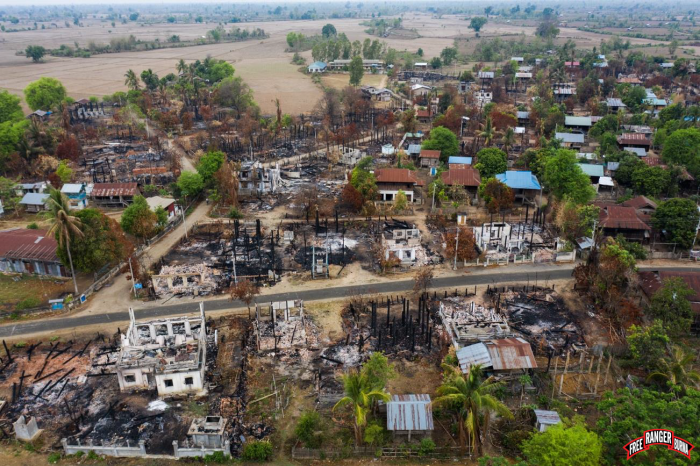
Fires in India's Manipur state.

‘We don’t know how we can restart our lives’ – stories from Manipur

‘On 3 May, around 10pm, we heard people throwing stones at our house. We didn’t understand what was happening. In the morning, we woke up and we were cooking. We saw that there was a frenzy outside. Everyone was walking out of their homes with their bags packed. They asked us why we were still at home and explained the situation. We were scared.’

Runa, Imphal

India’s Manipur State has been engulfed in violence for two and a half months now. Sparked by a protest on 3 May in which an estimated 60,000 people marched in opposition to the Manipur High Court’s request to the state government to send a recommendation to the central government to include the non-tribal Meitei community in the Scheduled Tribe (ST) category, the unrest has claimed at least 100 lives, with local sources suggesting that the death toll is significantly higher.

Thousands of homes have been burned down and tens of thousands of people have been forcibly displaced in a dispute over whether the predominantly Hindu Meitei community should be granted access to the same benefits afforded to the state’s typically more disadvantaged tribal communities.

Continue reading “‘We don’t know how we can restart our lives’ – stories from Manipur”
North Korea flags.

With echoes of ‘the most difficult time in North Korean history’, the international community must do more to bring about change

Earlier this month, the BBC released information gathered from exclusive interviews with three individuals living inside North Korea. Their reports have brought the country back into the headlines, revealing the devastating reality of the situation for North Korean citizens since the COVID-19-triggered border closure in January 2020. They describe widespread starvation and brutal repression, without feasible means of escape.

Hanna Song from the North Korean Database Centre for Human Rights (NKDB) said in an interview with the BBC ‘This [report] takes us back to the most difficult time in North Korean history.’

Song is referring here to the widespread famine of the 1990s known as the arduous march.

The Democratic People’s Republic of Korea (DPRK) was founded in 1948 under the leadership of Kim Il-Sung. The communist nation’s economy was built on a system of state control: a public distribution system for food and material goods, and a state-assigned job system dictating citizen employment.

Continue reading “With echoes of ‘the most difficult time in North Korean history’, the international community must do more to bring about change”