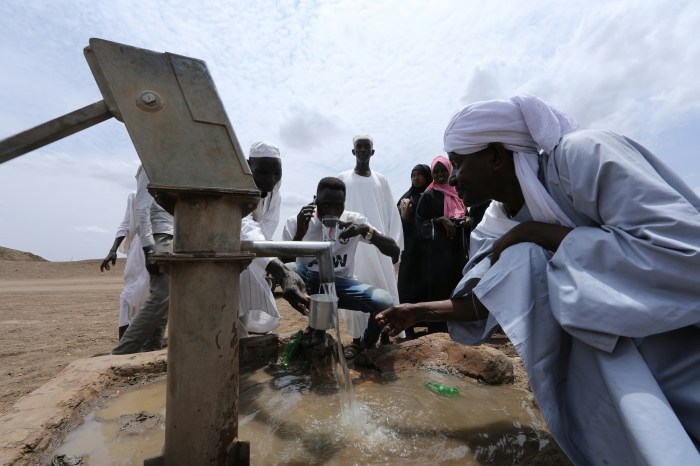
A year of conflict in Sudan – the international community must act now

This week marks one year since war broke out between the Sudanese Armed Forces (SAF) and the Rapid Support Forces (RSF), in the culmination of tensions and contradictions that have existed between the two groups since they seized power from the transitional government in October 2021.

What has been unusual about this war is that it started in the capital, Khartoum, and spread throughout the country. Since Sudan gained independence in 1956, conflicts and even revolutions have originated outside of the capital, which has often led to the insulation of communities in the centre, and arguably the north, of Sudan from the worst ramifications of the instability. Today however, few places in the country have been spared the large-scale hostilities between the two groups, and its impact on civilians has been catastrophic.

As the conflict enters its second year, it has claimed the lives of at least 13,000 people, and more than 33,000 have been injured. With the war intensifying in populated cities, the number of internally displaced persons (IDPs) has risen to more than nine million, and the number of those facing hunger is now estimated to be as high as 20 million. In addition, there are over two million refugees, half of them Darfuri, also facing hunger. Tragically, for the second time in 20 years, there are also credible reports of atrocity crimes, with the Prosecutor of the International Criminal Court (ICC) noting that the situation now in Darfur is worse than when the Security Council referred Sudan to the court.

Continue reading “A year of conflict in Sudan – the international community must act now”

International Women’s Day: A plea to end conflict-related sexual and gender-based violence  

Warning: This blog contains details some readers may find distressing. 

‘They destroyed my life; they sold and bought me like a sheep.’ 

Kofan was 14 years old when Islamic State (IS) terrorists abducted her from her village in Sinjar in northern Iraq in 2014.  

Over the subsequent decade she was sold as a sex slave multiple times, and at one point she was ‘owned’, along with six other women, by an elderly man called Abou Jaafar. The group of women were all brutally beaten and repeatedly raped while in captivity. 

Continue reading “International Women’s Day: A plea to end conflict-related sexual and gender-based violence  “
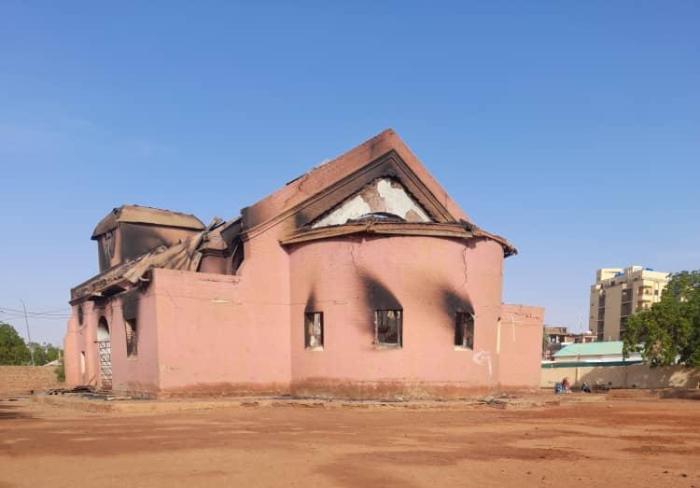
The Episcopal/Evangelical Church in Omdurman, which was shelled on 1 November 2023.

Sudan must not be allowed to slip off the international agenda

‘The land is valuable, and it will be easier to seize it if the buildings have been destroyed by war.’

This was the reaction of a CSW source to the bombing of churches and properties in Omdurman and Khartoum El-Shajara in Sudan at the start of the month.

On 1 November the Sudanese Armed Forces (SAF) shelled and completely destroyed a church that was used by the Episcopal and Evangelical denominations in Omdurman. It was the largest and second oldest church in the area, and its destruction came just three weeks after the Evangelical Commercial School and the Evangelical Secondary School were also bombed.

Continue reading “Sudan must not be allowed to slip off the international agenda”
Man in black and white long sleeve shirt holding red stick in Sudan.

As Sudan forms a new transitional government, the international community must not repeat its mistakes

April has become a significant month for the nation of Sudan. This year, after more than 18 months under the leadership of a military junta that seized power in October 2021, the month will hopefully see the formation of a new transitional government, and the possible dawn of a new chapter for the country.

But we have been here before. On 11 April 2019, after months of unprecedented nationwide protests, Sudan’s president of nearly 30 years, Omar al Bashir, was ousted.

It was hoped that his removal would bring an end to three decades of oppressive rule characterised by widespread violations of human rights, including of the right to freedom of religion or belief (FoRB) – and to some extent it did.

Continue reading “As Sudan forms a new transitional government, the international community must not repeat its mistakes”
A United Nations building in Geneva, Switzerland.

Disappointments at the UN, but we must not let the challenges obscure the good that it can achieve

Earlier this month, the UN General Assembly (UNGA) voted to elect 14 new members to the Human Rights Council (HRC) to serve from 2023 to 2025. Among those elected were Sudan and Vietnam. The former was selected in a clean slate election, meaning that the number of candidates equaled the number of seats available, while the latter defeated Afghanistan and the Republic of Korea (South Korea). 

The election of both of these states is deeply disappointing.  

Sudan is currently led by a military leader who seized power illegally from the civilian-led transitional government in an October 2021 coup, and where the past year has been characterized by the killing and brutalising of peaceful protesters, and attempts to reverse the limited human rights gains made under the transitional government, including in relation to the right to freedom of religion or belief (FoRB). 

The Vietnamese Communist Party (VCP) has led the northern part of Vietnam since 1954, and took control of the rest of the country in 1975, following the collapse of the South Vietnamese government. During that time, the VCP has repeatedly violated human rights, including FoRB and land rights, whilst routinely targeting those who request or advocate for such rights with harassment, arbitrary detention, imprisonment, physical violence and even torture

Continue reading “Disappointments at the UN, but we must not let the challenges obscure the good that it can achieve”