The Impact of Sudan’s Identity War on Freedom of Religion or Belief

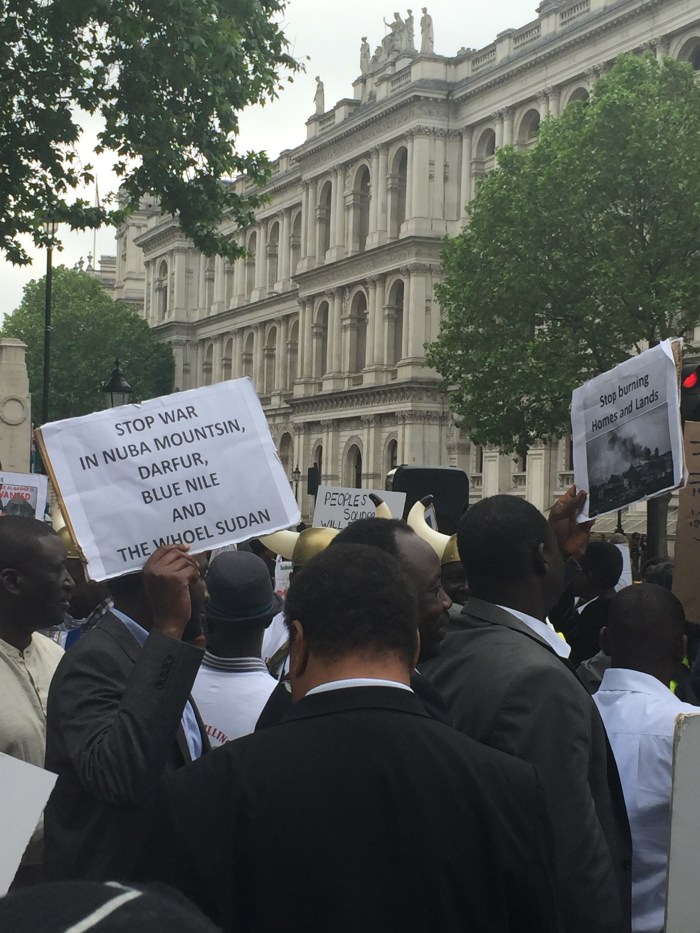
In June 2016, CSW joined a number of African and international civil society organisations in signing and delivering a letter marking the fifth anniversary of the conflicts in South Kordofan and Blue Nile regions, to 10 Downing Street. The letter urged the Prime Minister to use the UK’s considerable influence to ensure that international human rights and humanitarian law are respected.

Protesters walked from the Sudanese Embassy in London to Downing Street to deliver the letter. Among those taking part, it was striking to see veiled and unveiled Sudanese women from the Nuba Mountains, people from other parts of South Kordofan and Darfur, young children, and men in traditional Nuba dress united in calling for an end to all conflicts in Sudan.

This demonstration of unity in diversity was compelling, as was the cry for peace and freedom for all Sudanese citizens. The repression of religious and ethnic diversity in Sudan has been used repeatedly by President al Bashir’s government to sustain his 27-year rule, and what was clearly expressed on that overcast Saturday afternoon in London was the longing for an end to conflicts that serve to perpetuate a divisive government and for a lasting peace in which people can live side by side without fear, regardless of their cultural, linguistic, ethnic or religious differences.

Continue reading “The Impact of Sudan’s Identity War on Freedom of Religion or Belief”
The Plight of the Rohingya – His Eminence Cardinal Charles Maung Bo Addresses the Houses of Parliament, London, 25 May 2016

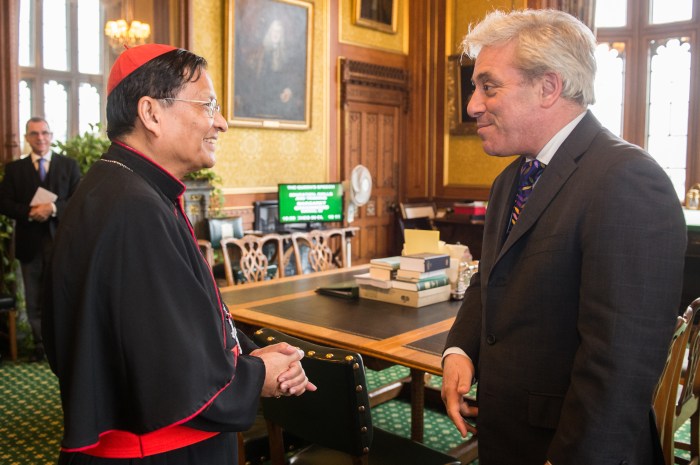
On May 25th Cardinal Charles Maung Bo of Burma, spoke before a meeting chaired by Lord Alton and hosted by the All Party Parliamentary Group on Burma, the All Party Parliamentary Group on International Freedom of Religion or Belief, and the Catholic Legislators Network. Below are sections from that speech, on freedom of religion or belief (FoRB) in Burma and the plight of Rohingya Muslims in Burma. Please contact CSW‘s office for a copy of the full speech and further recommendations. 


My country, Myanmar, now stands on the threshold of hope. We were once a Good Friday people, enduring our crucifixion as a nation on the cross of inhumanity and injustice, with five nails: dictatorship, war, displacement, poverty and oppression. Easter seemed a distant dream. My country was buried in the tomb of oppression and exploitation for six decades.

But today, we can perhaps begin to say that we are an Easter people. A new dawn has arisen. But it brings with it fresh challenges: reconciliation and peace-making, religious intolerance, land grabbing, constitutional limitations, and the fragile nature of a nascent democratic transition. And the old dangers have not gone away: the military remains powerful, corruption is widespread, and ethnic conflict continues in some parts of Myanmar.

“We were once a Good Friday people, enduring our crucifixion as a nation on the cross of inhumanity and injustice (…) But today, we can perhaps begin to say that we are an Easter people. A new dawn has arisen.”

Despite winning an enormous mandate from the people, Aung San Suu Kyi is barred by the Constitution from becoming President. The military, under the Constitution, retain control of three key ministries – Home Affairs, Border Affairs and Defence – and 25% of the seats in Parliament reserved for them. One of the two Vice-Presidents is a military appointee. So the new government is constrained, the military is still very powerful, and the country continues to face enormous challenges. Our journey has not ended; we are simply entering into a new chapter in our continuing struggle for freedom, democracy, human rights, human dignity and peace.

Continue reading “The Plight of the Rohingya – His Eminence Cardinal Charles Maung Bo Addresses the Houses of Parliament, London, 25 May 2016”