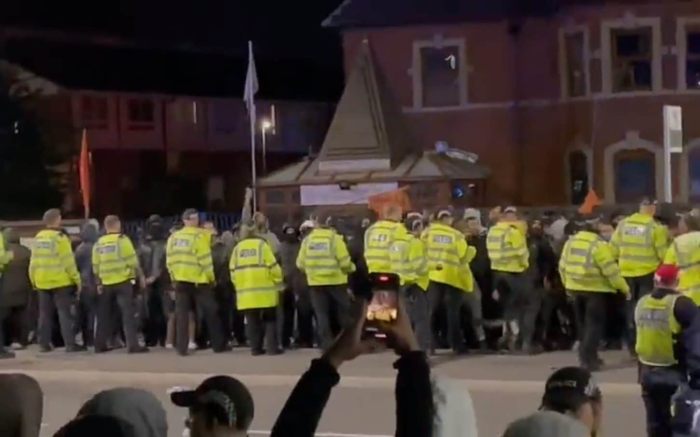
Police contain protesters following an outbreak of communal violence between Hindus and Muslims in Leicester, UK.

“Jai Shri Ram” on the streets of Leicester as India’s Hindu nationalism stretches beyond its borders

“Jai Shri Ram”, translating from Hindi as “hail Lord Ram” or “victory to Lord Ram”, is meant to be a harmless informal greeting, a proclamation of one’s faith and an expression of praise for a well-known Hindu deity.

Sadly, the expression has taken on far more sinister connotations in recent years. For far-right Hindu nationalists in India, who have been significantly emboldened over the past eight years under Prime Minister Narendra Modi and his ruling Bharatiya Janata Party (BJP), the slogan has been appropriated as a rallying cry for violent extremists.

CSW receives regular reports of communal violence in which the perpetrators have either chanted those three words while carrying out their attacks, or in some cases pressured their victims to declare them, forcing them to contradict their own religion or belief.

Continue reading “Jai Shri Ram” on the streets of Leicester as India’s Hindu nationalism stretches beyond its borders

A helicopter’s alleged involvement in Kaduna terrorist attacks could mean one of two things

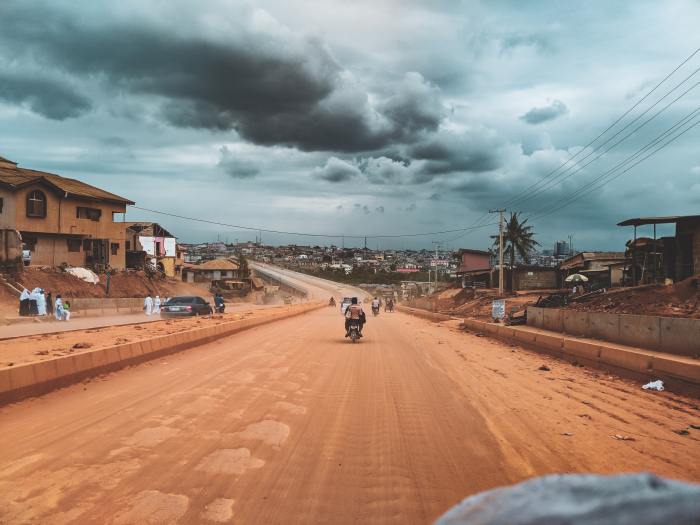
5 June brought with it familiar agony for four villages in southern Kaduna state, Nigeria. According to local reports, attackers of Fulani ethnicity are said to have descended on the villages of Dogon Noma, Maikori, Ungwan Gamu and Ungwan Sarki at around noon, with violence continuing for approximately six hours.

In consistency with previous reports of militia attacks in the region, the assailants were reportedly grouped three to a motorcycle, with one man to drive, and two others to shoot to the right and left respectively.

At least 32 people were killed across the four villages, while an unknown number remain missing following the latest attack to specifically target the Adara people, who have suffered violence at the hands of Fulani assailants for several years now.

Continue reading “A helicopter’s alleged involvement in Kaduna terrorist attacks could mean one of two things”

Her name was Deborah Emmanuel – blasphemy accusations claim another life in Nigeria

Her name was Deborah Emmanuel – a second-year Christian student of Home Economics at the Shehu Shagari College of Education in Sokoto state, Nigeria. She should have been safe from harassment and violence at an academic institution. But she wasn’t.

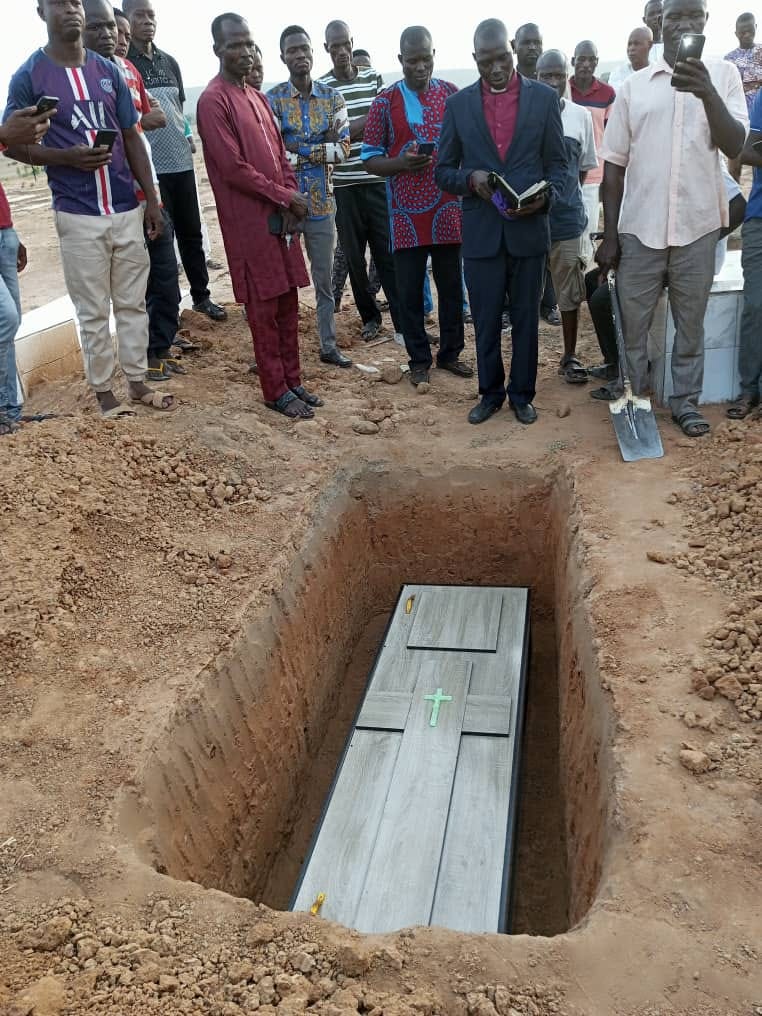
On 12 May Ms Emmanuel was brutally beaten and stoned to death by a predominantly male mob who proceeded to immolate her in a pile of tyres whilst chanting “Allahu Akbar”. She was buried just two days later.

Deborah Emmanuel is buried on 14 May

Ms Emmanuel was killed after she was falsely accused of blaspheming the Prophet Mohammed in a WhatsApp group chat in which she reportedly expressed exasperation at members posting religious articles and asked them to focus on issues relevant to course work, as it was a departmental group.

Continue reading “Her name was Deborah Emmanuel – blasphemy accusations claim another life in Nigeria”

Long Read: One year since the Lekki Toll Gate massacre, Nigeria continues its slide into failed statehood

On 20 October 2020 Nigerian security forces at the Lekki Toll Gate in Lagos opened fire on unarmed and peaceful demonstrators who had gathered to protest the notorious police unit, the Special Armed Robbery Squad (SARS) and call for good governance. The soldiers opened fire just as the protestors finished singing the national anthem.  When they withdrew, the police arrived and also opened fire.

Estimates of those killed are variable, ranging from nine to over 70. The real number could be higher still, with video footage subsequently emerging which appeared to confirm allegations by survivors that the military had evacuated bodies from the scene in armoured vehicles, as had occurred in 2015 when soldiers attacked Islamic Movement of Nigeria (IMN) facilities in Zaria, Kaduna state, and more recently, during an armed raid on the home of a Yoruba activist in Ibadan.  

Prior to attacking, engineers had arrived at the toll gate earlier that afternoon and removed and disabled the CCTV. Just before the attack began, the lights in the area were switched off. 

The Nigerian army, which was ostensibly enforcing a curfew announced by the Lagos state government just hours before the attack, initially attempted to deny responsibility, and even claimed soldiers were not in the area, despite footage from mobile phones proving otherwise.  The Governor of Lagos also attempted to distance himself from responsibility for the incident, visiting some of the wounded in hospital. However, he later claimed in a television address that there had been no casualties, enraging survivors, families of victims, and all who had followed livestreaming of the massacre on social media. Regardless of the number of casualties, these deaths amount to cynically executed extrajudicial killings of young people merely for demanding good governance and rule of law.

Continue reading “Long Read: One year since the Lekki Toll Gate massacre, Nigeria continues its slide into failed statehood”

Long Read: Removing the Obstacles to Freedom of Religion or Belief in Africa

Religion-related tensions continue to arise in many African countries. They come in varying forms and degrees of intensity, and can be intra-religious or occur between religious communities.

Religion is either instrumentalised as a rallying point or is the raison d’étre of armed non state actors seeking to enforce an extremist interpretation of their creed or to gain material advantage. It is used by individuals or political parties as a bridge to power and rallying point.  In addition, some governments view religion, or certain religious or non-religious groups, as threats, exercising control through excessive registration requirements or more forcible means. 

Every country on the African continent is a signatory to the International Covenant on Civil and Political Rights (ICCPR), with its expanded articulation of the right to freedom of religion or belief (FoRB), and to the African Charter on Human and Peoples Rights (ACHPR), where the right to change or refuse one’s religion or belief as an act of conscience can be inferred from Article 8. However, in parts of the continent, human rights in general, and FoRB in particular, are challenged by arguments about cultural relativism and frequent but erroneous assertions that they are a Western construct. 

Thus, despite being parties to international and regional treaties, many African countries either do not give legal effect to them, or create exemptions for their implementation. This has further exacerbated their already poor profile on human rights protection.

Continue reading “Long Read: Removing the Obstacles to Freedom of Religion or Belief in Africa”