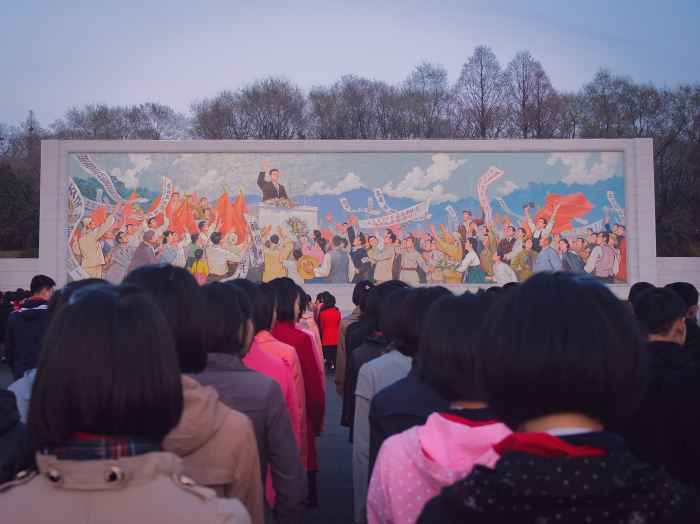
Women in front of a mural in North Korea.

Sisters separated for decades – the story of Kyu Li and Cheol-Ok

‘Every day I just miss her, I will find her. One day I will find her. If she’s alive.’

Kyu Li Kim hasn’t seen her younger sister Cheol-Ok since 1997. Like so many others who have fled rampant poverty, starvation and human rights violations in North Korea, her family has been separated for decades, often with little or no idea as to their whereabouts or wellbeing.

Kyu Li was just 20 years old when she left North Korea. She fled to China where she was sold to a Chinese Korean man for 3,000 Yuan. She told CSW that she was lucky that the family she was sold to were kind to her and had some money, and that they lived further from the border which meant she was less likely to be caught and returned to North Korea.

Continue reading “Sisters separated for decades – the story of Kyu Li and Cheol-Ok”

Seven years since Colombia’s peace agreement, but violence against the religious sector continues

On 30 November 2016, the Colombian Congress ratified a peace agreement between the government and the Revolutionary Armed Forces of Colombia-Army of the People (FARC-EP), a Marxist-Leninist guerrilla group.

It was hoped that the agreement would mark the beginning of the end of the complex internal conflict which has engulfed Colombia since 1958 and involves multiple far-left and far-right illegal armed groups, criminal groups, and government forces. However, seven years later peace remains elusive; the violence continues.

Undelivered promises

At first, things seemed to be improving; from 2016 to 2017, violence related to freedom of religion or belief (FoRB) appeared to decrease. However, from 2018 to 2022, and especially since 2019, the numbers have been on the upswing once again.

Continue reading “Seven years since Colombia’s peace agreement, but violence against the religious sector continues”

Siete años después del acuerdo de paz en Colombia, la violencia contra el sector religioso persiste

El 30 de noviembre de 2016, el Congreso colombiano ratificó un acuerdo de paz entre el gobierno y las Fuerzas Armadas Revolucionarias de Colombia-Ejército del Pueblo (FARC-EP), un grupo guerrillero marxista-leninista.

Se esperaba que el acuerdo marcara el comienzo del fin del complejo conflicto interno que ha afectado a Colombia desde 1958, involucrando a múltiples grupos armados ilegales de izquierda y derecha, grupos criminales y fuerzas gubernamentales. Sin embargo, siete años después, la paz sigue siendo esquiva; la violencia persiste.

Promesas incumplidas

Inicialmente, parecía que las cosas mejoraban; de 2016 a 2017, la violencia relacionada con la libertad de religión o creencia (FoRB, por sus siglas en inglés) parecía disminuir. Sin embargo, desde 2018 hasta 2022 y especialmente desde 2019, los números han vuelto a aumentar.

Continue reading “Siete años después del acuerdo de paz en Colombia, la violencia contra el sector religioso persiste”
Daffodils in front of the UK Houses of Parliament

Combatting impunity is essential for the realisation of the right to freedom of religion or belief 

Violations of freedom of religion or belief (FoRB) take many forms: harassment, discrimination, threats, imprisonment or even death on account of one’s religion or belief. The impunity that generally surrounds these violations undercuts the rule of law, denies justice to victims, and perpetuates an environment conducive to further violations. The issue is multifaceted and nuanced, with socio-political, legal, and psychological dimensions.

Socio-political implications

When state or non-state actors perpetrate FoRB violations without facing repercussions, it critically erodes public trust in the institutions responsible for upholding the rule of law. This erosion of trust threatens social cohesion and contributes to societal fragmentation.

Continue reading “Combatting impunity is essential for the realisation of the right to freedom of religion or belief “
The Episcopal/Evangelical Church in Omdurman, which was shelled on 1 November 2023.

No se debe permitir que Sudán quede fuera de la agenda internacional

“La tierra es valiosa y será más fácil apoderarse de ella si los edificios han sido destruidos por la guerra”.

Esta fue la reacción de una fuente de CSW ante el bombardeo de iglesias y propiedades en Omdurman y Jartum El-Shajara en Sudán a principios de mes.

El 1 de noviembre, las Fuerzas Armadas Sudanesas bombardearon y destruyeron por completo una iglesia utilizada por las denominaciones episcopal y evangélica en Omdurman. Era la iglesia más grande y la segunda más antigua de la zona, y su destrucción se produjo apenas tres semanas después de que también fueran bombardeadas la Escuela Comercial Evangélica y la Escuela Secundaria Evangélica.

Continue reading “No se debe permitir que Sudán quede fuera de la agenda internacional”