Daffodils in front of the UK Houses of Parliament

Combatting impunity is essential for the realisation of the right to freedom of religion or belief 

Violations of freedom of religion or belief (FoRB) take many forms: harassment, discrimination, threats, imprisonment or even death on account of one’s religion or belief. The impunity that generally surrounds these violations undercuts the rule of law, denies justice to victims, and perpetuates an environment conducive to further violations. The issue is multifaceted and nuanced, with socio-political, legal, and psychological dimensions.

Socio-political implications

When state or non-state actors perpetrate FoRB violations without facing repercussions, it critically erodes public trust in the institutions responsible for upholding the rule of law. This erosion of trust threatens social cohesion and contributes to societal fragmentation.

Continue reading “Combatting impunity is essential for the realisation of the right to freedom of religion or belief “
Fang Bin with his wife and son in an undated photo.

A family shattered for 24 years – the story of Falun Gong activist Fang Bin

Crowded hospital halls, frantic doctors and nurses in protective suits, patients lying in the corridors, body bags piled up in a funeral van outside a hospital… In early February 2020, 57-year-old businessman Fang Bin drove around Wuhan and documented what he saw in five hospitals. The short videos he posted on social media gave a rare glimpse into what was happening in the epicentre of the pandemic under lockdown.

Mr Fang was detained by police briefly on 1 February 2020. In the next few days, he became more outspoken. Videos were widely shared on social media in which he commented that ‘tyranny lies at the root of this virus’. Then, on 9 February 2020, he vanished after calling ‘all citizens to resist’ tyranny and the government to ‘return the power to the people’ on YouTube, a platform banned in China.

The disappearances of Fang Bin, Zhang Zhan and at least two other citizen journalists drew the attention of world media. Although Mr Fang and his wife are known to the authorities as veteran Falun Gong activists, people who are familiar with him hesitated in mentioning his faith background when calling for his release. They may have been conscious of the social stigma attached to this belief group in China, or feared that he might be jailed not for his online speech but for his faith, or even that he might face mistreatment for it in police custody.

Continue reading “A family shattered for 24 years – the story of Falun Gong activist Fang Bin”
Chinese human rights lawyer Jiang Tianyong and his wife Jin Bianling and daughter. Source: Twitter @jinbianling

‘Worse than physical torture’ – how China uses exit bans to inflict suffering on human rights defenders and their loved ones

‘Today, I received terrible news that our dream of reunion has once again been dashed.’

On 22 May 2023, Jin Bianling learnt that her husband Jiang Tianyong’s applications for a passport and a travel pass for Hong Kong and Macau had been turned down again. It had been ten years since the disbarred award-winning human rights lawyer was separated from his wife and daughter.

Being blocked from leaving China by the authorities has become common under Xi Jinping’s rule. Some have had their passport applications or renewals turned down, others have been stopped at the airport by police, such as the exiled activist Lin Shengliang’s 12-year-old daughter, while still others have had their boarding passes torn up by airport security guards. In the case of 80-year-old historian and writer Zhang Yihe, just a word from one of the government departments was enough to bar her from leaving China. She revealed on 8 June 2023 that she had become ‘a prisoner of the state’ as of the day before, unable to travel abroad.

Continue reading “‘Worse than physical torture’ – how China uses exit bans to inflict suffering on human rights defenders and their loved ones”
Chinese human rights lawyer Lu Siwei. Credit: Radio Free Asia

China, stop targeting overseas human rights defenders

‘Three policemen have come. They want to take me away. I can’t send you messages anymore.’

Zhang Chunxiao recalled these as the last words her husband left her before his detention in Laos on Friday 28 July 2023.

Lu Siwei was taken by Lao police while trying to travel to Thailand, where he would board a flight to the United States to reunite with Zhang and their 14-year-old daughter.

Mr Lu is a well-known Chinese human rights lawyer, whose license was revoked by authorities in 2021 following years of representing clients deemed to be dissidents by the authorities.

Continue reading “China, stop targeting overseas human rights defenders”
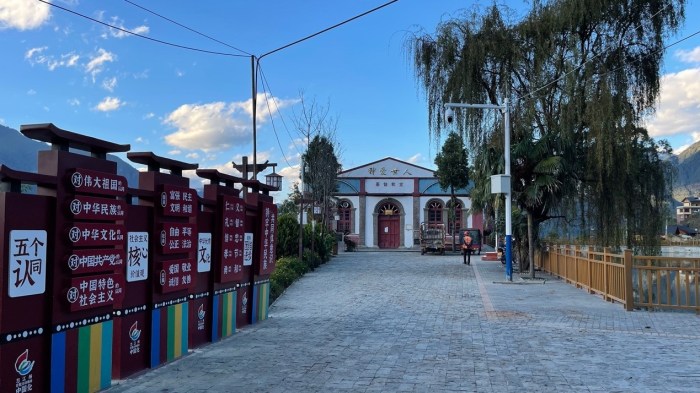
A series of political slogan boards erected outside Laomudeng Church in Yunnan, China.

‘The Yunnan Model’ could be an indicator that life is going to get even harder for religious and ethnic groups across China

Wang Shunping, Nu Sangdeng, San Luobo, Hua Xiuxia and Dong Mengru spent the past nine months in detention.

Their crime? Holding a handful of Christian gatherings and teaching guitar and hymns to a group of young people in their rented home in Fugong County in the Nujiang Lisu Autonomous Prefecture of China’s Yunnan Province.

Though they were released on bail on 7 May, the charges against them relating to ‘organising and sponsoring an illegal gathering’ are yet to be dismissed.

All five individuals – three men and two women – work among the ethnic Nu community, one of the 56 ethnic groups officially recognised by the Chinese authorities; the three men are Nu ethnic preachers. In China, the majority of the Nu live in Yunnan, where a significant history of Western missionary activity has resulted in a large Protestant Christian population alongside the majority religions of Buddhism and tribal animism.

Continue reading “‘The Yunnan Model’ could be an indicator that life is going to get even harder for religious and ethnic groups across China”