A protester holds a sign that reads 'Woman Life Freedom' during demonstrations following the following the death of Iranian woman Zhina ‘Mahsa’ Amini.

‘Woman, Life, Freedom’ – Iran faces a crisis with freedom of religion or belief and gender equality at its core

Iran is enduring its most turbulent period since the 2019-2020 pro-democracy protests, with gender equality and a lack of freedom of religion or belief at its very core. 

Since September 2022 distressing news reports have been emerging of violence meted out on Iranian citizens protesting for change – the arbitrary application of the death penalty, extrajudicial killings (including of minors),  maiming, excessive sentencing, and the suspicious deaths of several protestors after being released from detention, to highlight a few.

In the face of these violations an initially slow and largely reactive international response accelerated, and a special session of the UN Human Rights Council in November 2022 which established an independent, international fact-finding mission to investigate alleged human rights violations related to the protests, was followed by Iran’s expulsion from the UN Commission on the Status of Women in December 2022. Then in January 2023 the United States, the United Kingdom and the European Union announced sanctions on 10 additional Iranian individuals and one additional Iranian entity.

Continue reading “‘Woman, Life, Freedom’ – Iran faces a crisis with freedom of religion or belief and gender equality at its core”
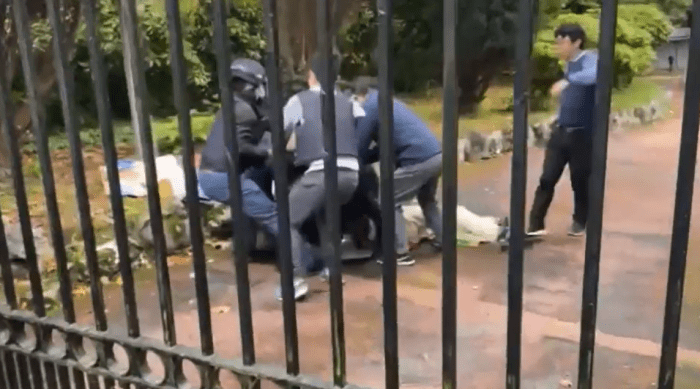
Bob Chan is beaten inside the grounds of the Chinese consulate in Manchester, UK.

As China, Eritrea, Iran and more extend repression beyond their own borders, we must do better

In November last year, Ken McCallum, the Director General of the UK’s Security Service known as MI5, claimed that his agency had identified “at least ten” potential threats to kidnap or even kill British or UK-based individuals perceived as enemies of the Iranian regime. He added that the Iranian intelligence services “are prepared to take reckless action” against opponents in the West, including by luring individuals to Iran.

Coming at a time of intense civil unrest in Iran following the death in police custody of 22-year-old Mahsa Amini, who was arrested for incorrectly wearing her hijab, McCallum’s comments highlighted a concerning issue that applies to several of the countries CSW works on: repressive regimes are becoming increasingly unafraid to reach beyond their borders.

China

Perhaps one of the most obvious examples is China, a global superpower which regularly uses its economic and geopolitical influence to shape decisions in international fora such as the Human Rights Council, and routinely metes out sanctions against Western parliamentarians and others who openly condemn the widespread violations taking place in the country.

Continue reading “As China, Eritrea, Iran and more extend repression beyond their own borders, we must do better”
A protester holds a sign that reads 'Stop killing my people' during demonstrations against the coup in Myanmar/Burma.

In a world of crises and tragedy, we must not forget about Myanmar

By Benedict Rogers

When Myanmar (Burma)’s army reportedly killed 11 children in a helicopter attack last week, those of us who follow Myanmar heaved a sigh and shed a tear, and the rest of the world gave a shrug and averted its gaze. In a world filled with so much tragedy, the crisis in Myanmar seems to be passing so many by. For those of us watching, it was yet another bombing, yet another massacre, yet another atrocity – and dare I say it, yet another attack which has become daily news.

It’s staggering, really. Myanmar’s illegal military regime seized power in a coup just over 18 months ago, overthrowing a democratically elected government, snuffing out a decade of hoped-for liberalization, and turning the clock back by at least ten years – and yet the rest of the world shrugs its shoulders. A brutal, criminal dictatorship has locked up a Nobel Laureate – who had already spent years under house arrest and then a decade sharing power with the military in government – and the world turns its back. A junta arrests and jails a former British ambassador, Vicky Bowman, alongside an Australian academic, Sean Turnell, both of whom I know, and no one really says a word. And that regime spends months relentlessly bombing innocent civilians and the international community is silent. What is going on?

True, the world right now is full of woes. The war in Ukraine. The energy crisis. The threats to Taiwan. Protests in Iran. And many other tragedies – some in the news, others forgotten. Nigeria. Yemen. Syria. North Korea. Hong Kong. The Xinjiang Uyghur Autonomous Region. These are all desperate heartaches which sometimes gain the spotlight and yet so often remain forgotten. But Myanmar is a Ukraine in slow-motion, and yet almost no one is speaking about it.

Continue reading In a world of crises and tragedy, we must not forget about Myanmar

‘A new front’ in the pursuit of justice in Cuba

On the night of 28 February, Cuban police and State Security agents carried out a raid, capturing a man who they had been searching for 44 days. He was taken to an interrogation center and given an ultimatum: leave the country within the week or spend the next 30 years in a maximum-security prison. In early March, the man said good-bye to his wife and baby daughter and boarded a plane to Europe. Eighteen hours later, he submitted a formal request for asylum in Switzerland.

The man had committed no act of violence, nor had he stolen anything. He is a pastor. His only crime was to have extended his pastoral work to reach out to and pray with the families of political prisoners.

The Cuban government has long been fearful of any link between religious groups and political dissidents and has, for decades, gone to great effort to keep both as separate as possible. This is in part a general strategy to socially isolate all those it considers to be dissidents, including political activists, human rights defenders and independent journalists, in order to weaken and ultimately neutralise them. However, it is also, whether any of the Cuban Communist Party leadership would admit it or not, a recognition of the power in the combination of spirituality with the fight for justice and freedom.

Continue reading “‘A new front’ in the pursuit of justice in Cuba”

“Un nuevo frente” en búsqueda de la justicia en Cuba

En la noche del 28 de febrero, la policía cubana y agentes de la Seguridad del Estado realizaron un allanamiento, apresando a un hombre al que buscaban desde hacía 44 días. Lo llevaron a un centro de interrogatorios y le dieron un ultimátum: Abandonar el país en una semana o pasar los próximos 30 años en una prisión de máxima seguridad. A principios de marzo, el hombre se despidió de su esposa y de su pequeña hija y abordó un avión rumbo a Europa. Dieciocho horas después, presentó una solicitud formal de asilo en Suiza.

El hombre no había cometido ningún acto de violencia, ni había robado nada. Él es un pastor. Su único delito fue haber extendido su labor pastoral para alcanzar y orar con las familias de los presos políticos.

El gobierno cubano ha temido durante mucho tiempo cualquier vínculo entre grupos religiosos y disidentes políticos y, durante décadas, ha hecho un gran esfuerzo para mantener a ambos lo más separados posible. Esta es en parte, una estrategia general para aislar socialmente a todos aquellos que considera disidentes, incluidos activistas políticos, defensores de los derechos humanos y periodistas independientes, con el fin de debilitarlos y, en última instancia, neutralizarlos. Sin embargo, es también, lo admita o no alguna dirigencia del Partido Comunista de Cuba, un reconocimiento del poder que se produce por la combinación de la espiritualidad con la lucha por la justicia y la libertad.

Continue reading ““Un nuevo frente” en búsqueda de la justicia en Cuba”