A year of conflict in Sudan – the international community must act now

This week marks one year since war broke out between the Sudanese Armed Forces (SAF) and the Rapid Support Forces (RSF), in the culmination of tensions and contradictions that have existed between the two groups since they seized power from the transitional government in October 2021.

What has been unusual about this war is that it started in the capital, Khartoum, and spread throughout the country. Since Sudan gained independence in 1956, conflicts and even revolutions have originated outside of the capital, which has often led to the insulation of communities in the centre, and arguably the north, of Sudan from the worst ramifications of the instability. Today however, few places in the country have been spared the large-scale hostilities between the two groups, and its impact on civilians has been catastrophic.

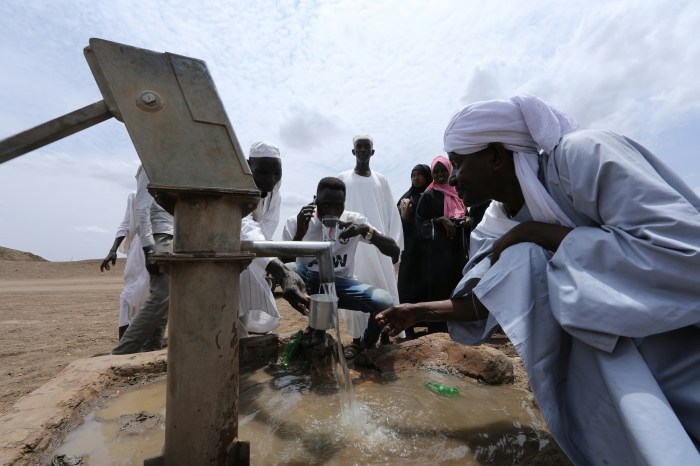
As the conflict enters its second year, it has claimed the lives of at least 13,000 people, and more than 33,000 have been injured. With the war intensifying in populated cities, the number of internally displaced persons (IDPs) has risen to more than nine million, and the number of those facing hunger is now estimated to be as high as 20 million. In addition, there are over two million refugees, half of them Darfuri, also facing hunger. Tragically, for the second time in 20 years, there are also credible reports of atrocity crimes, with the Prosecutor of the International Criminal Court (ICC) noting that the situation now in Darfur is worse than when the Security Council referred Sudan to the court.

Continue reading “A year of conflict in Sudan – the international community must act now”

Central African Republic: is justice being sacrificed for the illusion of peace?

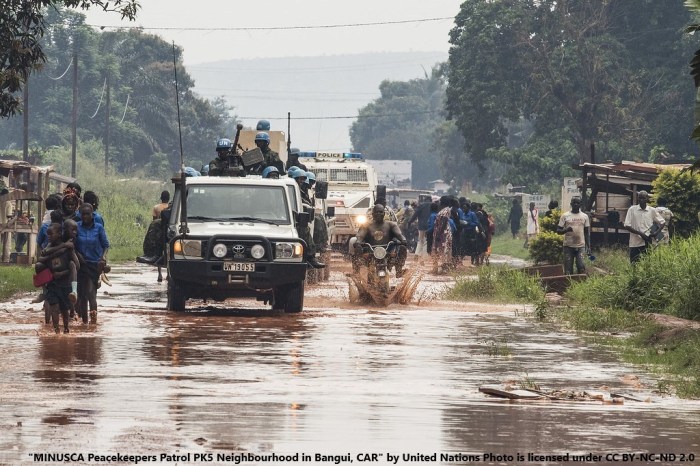
On 21 May, over 26 people were killed and dozens injured when an armed group attacked two villages in the north west of the Central African Republic (CAR). The attacks were reported by the UN peacekeeping mission in CAR, MINUSCA, which confirmed that twelve people were killed in Koundjili village and 14 in Djoumjoum village. 

Whilst reports of violent and devastating attacks on civilians in CAR are not new, these attacks represent a new challenge for the recently re-constituted government following the latest peace agreement between the government and armed groups.

The alleged perpetrator of the attacks on the two villages is the rebel group known as 3R (Return, Reclamation and Reconciliation). The group was formerly part of the Seleka alliance that took over the country following a coup in March 2013.  The alliance was subsequently disbanded, but armed groups fragmented and seized territories outside of the capital, Bangui.

Continue reading “Central African Republic: is justice being sacrificed for the illusion of peace?”

Religious Identity and Conflict in the Middle East

The Arab Spring reignited a debate within the Middle East and in academic circles about the universality of human rights and their compatibility, or incompatibility, with culture and religion. Although the Arab Spring was marked by the rise of Political Islam movements, it also opened the door  to discussions on topics that had long been taboo, such as sectarianism, racism and gender equality in the Arab world.

Religion has dominated politics in the Middle East for centuries, and plays a significant role in the lives of individuals: their rights, opportunities and social status are all impacted by it.

Constitutions, laws, education systems and even art and sport are viewed through the lens of religion, and every effort is made to ensure that these elements of society comply with religious norms and symbolism.

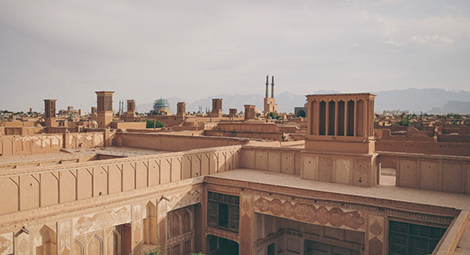
Sectarianism remains a powerful political, social and cultural force, and the source of most conflicts in the Middle East. Many of the current conflicts in the region have deep historical roots – most notably the ongoing Arab-Israeli conflict and the Sunni-Shi’a division.

Continue reading “Religious Identity and Conflict in the Middle East”

Warning Signs Unheeded: The Kandhamal Tragedy

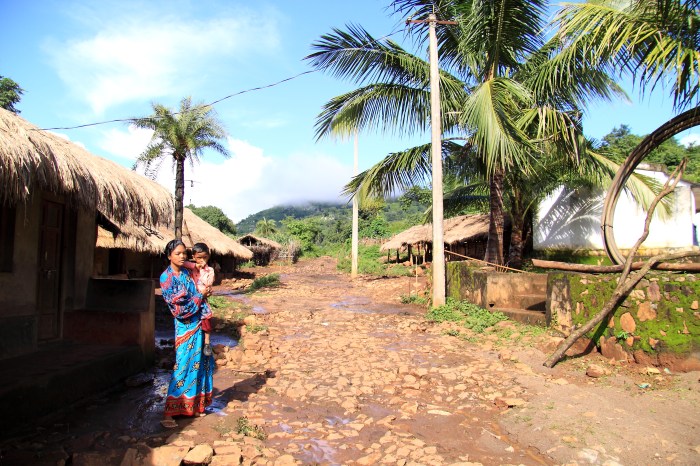
Kandhamal district is among the poorest and most marginalised in Odisha (formerly Orissa) state, India. On 25 August 2008, it was the epi-centre of communal attacks against the Christian community in India. Local monitoring groups have estimated that over 90 people were killed with at least 54,000 displaced and over 300 churches destroyed by groups belonging to the Rashtriya Swayamsevak Sangh (RSS) that espouses the Hindutva ideology.

Ten years on, attacks on religious minorities and on freedom of expression by groups belonging to the RSS continue. The lack of official condemnation towards acts of intimidation and violence has further empowered these groups. As with recent attacks against religious minorities in India, the carnage that unfolded in Kandhamal was not a one-off isolated incident devoid of a historical narrative.

Continue reading “Warning Signs Unheeded: The Kandhamal Tragedy”

Justice Delayed is Justice Denied

Next week the United Nations’ (UN) Human Rights Council (HRC) is holding a high level dialogue to assess the situation in the Central African Republic (CAR). The last time the HRC considered the situation of CAR was in September 2017, when President Faustin-Archange Touadéra made an unexpected appearance, and addressed member states, nongovernmental organisations (NGOs) and human rights mandate holders.

Christian Solidarity Worldwide (CSW) was present during this address and noted the positive engagement CAR maintains with the UN’s human rights mechanisms, including by granting access to the Independent Expert on CAR, Ms. Marie-Therese Keita Bocoum.

End of transition was not the end of the security crisis

During his speech, President Touadéra noted that the end of the transitional government and the return to democracy did not bring an end to the security crisis in CAR. Since November 2016, armed groups that were once part of the Seleka Alliance have clashed in the north and eastern regions. This violence has been characterised by the targeting of civilians and destruction of civilian infrastructure leading to mass displacement.

Continue reading “Justice Delayed is Justice Denied”