
All posts

A church in Araucania, Chile.

‘The only church that enlightens is the one that burns’: The glowing embers of Chile’s Latin American success story

Today marks 50 years since Augusto Pinochet’s coup d’état forever changed the course of Chilean history. His rule brought about years of egregious human rights violations, during which many Chileans were tortured, murdered or forcibly disappeared, and their bodies never found. The trauma still scars the population today.

Pinochet was removed from power in 1990 after 17 years of brutal military dictatorship, and as President Patricio Aylwin took office on 11 March 1990, he declared, ‘Chile doesn’t want violence or war; it wants peace’. Whilst Chile has enjoyed relative peace and human rights have generally been respected since 1990 compared with the 17 years preceding it, Aylwin’s words still ring true more than 30 years later.

Success wearing thin

Chile has largely been heralded for its stability for the last decade or so; prosperous and peaceful, largely untouched by the levels of violence experienced by other countries in the region. The Latin American success story is largely backed up by statistics, such as those of the Global Peace Index, which ranked Chile at 58 out of 163 countries for its levels of peace in 2023.

Continue reading “‘The only church that enlightens is the one that burns’: The glowing embers of Chile’s Latin American success story”
A church in Araucania, Chile.

‘La única iglesia que ilumina es la que arde’: Las brasas ardientes de la historia de éxito de Chile en América Latina

Hoy se cumplen 50 años desde que el golpe de Estado de Augusto Pinochet cambió para siempre el curso de la historia chilena. Su gobierno provocó años de atroces violaciones de derechos humanos, durante los cuales muchos chilenos fueron torturados, asesinados o desaparecidos por la fuerza, y sus cuerpos nunca fueron encontrados.  El trauma aún hoy deja cicatrices en la población.

Pinochet fue derrocado del poder en 1990 después de 17 años de brutal dictadura militar, y cuando el presidente Patricio Aylwin asumió el cargo el 11 de marzo de 1990, declaró: “Chile no quiere violencia ni guerra; quiere paz”. Si bien Chile ha disfrutado de una paz relativa y los derechos humanos en general han sido respetados desde 1990 en comparación con los 17 años anteriores, las palabras de Aylwin todavía suenan ciertas, a más de 30 años después.

El éxito se está agotando

Chile ha sido ampliamente elogiado por su estabilidad durante la última década; próspero y pacífico, en gran medida al margen de los niveles de violencia experimentados por otros países de la región. La historia de éxito latinoamericana está respaldada en gran medida por estadísticas, como las del Índice de Paz Global, que ubicó a Chile en el puesto 58 de 163 países por sus niveles de paz en 2023.

Continue reading “‘La única iglesia que ilumina es la que arde’: Las brasas ardientes de la historia de éxito de Chile en América Latina”
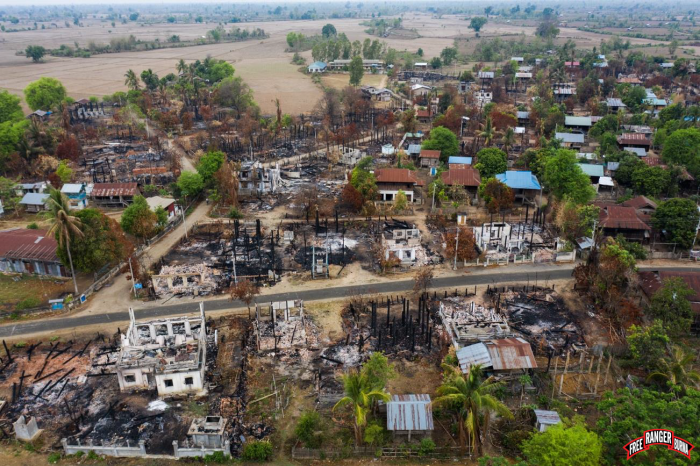
Ruins of Nan Lan Village in Myanmar. Credit: Free Burma Rangers.

The brutal ‘Four Cuts’ strategy is causing untold suffering in Myanmar, yet the international community remains slow to react

The ‘Four Cuts’ strategy, designed to sever insurgents’ supplies of food, funds, information and recruits, is an approach that has been used for decades by a series of military dictatorships in Myanmar/Burma. This devastating tactic is once again being employed, but in one of its bloodiest forms yet.  

Breaking society 

In a remarkable piece of reporting, in a country where foreign journalists have no official access to the true story of Myanmar’s civil war, Sky News recently released details of an undercover mission deep into southeastern Myanmar. Chief correspondent Stuart Ramsay encountered first-hand the Myanmar military regime’s devastating campaign of violence. 

Ramsay and his team discovered shocking evidence of sustained attacks on civilian homes and infrastructure, including daily artillery and aerial bombardment as well as arson attacks, which are forcing people from their homes with over 1.5 million people currently displaced and in desperate need of humanitarian assistance. 

Continue reading “The brutal ‘Four Cuts’ strategy is causing untold suffering in Myanmar, yet the international community remains slow to react”
Chinese human rights lawyer Jiang Tianyong and his wife Jin Bianling and daughter. Source: Twitter @jinbianling

‘Worse than physical torture’ – how China uses exit bans to inflict suffering on human rights defenders and their loved ones

‘Today, I received terrible news that our dream of reunion has once again been dashed.’

On 22 May 2023, Jin Bianling learnt that her husband Jiang Tianyong’s applications for a passport and a travel pass for Hong Kong and Macau had been turned down again. It had been ten years since the disbarred award-winning human rights lawyer was separated from his wife and daughter.

Being blocked from leaving China by the authorities has become common under Xi Jinping’s rule. Some have had their passport applications or renewals turned down, others have been stopped at the airport by police, such as the exiled activist Lin Shengliang’s 12-year-old daughter, while still others have had their boarding passes torn up by airport security guards. In the case of 80-year-old historian and writer Zhang Yihe, just a word from one of the government departments was enough to bar her from leaving China. She revealed on 8 June 2023 that she had become ‘a prisoner of the state’ as of the day before, unable to travel abroad.

Continue reading “‘Worse than physical torture’ – how China uses exit bans to inflict suffering on human rights defenders and their loved ones”
Chinese human rights lawyer Jiang Tianyong and his wife Jin Bianling and daughter. Source: Twitter @jinbianling

“比肉体酷刑更厉害”——中国当局以限制出境折磨人权捍卫者及其亲人

“今天,接到一个很不好的消息,我们团聚的梦想再次破灭。”

2023年5月22日,金边玲得知丈夫江天勇申请护照和港澳通行证再次被拒。这位被取消律师资格的获奖人权律师与妻女分离已有十年之久。

在习近平执政期间,当局随意禁止出境已成为司空见惯的事情。有些人申请办理或换发护照被拒,有些人在机场被警察拦截,比如流亡活动人士林生亮 12 岁的女儿,还有一些人的登机牌被机场保安撕毁。 就八旬历史学家章诒和而言,某政府部门的一句话就足以禁止她离开中国。她在 2023 年 6 月 8 日透露,她从前一天起就成了“国家囚徒”,无法出国旅行。

Continue reading ““比肉体酷刑更厉害”——中国当局以限制出境折磨人权捍卫者及其亲人”