All posts

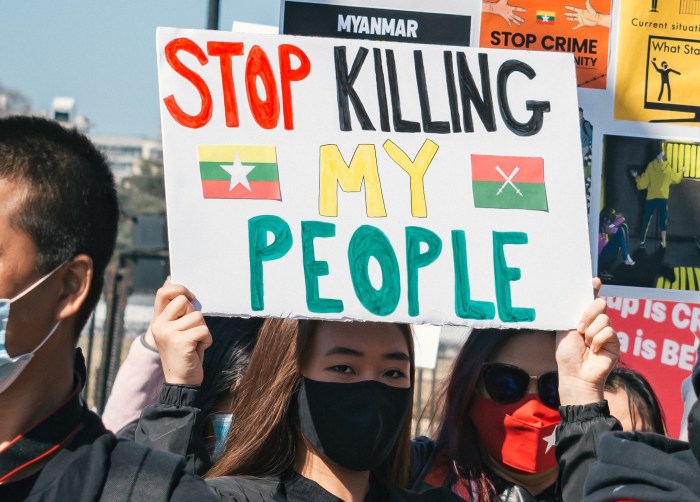
A protester holds a sign that reads 'Stop killing my people' during demonstrations against the coup in Myanmar/Burma.

In a world of crises and tragedy, we must not forget about Myanmar

By Benedict Rogers

When Myanmar (Burma)’s army reportedly killed 11 children in a helicopter attack last week, those of us who follow Myanmar heaved a sigh and shed a tear, and the rest of the world gave a shrug and averted its gaze. In a world filled with so much tragedy, the crisis in Myanmar seems to be passing so many by. For those of us watching, it was yet another bombing, yet another massacre, yet another atrocity – and dare I say it, yet another attack which has become daily news.

It’s staggering, really. Myanmar’s illegal military regime seized power in a coup just over 18 months ago, overthrowing a democratically elected government, snuffing out a decade of hoped-for liberalization, and turning the clock back by at least ten years – and yet the rest of the world shrugs its shoulders. A brutal, criminal dictatorship has locked up a Nobel Laureate – who had already spent years under house arrest and then a decade sharing power with the military in government – and the world turns its back. A junta arrests and jails a former British ambassador, Vicky Bowman, alongside an Australian academic, Sean Turnell, both of whom I know, and no one really says a word. And that regime spends months relentlessly bombing innocent civilians and the international community is silent. What is going on?

True, the world right now is full of woes. The war in Ukraine. The energy crisis. The threats to Taiwan. Protests in Iran. And many other tragedies – some in the news, others forgotten. Nigeria. Yemen. Syria. North Korea. Hong Kong. The Xinjiang Uyghur Autonomous Region. These are all desperate heartaches which sometimes gain the spotlight and yet so often remain forgotten. But Myanmar is a Ukraine in slow-motion, and yet almost no one is speaking about it.
Continue reading In a world of crises and tragedy, we must not forget about Myanmar
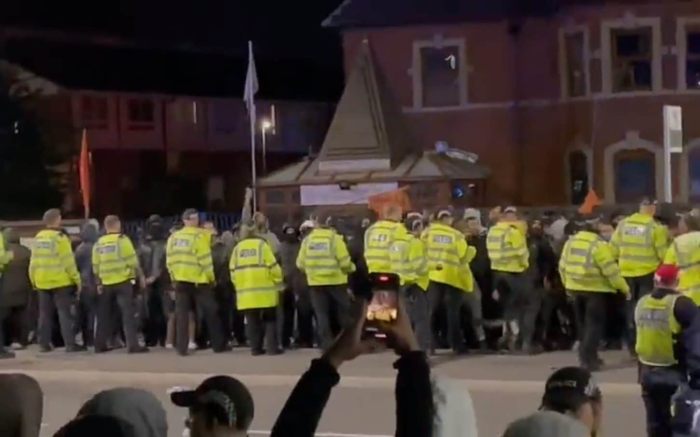
Police contain protesters following an outbreak of communal violence between Hindus and Muslims in Leicester, UK.

“Jai Shri Ram” on the streets of Leicester as India’s Hindu nationalism stretches beyond its borders

“Jai Shri Ram”, translating from Hindi as “hail Lord Ram” or “victory to Lord Ram”, is meant to be a harmless informal greeting, a proclamation of one’s faith and an expression of praise for a well-known Hindu deity.

Sadly, the expression has taken on far more sinister connotations in recent years. For far-right Hindu nationalists in India, who have been significantly emboldened over the past eight years under Prime Minister Narendra Modi and his ruling Bharatiya Janata Party (BJP), the slogan has been appropriated as a rallying cry for violent extremists.

CSW receives regular reports of communal violence in which the perpetrators have either chanted those three words while carrying out their attacks, or in some cases pressured their victims to declare them, forcing them to contradict their own religion or belief.

Continue reading “Jai Shri Ram” on the streets of Leicester as India’s Hindu nationalism stretches beyond its borders
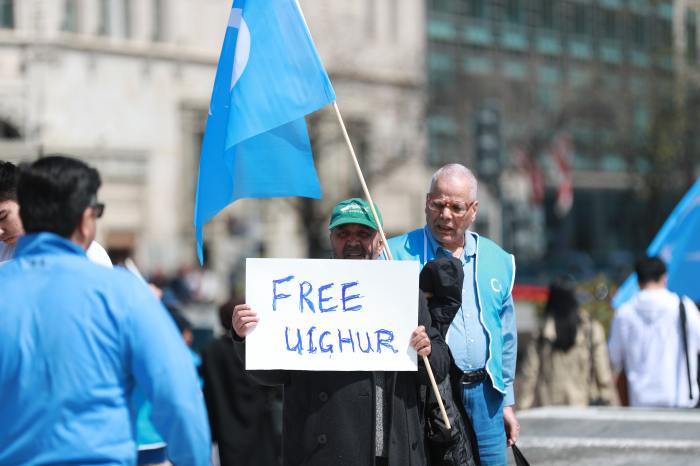
A man holds a sign that says 'Free Uighur' as part of a protest against China's actions in the Xinjiang Uyghur Autonomous Region.

After the UN’s allegations of crimes against humanity, the world must mobilise on China’s actions in the Xinjiang Uyghur Autonomous Region

In April 2020, CSW published a guest blog written by an expert on Uyghur culture who outlined the pervasive human rights crisis in the Xinjiang Uyghur Autonomous Region. Over two years later, the situation remains unchanged, and as we hear from the same expert, the need for international action grows more pressing with every passing day.

“Kamil is a broken young man. Wrenched from his home at dead of night five years ago, hooded, shackled and shoved into the back of a police van, he disappeared. Two years ago, he re-emerged. Via friends of friends we heard with immense relief that he was alive, but the message we received was that he feared nothing anymore, such had been the terror he had faced daily during his incarceration. Yes he was alive, but barely.

More than two years have passed since my last blog, and there are hundreds of thousands of Kamils. Some have been ‘released’ to forced labour, many making cheap clothing for Western brands; others have been sentenced for spurious crimes in secret courts to draconian prison terms; others are still unaccounted for, and many have died.

The Chinese government has been working overtime garnering support around the world to justify incarcerating up to three million Uyghur and Turkic minority citizens from the Xinjiang Uyghur Autonomous Region, its North Westernmost province, in a network of at least 380 razor-wire clad and watchtower-surrounded so-called ‘Vocational Training Schools’.

Continue reading After the UN’s allegations of crimes against humanity, the world must mobilise on China’s actions in the Xinjiang Uyghur Autonomous Region
A street in Trinidad, Cuba.

El referéndum de Cuba del 25 de septiembre es mucho más que un tema sobre matrimonio homosexual 

El 25 de septiembre los cubanos acudirán a las urnas para votar en referéndum popular un nuevo Código de las Familias que, de ser aprobado, se convertirá en ley. La cobertura de los medios, dentro y fuera de Cuba, incluso en la prensa británica y estadounidense, ha presentado el referéndum como una votación sobre el matrimonio homosexual. La verdad es que la propuesta del Código de las Familias tiene más de 100 páginas; pero solo un puñado de los 474 artículos son relevantes para los derechos LGBTQ+. 

Presentarlo como un referéndum sobre los derechos de los homosexuales no solo es incorrecto sino también peligroso; permite al gobierno cubano oscurecer algunos de los aspectos altamente problemáticos del Código, que tienen el potencial de violar los derechos fundamentales de todos los cubanos y daría a las autoridades otra forma, muy efectiva, de silenciar las voces independientes o críticas. 

Lo más preocupante es el artículo 191 que permitiría la separación de los hijos si sus padres no cumplen con las responsabilidades detalladas en el artículo 138 del nuevo código, que incluyen los deberes de inculcar en sus hijos el amor a la patria, el respeto a sus símbolos y el respeto a las autoridades (artículo 138 (ñ)). 

Continue reading El referéndum de Cuba del 25 de septiembre es mucho más que un tema sobre matrimonio homosexual “
A street in Trinidad, Cuba.

Cuba’s referendum on 25 September is about far more than gay marriage

On 25 September Cubans will go to the polls to vote in a popular referendum on a new Family Code, which, if approved, will become law. Media coverage, in and outside of Cuba, including in the UK and US press, has presented the referendum as a vote on gay marriage. The truth is that the proposed family code runs over 100 pages; only a handful of the 474 articles are relevant to LGBTQ+ rights.

Presenting it as a referendum on gay rights is not only incorrect but also dangerous. It allows the Cuban government to obscure some of the highly problematic aspects of the code, which have the potential to violate the fundamental rights of all Cubans and would give the authorities another, and very effective, way of silencing independent or critical voices.   

Most worrying is Article 191 which would allow for the removal of children if their parents fail to fulfil a list of responsibilities detailed in Article 138. These include the duties to instill in their children love for the homeland, respect of its symbols, and respect for the authorities (Article 138 (ñ)).

Continue reading Cuba’s referendum on 25 September is about far more than gay marriage