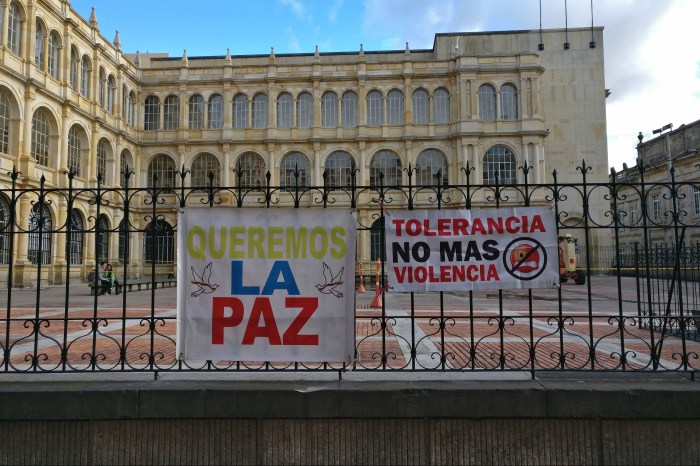
Graffiti in Colombia reads 'Viva el ejercito del pueblo FARC' i.e. 'Long live the army of the people, FARC'

Colombia must finally reckon with the religious element of its decades long internal conflict

Darkness falls quickly in Colombia due to its proximity to the equator, and it was no different on the night of Thursday 5 July 2007. As night closed in, Joel Cruz Garcia, a 27-year-old pastor, heard banging on the front door of the small home he shared with his wife Yuvy and their nine-month-old daughter in the village of El Dorado in the department of Huila. When the pastor opened the door, he was faced with a heavily armed group of individuals dressed in the uniform of the 17th Brigade of the Revolutionary Armed Forces of Colombia, better known as the FARC, who demanded that he come with them.  

The pastor was given no choice, and his wife later recounted how even as the guerrillas manhandled him and ridiculed his faith, Joel quoted a Bible verse to them, saying, ‘To live is Christ and to die is gain.’ 

‘Good,’ the guerrillas responded. ‘Then you will die.’ 

Continue reading “Colombia must finally reckon with the religious element of its decades long internal conflict”
A street with flags flying in Michoacán, Mexico.

Religious minorities in Michoacán, Mexico just wanted to be treated equally

Michoacán is a state located in central Mexico. This region of mountains and forests is inhabited by the P’urhépecha indigenous populations, whose language P’urhe is still spoken today and who are renowned for their fine work with the different types of wood found in the area. The P’urhépecha are concentrated in 22 municipalities across the breadth of the state.

Michoacán is also known for its natural beauty and the richness of its land and climate, making it a favourable place for the cultivation of different fruits exported internationally, including the avocado. Mexico is the largest producer worldwide of this precious product which has an annual economic impact of billions of dollars.

The P’urhépecha Plateau is home to around 70% of Mexico’s national avocado production. This has given rise to clashes in Michoacán between organized crime groups as they vie for control of the territory and avocado market. The situation has led, in turn, to the formation of community militias and self-defence groups who, fed up with the extortion and the abuses committed by the organized crime groups, have taken up arms to protect their lands. In some cases, however, these community militias and self-defence groups have also been involved in the violation of human rights.

Continue reading “Religious minorities in Michoacán, Mexico just wanted to be treated equally”
A street with flags flying in Michoacán, Mexico.

México: Las minorías religiosas en Michoacán solo desean ser tratadas con igualdad y respeto

Michoacán es un estado ubicado en el centro de México. Esta región de montañas y bosques está habitada por las poblaciones indígenas P’urhépecha, cuya lengua P’urhe aún se habla hoy en día y que son reconocidos por su fino trabajo y artesanías con los diferentes tipos de madera que se encuentran en la zona. Los p’urhépecha se concentran en 22 municipios a lo largo del estado. 1

Michoacán también es conocido por su belleza natural y la riqueza de su tierra y clima, lo que lo convierte en un lugar propicio para el cultivo de diferentes frutas que se exportan a nivel internacional, entre ellas el aguacate. México es el mayor productor a nivel mundial de este preciado producto que tiene un impacto económico anual de miles de millones de dólares.

La meseta de P’urhépecha alberga alrededor del 70% de la producción nacional de aguacate de México. Esto ha dado lugar a enfrentamientos en Michoacán entre grupos del crimen organizado que se disputan el control del territorio y el mercado del aguacate. La situación ha provocado, a su vez, la formación de milicias comunitarias y grupos de autodefensa que, hartos de la extorsión y los abusos cometidos por los grupos del crimen organizado, han tomado las armas para proteger sus tierras. En algunos casos, sin embargo, estas milicias comunitarias y grupos de autodefensa también han estado involucrados en la violación de los derechos humanos.

Continue reading “México: Las minorías religiosas en Michoacán solo desean ser tratadas con igualdad y respeto”
Rosh Hashanah celebrations at the Heliopolis Synagogue in Cairo, Egypt. Credit: Facebook/JCC Cairo

Un mensaje de ánimo al Presidente Sisi para ir más allá en la promoción de la libertad de religión o creencia en Egipto

A principios de este mes, el 15 de septiembre, la comunidad judía de El Cairo se reunió en la Sinagoga “Heliópolis” de El Cairo para celebrar Rosh Hashaná.

La ocasión, que marcó el inicio del Año Nuevo judío, siempre es significativa, pero en este contexto fue aún más significativa, ya que marcó la primera vez en 70 años que la comunidad ha sido libre de celebrarlo públicamente en todo Egipto.

Había tardado en llegar, ya que en los últimos años el gobierno egipcio ha implementado una serie de iniciativas para beneficiar a la comunidad judía. Por ejemplo, poco más de dos semanas antes de que la comunidad se reuniera para Rosh Hashaná en Cario, el Primer Ministro egipcio, Mostafa Madbouly, se unió al Ministro de Turismo Ahmed Issa para reabrir la sinagoga Ben Ezra, también en la capital, después de años de cuidadosa restauración.

Continue reading “Un mensaje de ánimo al Presidente Sisi para ir más allá en la promoción de la libertad de religión o creencia en Egipto”
Fang Bin with his wife and son in an undated photo.

A family shattered for 24 years – the story of Falun Gong activist Fang Bin

Crowded hospital halls, frantic doctors and nurses in protective suits, patients lying in the corridors, body bags piled up in a funeral van outside a hospital… In early February 2020, 57-year-old businessman Fang Bin drove around Wuhan and documented what he saw in five hospitals. The short videos he posted on social media gave a rare glimpse into what was happening in the epicentre of the pandemic under lockdown.

Mr Fang was detained by police briefly on 1 February 2020. In the next few days, he became more outspoken. Videos were widely shared on social media in which he commented that ‘tyranny lies at the root of this virus’. Then, on 9 February 2020, he vanished after calling ‘all citizens to resist’ tyranny and the government to ‘return the power to the people’ on YouTube, a platform banned in China.

The disappearances of Fang Bin, Zhang Zhan and at least two other citizen journalists drew the attention of world media. Although Mr Fang and his wife are known to the authorities as veteran Falun Gong activists, people who are familiar with him hesitated in mentioning his faith background when calling for his release. They may have been conscious of the social stigma attached to this belief group in China, or feared that he might be jailed not for his online speech but for his faith, or even that he might face mistreatment for it in police custody.

Continue reading “A family shattered for 24 years – the story of Falun Gong activist Fang Bin”