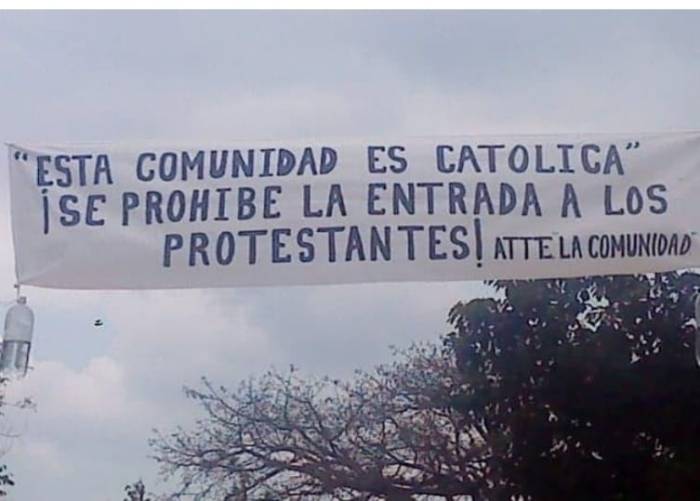
Maria Concepción, a member of the Great Commission Baptist Church in Rancho Nuevo in the Huejutla de los Reyes Municipality of Hidalgo state, Mexico.

After a brutal attack on one of their own, a religious minority community in Mexico is waiting for justice and religious freedom

Maria Concepción began 2023 in hospital recovering from a brutal physical attack that was linked to her membership of a religious minority in her community. On 1 January she was admitted to intensive care due to constant vomiting that meant she was unable to keep food down. She spent ten days there before she was briefly released only to be returned to intensive care due to vomiting blood on 18 January.

As doctors did not report any improvement at first, her family did not see much hope at all, to the point that members of her church in Rancho Nuevo in the Huejutla de los Reyes Municipality of Hidalgo state, Mexico, had cleared a piece of land for her burial.

Mercifully, she pulled through. She returned home on 9 February, and today she walks with the help of her son and a cane. She still suffers from persistent back pain caused by being forcefully thrown into the trunk of a tree, but her recovery remains nothing short of miraculous.

Continue reading “After a brutal attack on one of their own, a religious minority community in Mexico is waiting for justice and religious freedom”

Silenciados por defender a los oprimidos: defendiendo a los presos de conciencia de Vietnam

El Partido Comunista de Vietnam viola continuamente los derechos civiles y políticos de su pueblo. El derecho a la libertad de expresión, opinión y expresión está estrictamente restringido y reprimido, con poco o ningún espacio para la voz de la sociedad civil.  El gobierno vietnamita encarcela regularmente a personas por su trabajo de derechos humanos, esto incluye la denuncia de la corrupción, la oferta de asistencia legal, la organización de protestas pacíficas y el uso de las redes sociales para abogar por cuestiones sociales y denunciar las injusticias sociales.

Muchos defensores y defensoras de los derechos humanos arriesgan su propia seguridad para defender a las víctimas de violaciones de derechos humanos, incluido el derecho a la libertad de religión o de creencias. Quienes hablan con frecuencia se enfrentan al acoso, la intimidación, la vigilancia intrusiva e incluso a el encarcelamiento por parte del gobierno vietnamita.

Seis de estos activistas son Nguyen Van Dai, Le Thu Ha, Nguyen Trung Ton, Nguyen Bac Truyen, Pham Van Troi y Truong Minh Duc. El 5 de abril de 2018, fueron juzgados acusados de “llevar a cabo actividades destinadas a derrocar al gobierno”, y recibieron penas de prisión de entre siete y 15 años.

Continue reading “Silenciados por defender a los oprimidos: defendiendo a los presos de conciencia de Vietnam”
Man in black and white long sleeve shirt holding red stick in Sudan.

As Sudan forms a new transitional government, the international community must not repeat its mistakes

April has become a significant month for the nation of Sudan. This year, after more than 18 months under the leadership of a military junta that seized power in October 2021, the month will hopefully see the formation of a new transitional government, and the possible dawn of a new chapter for the country.

But we have been here before. On 11 April 2019, after months of unprecedented nationwide protests, Sudan’s president of nearly 30 years, Omar al Bashir, was ousted.

It was hoped that his removal would bring an end to three decades of oppressive rule characterised by widespread violations of human rights, including of the right to freedom of religion or belief (FoRB) – and to some extent it did.

Continue reading “As Sudan forms a new transitional government, the international community must not repeat its mistakes”

Silenced for defending the oppressed – standing up for Vietnam’s prisoners of conscience

The Communist Party of Vietnam routinely violates the civil and political rights of its people. The right to freedom of expression, opinion and speech is tightly restricted and suppressed, with little or no space for the voice of civil society. The Vietnamese government regularly imprisons individuals for human rights work including exposing corruption, offering legal assistance, organising peaceful protests, and using social media to advocate on social issues and speak out against social injustices.

Many human rights defenders risk their own safety to stand up for victims of human rights violations, including the right to freedom of religion or belief (FoRB). Those who speak out frequently face harassment, intimidation, intrusive monitoring and even imprisonment by the Vietnamese government.

Six such activists are Nguyen Van Dai, Le Thu Ha, Nguyen Trung Ton, Nguyen Bac Truyen, Pham Van Troi and Truong Minh Duc. On 5 April 2018, they stood trial under accusations of ‘carrying out activities aimed at overthrowing the government’, receiving prison sentences of between seven and 15 years.

Continue reading “Silenced for defending the oppressed – standing up for Vietnam’s prisoners of conscience”
School children in the Central African Republic.

Diez años después del encuentro en la República Centroafricana, las alianzas armadas han cambian, pero los civiles siguen sufriendo

El 23 de marzo de 2013, el mundo se despertó con la noticia de que el presidente François Bozizé de la República Centroafricana (RCA) había huido del país y una Coalición rebelde había tomado la capital. La respuesta algo automática de la Unión Africana (UA) condenando la entrega inconstitucional del poder fue igualada por el caos resultante en el país cuando una Coalición flexible de grupos rebeldes, predominantemente del norte del país y ampliamente musulmanes, lucharon por quién se convertiría en presidente. Finalmente, fue Michael Dijotida quien tomó el timón y supervisó el país durante nueve meses.

Fue durante esos primeros nueve meses que se perpetraron algunos de los abusos más graves contra los Derechos Humanos, mientras los líderes mundiales reflexionaban sobre su respuesta. A medida que la Coalición rebelde, conocida como Seleka, avanzó sobre la capital, dejaron muerte y destrucción a su paso. Mientras tanto, los líderes religiosos de todas las religiones viajaban a las comunidades,  donde a veces los cuerpos aún yacían en el suelo, para consolar a los dolientes e instarlos a no vengarse.

La UA lideró en gran medida la respuesta global, con la excepción de Francia, que decidió poner tropas sobre el terreno mientras la ONU negociaba la creación de una misión para mantener la paz.

Continue reading “Diez años después del encuentro en la República Centroafricana, las alianzas armadas han cambian, pero los civiles siguen sufriendo”