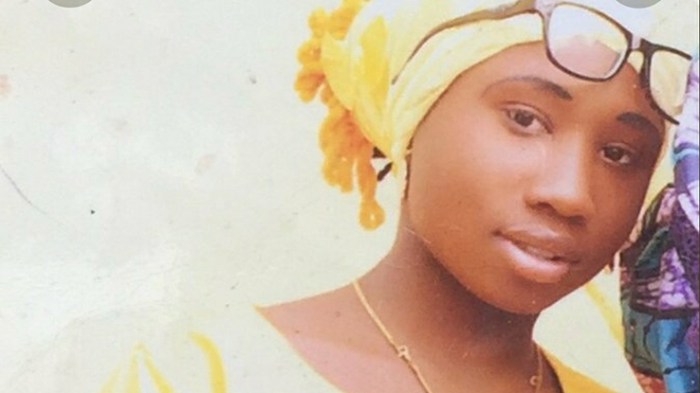
The international community must not allow the Nigerian government to fail Leah Sharibu any longer

Today is Leah Sharibu’s 22nd birthday. 

Anyone who has been following the work of CSW for some time will likely be familiar with some of the details surrounding her case: the fact that this is the eighth consecutive birthday that she has marked as a prisoner of the Islamic State West Africa Province (ISWAP); the fact that she was one of 110 girls abducted from the Government Girls Science and Technical College in Dapchi in Nigeria’s Yobe State on 19 February 2018; the fact that she was the sole Christian among them and was therefore denied her freedom because she refused to convert to Islam as a pre-condition for release – even as government negotiations saw all of her surviving classmates returned to their families in March 2018. 

Over the past seven years, successive administrations have failed to deliver on official promises to secure Leah’s release, including a personal pledge by former President Muhammadu Buhari made directly to Leah’s mother Rebecca. In January 2022 – over three years ago – Nigeria’s then Chief of Defence Staff General Lucky Irabor assured Nigerian media that there were plans and processes in place ‘to ensure that not just Leah Sharibu but every other person held captive is released.’  

And yet she remains in captivity, having been declared a ‘slave for life’, renamed, forcibly ‘married’ to ISWAP fighters, and given birth to three children. 

Continue reading “The international community must not allow the Nigerian government to fail Leah Sharibu any longer”

Truth matters: How misinformation and sensationalism undermines support for victims of human rights violations

In early March, alarming reports surfaced of the killing of Christians in Syria. As a shocking outbreak of violence claimed the lives of over 1,000 people within just two days, including 745 civilians, many outlets were quick to claim that the country’s Christian community had been the target. 

GB News led with ‘Christians massacred as Syrian jihadist launches killing spree just weeks after toppling Assad’; a writer for the Times of Israel lamented what he identified as the media’s ‘predictable’ disdain for Syrian Christians; the Christian outlet Relevant Magazine claimed that ‘hundreds of Christians’ were among those killed, and countless posts on social media amplified claims of Christians being deliberately targeted and murdered in large numbers. 

Such reporting appeared to confirm the worst fears that many have harboured since December 2024, when President Bashir al-Assad was ousted by a coalition of rebel groups led by the Islamist military organisation Hayat Tahrir al-Sham (HTS), an organisation sanctioned by the US government. In the immediate aftermath of the takeover, many predominantly – though not exclusively – Christian outlets expressed understandable concern over impending threats to the country’s Christian community, with some warning of potential ‘ethnic cleansing’, ‘persecution’ and ‘genocide’. 

Continue reading “Truth matters: How misinformation and sensationalism undermines support for victims of human rights violations”

Pope Francis leaves a legacy of standing up for freedom of religion or belief. His successor must build on it. 

‘There can be no peace without freedom of religion, freedom of thought, freedom of expression and respect for the views of others.’ 

It is both fitting and moving that Pope Francis included these words in what was to be his final public address, delivered on his behalf by Master of Liturgical Ceremonies Archbishop Diego Ravelli to a crowd of over 20,000 people at the Vatican’s St. Peter’s Square on Easter Sunday. 

Throughout his 12-year papacy, Francis was a committed friend to the poor and the marginalised, a vocal advocate for freedom of religion or belief (FoRB) and other fundamental human rights, and a man who spoke truth to power right up to the final days of his pontificate. 

At a time when leaders of such humility and integrity appear to be in increasingly short supply, it is essential that his successor follows his example. 

Continue reading “Pope Francis leaves a legacy of standing up for freedom of religion or belief. His successor must build on it. “

A year since over 170 Protestants were forced from their homes, authorities in Mexico’s Hidalgo State must take action to protect religious minorities 

It was the end of 2015 when Rogelio Hernández Baltazar returned to his community in Rancho Nuevo in the Huejutla de Reyes Municipality of Hidalgo State. He had spent several months working in the fields of Coahuila in Northern Mexico, because there were no opportunities for work or to generate income to support his family in his own village. 

This time things were different; he returned to his community transformed after having struggled for years with alcohol addiction and anger management. While he was working in Coahuila a colleague had invited him to the local Fundamental Baptist Church, where he made the decision to convert to Christianity. What he did not know was that it would have serious consequences within his community. 

When Rogelio returned home things seemed not to have changed much, but something inside him had. He had only been attending the church in Coahuila for two months, but when he returned to his indigenous Nahuatl community, people noticed such a significant change in him that they began to wonder what had happened to him in his workplace. With the little understanding that he had, Rogelio began to explain that his radical change was due to what he had read in the Bible, so he invited people to Bible studies in his home.  

Continue reading “A year since over 170 Protestants were forced from their homes, authorities in Mexico’s Hidalgo State must take action to protect religious minorities “

A un año de que más de 170 protestantes fueran expulsados de sus hogares, las autoridades del Estado de Hidalgo, México, deben tomar medidas para proteger a esta minoría religiosa

A finales de 2015, Rogelio Hernández Baltazar regresó a su comunidad en Rancho Nuevo, municipio de Huejutla de Reyes, estado de Hidalgo. Había pasado varios meses trabajando en los campos de Coahuila, en el norte de México, porque no había oportunidades de trabajo ni de generar ingresos para mantener a su familia en su propio pueblo. 

Esta vez las cosas fueron diferentes; regresó a su comunidad transformado tras años de lucha contra la adicción al alcohol y controlar la ira. Mientras trabajaba en Coahuila, un colega lo invitó a la Iglesia Bautista Fundamental local, donde decidió entrar al cristianismo. Lo que no sabía era que esto le traería graves consecuencias en su comunidad. 

Cuando Rogelio regresó a casa, las cosas parecían no haber cambiado mucho, pero algo dentro de él sí. Solo llevaba dos meses asistiendo a la iglesia en Coahuila, pero al regresar a su comunidad indígena náhuatl, la gente notó un cambio tan significativo en él, que empezaron a preguntarse qué le había pasado en su lugar de trabajo. Con la poca comprensión que tenía, Rogelio comenzó a explicar que su cambio radical se debía a lo que había leído en la Biblia, así que invitó a la gente a participar en estudios bíblicos en su casa. 

Continue reading “A un año de que más de 170 protestantes fueran expulsados de sus hogares, las autoridades del Estado de Hidalgo, México, deben tomar medidas para proteger a esta minoría religiosa”