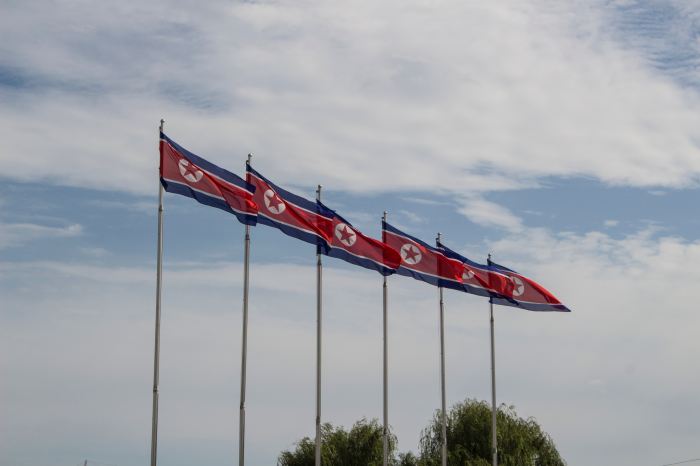
North Korea flags.

With echoes of ‘the most difficult time in North Korean history’, the international community must do more to bring about change

Earlier this month, the BBC released information gathered from exclusive interviews with three individuals living inside North Korea. Their reports have brought the country back into the headlines, revealing the devastating reality of the situation for North Korean citizens since the COVID-19-triggered border closure in January 2020. They describe widespread starvation and brutal repression, without feasible means of escape.

Hanna Song from the North Korean Database Centre for Human Rights (NKDB) said in an interview with the BBC ‘This [report] takes us back to the most difficult time in North Korean history.’

Song is referring here to the widespread famine of the 1990s known as the arduous march.

The Democratic People’s Republic of Korea (DPRK) was founded in 1948 under the leadership of Kim Il-Sung. The communist nation’s economy was built on a system of state control: a public distribution system for food and material goods, and a state-assigned job system dictating citizen employment.

Continue reading “With echoes of ‘the most difficult time in North Korean history’, the international community must do more to bring about change”
Reverend Dr Hkalam Samson, one of Myanmar/Burma’s most senior and internationally renowned Christian pastors.

The continued imprisonment of Reverend Dr Hkalam Samson is proof that no one is safe in Myanmar

By Benedict Rogers

When I heard that my friend Reverend Dr Hkalam Samson, one of Myanmar/Burma’s most senior and internationally renowned Christian pastors, had been arrested at Mandalay airport on 5 December as he attempted to travel to Bangkok, several thoughts went through my mind.

On one level I was not surprised, because the current illegal military junta, which seized power in a coup on 1 February 2021, has been even more brutal, ruthless and inhumane than any of the succession of military dictatorships that have ruled Myanmar for most of the past six decades.

On another level, due to his international connections, I thought his arrest might simply lead to a brief detention, for the purposes of interrogation. I half expected him to be released within a matter of days. This is a man, after all, who has met the President of the United States in the White House, a Minister of State in the United Kingdom’s Foreign, Commonwealth and Development Office, parliamentarians around the world and has attended international fora including the International Ministerial Conference on freedom of religion or belief in Washington, DC in 2019.

Continue reading “The continued imprisonment of Reverend Dr Hkalam Samson is proof that no one is safe in Myanmar”
A sign prohibiting the entry of Protestants into the community of Cuamontax in Huazalingo Municipality of Hidalgo State, Mexico.

Chhattisgarh: A state where religious minorities live in fear

Five months after the mob violence that forced hundreds of Christians from Chhattisgarh’s tribal belt to flee their homes, victims say they are back home and safe for now, but they continue to live in fear.

On 18 December 2022, more than 20 incidents of anti-Christian violence were reported in various villages of Chhattisgarh’s Kondgaon and Narayanpur districts. Locals claimed that they were pressured to leave their religion and if they refused, they were beaten up badly, their homes were vandalised and their crops were destroyed.

According to reports that emerged later, close to a thousand Christians were forced to flee their homes and seek shelter in neighbouring districts. Some had to walk hundreds of kilometres to seek shelter in an indoor stadium.

Continue reading “Chhattisgarh: A state where religious minorities live in fear”
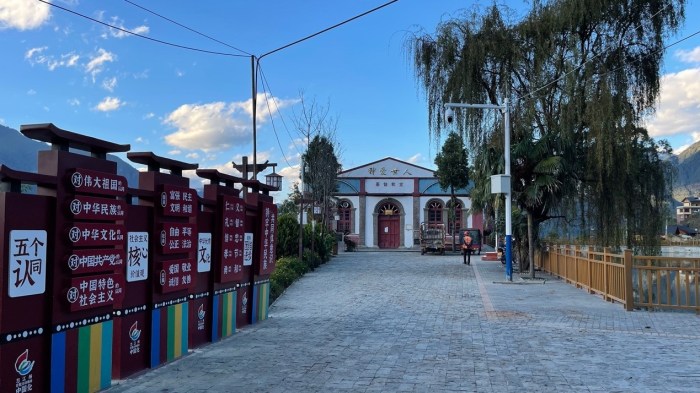
A series of political slogan boards erected outside Laomudeng Church in Yunnan, China.

‘The Yunnan Model’ could be an indicator that life is going to get even harder for religious and ethnic groups across China

Wang Shunping, Nu Sangdeng, San Luobo, Hua Xiuxia and Dong Mengru spent the past nine months in detention.

Their crime? Holding a handful of Christian gatherings and teaching guitar and hymns to a group of young people in their rented home in Fugong County in the Nujiang Lisu Autonomous Prefecture of China’s Yunnan Province.

Though they were released on bail on 7 May, the charges against them relating to ‘organising and sponsoring an illegal gathering’ are yet to be dismissed.

All five individuals – three men and two women – work among the ethnic Nu community, one of the 56 ethnic groups officially recognised by the Chinese authorities; the three men are Nu ethnic preachers. In China, the majority of the Nu live in Yunnan, where a significant history of Western missionary activity has resulted in a large Protestant Christian population alongside the majority religions of Buddhism and tribal animism.

Continue reading “‘The Yunnan Model’ could be an indicator that life is going to get even harder for religious and ethnic groups across China”
A Narikuravar woman walking through her hometown of Mappedu in Chennai, India.

‘I hope that my husband will let me go to church’: the tension between tradition and religious freedom for women in the Narikuravar community

Every morning after finishing her household chores, 17-year-old Deepa* walks into a small thatched building in Mappedu, Chennai. This is where Christians belonging to the indigenous Narikuravar community in Mappedu have been gathering for prayer meetings and Sunday services for more than a decade.

Deepa has been attending these meetings since she was a child. She loved learning Bible verses, sharing her testimony and singing songs. But there was a huge price to pay. To this day, she has been facing significant opposition from her parents, to the point that she has been physically abused because she continues attending church

Deepa told CSW: ‘My parents used to scold me and beat me up since I started going to church, but I would still go. We had fights at home everyday. They would swear at me, threaten me with dire consequences and beat me up. I would just pour my heart out to God and keep praying. When I told them I was going to get baptised, they were furious. I’ve now decided to wait a little longer to get baptised.’

Continue reading “‘I hope that my husband will let me go to church’: the tension between tradition and religious freedom for women in the Narikuravar community”