Interview with a Sri Lankan Human Rights Advocate – Part 2

Part 2: Circular 2008

CSW spoke to a human rights advocate in Sri Lanka whose identity for security reasons has been withheld. This post has been edited for clarity.

Q: Would you be able to share with us what groups like yours – and other civil society organisations based in Sri Lanka – are doing at the moment to address freedom of religion or belief (FoRB) violations?

A: There are various strategies. One of the core things that we do is to document incidents. We do a lot of advocacy at a local level by meeting government officials and ministers. We also lobby with some of our international partners as well. We file cases on behalf of victims who are religious minorities, and we take up different legal interventions. For example, when there is an attack, we will not file a case immediately but we try first to send out legal letters; working with the national police commission, working with the relevant ministries, and so on. If that does not work out, then of course we will file a case against the authorities in the Supreme Court.

In most instances, we support cases that have been filed against Christians. We also do a lot of other projects where we work on broader human rights issues and we form local networks with community leaders, with pastors. We have consultation processes with them, we train them, we have advocacy seminars – making them aware of their legal rights and teaching them good practices. We also work with the media and journalists, bringing together journalists and the media on good reporting for religious violence.

Q: What can international organisations do to echo the concerns you’ve identified?

Continue reading “Interview with a Sri Lankan Human Rights Advocate – Part 2”

On the Road with Cardinal Bo, a Personal Reflection

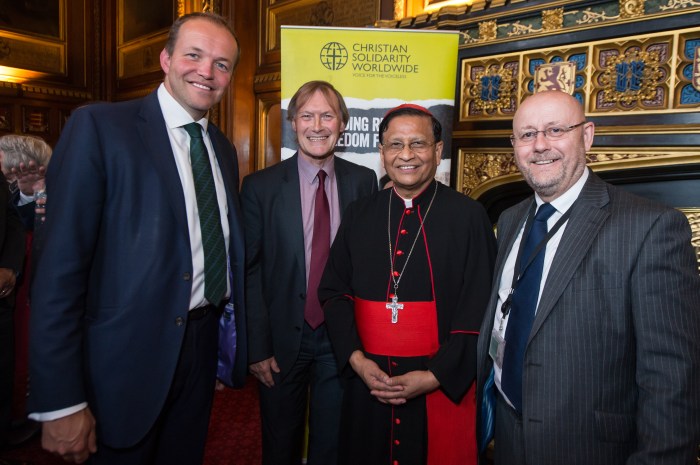
Featured image left to right: David Burrowes MP, Sir David Amess MP, Cardinal Bo, and CSW’s Chief Executive Mervyn Thomas. Photo Credit: mazur/catholicnews.org.uk

In the Chapel of St Mary Undercroft, the parliamentary chapel just underneath Westminster Hall in the Houses of Parliament, Burma’s first-ever Cardinal celebrated Mass.

“Coming from a country, Burma, that is just emerging from over half a century of cruel, brutal military dictatorship, a country torn apart by war, ravaged by religious and ethnic persecution, with rampant corruption and dire poverty, into a new Easter dawn of democracy, to stand here in this chapel with all that it symbolises and represents is an immense joy,” Cardinal Charles Bo said. “Britain and the British Parliament has a long history with Burma; many of you have been with us in our darkest hour, stretching out a hand of friendship and solidarity in our time of need, raising a voice for us when we were voiceless.”

It was just one of many beautiful and significant moments during Cardinal Bo’s almost three-week tour of the United Kingdom and Brussels, which began with Mass in St Andrew’s Cathedral, Glasgow, with a piper on the door. The tour then took us the length and breadth of the UK, and to Westminster and the European Union.

Continue reading “On the Road with Cardinal Bo, a Personal Reflection”

The Plight of the Rohingya – His Eminence Cardinal Charles Maung Bo Addresses the Houses of Parliament, London, 25 May 2016

On May 25th Cardinal Charles Maung Bo of Burma, spoke before a meeting chaired by Lord Alton and hosted by the All Party Parliamentary Group on Burma, the All Party Parliamentary Group on International Freedom of Religion or Belief, and the Catholic Legislators Network. Below are sections from that speech, on freedom of religion or belief (FoRB) in Burma and the plight of Rohingya Muslims in Burma. Please contact CSW‘s office for a copy of the full speech and further recommendations. 


My country, Myanmar, now stands on the threshold of hope. We were once a Good Friday people, enduring our crucifixion as a nation on the cross of inhumanity and injustice, with five nails: dictatorship, war, displacement, poverty and oppression. Easter seemed a distant dream. My country was buried in the tomb of oppression and exploitation for six decades.

But today, we can perhaps begin to say that we are an Easter people. A new dawn has arisen. But it brings with it fresh challenges: reconciliation and peace-making, religious intolerance, land grabbing, constitutional limitations, and the fragile nature of a nascent democratic transition. And the old dangers have not gone away: the military remains powerful, corruption is widespread, and ethnic conflict continues in some parts of Myanmar.

“We were once a Good Friday people, enduring our crucifixion as a nation on the cross of inhumanity and injustice (…) But today, we can perhaps begin to say that we are an Easter people. A new dawn has arisen.”

Despite winning an enormous mandate from the people, Aung San Suu Kyi is barred by the Constitution from becoming President. The military, under the Constitution, retain control of three key ministries – Home Affairs, Border Affairs and Defence – and 25% of the seats in Parliament reserved for them. One of the two Vice-Presidents is a military appointee. So the new government is constrained, the military is still very powerful, and the country continues to face enormous challenges. Our journey has not ended; we are simply entering into a new chapter in our continuing struggle for freedom, democracy, human rights, human dignity and peace.

Continue reading “The Plight of the Rohingya – His Eminence Cardinal Charles Maung Bo Addresses the Houses of Parliament, London, 25 May 2016”

In China, the Cross is Once Again a Symbol of Dissent

Saturday 4 June will mark 27 years since the Tiananmen Square Massacre, also referred to as the Tiananmen Square Protests, or simply the June Fourth Incident. On 3 June 1989, Chinese army tanks rolled into Beijing’s famous square and began to fire at unarmed protesters who had been camping out there for weeks to call for democratic reform. Students, workers and bystanders were shot down by their own “people’s army”, at the command of their country’s leaders. Estimates of the number of people killed range from hundreds to several thousand. More deaths followed as workers were tried and executed for their part in the protests.

Tiananmen as a turning point

The protesters were not calling explicitly for the right to freedom of religion or belief. Yet the massacre had a significant impact on some of the most prominent defenders of religious freedom in China today. A disproportionate number of human rights lawyers in China are Christian, and many veteran lawyers say that June Fourth had a profound effect on their personal journey towards both the Christian faith and the defence of human rights. Christian activists living outside China, and influential pastors inside, also refer to 1989 as a personal turning point. The intervening 27 years have seen rapid growth in the Protestant church; as some space opened up for religious activities, the church grew in leaps and bounds both in terms of size and visibility. Part of the reason was a rising curiosity among the urban young, not only about Christianity but about religion, belief and spirituality more broadly. Religion has also played an important and visible role in charity work and in some cases addressing social injustices.

Continue reading “In China, the Cross is Once Again a Symbol of Dissent”

From the Darkness into the Light: the Hope for Justice in North Korea

Today, marching, singing and dancing will flood the capital of one the most notoriously secretive and closed nations in the world. 15 April is the “Day of the Sun” in North Korea, one of the most important national holidays in the country because it venerates the late founder and perpetual leader, Kim Il-Sung.

Despite the awesome displays of colourful dance events and firework displays to celebrate Kim Il-Sung’s perceived achievements in creating the ‘revered’ nation, the reality is far from being a day in the sun, but more a descent into darkness.

The ‘Great’ Leader Who Founded a Despotic Regime

Kim Il-Sung, the ‘Father’ of North Korea, was highly instrumental in establishing one of the most authoritarian regimes in the world. Between the late 1940s and early 1990s he oversaw the creation of a country ruled by fear. The Workers’ Party he founded crushed dissent, abducted foreign nationals, created an extremely discriminatory and hierarchical ‘songbun’ caste system, and forcibly detained hundreds of thousands into a hidden prison system, which still subjects North Koreans to forced labour, torture and even execution. Both his son, Kim Jong-Il, and his grandson, Kim Jong-Un have continued the brutal legacy.

Continue reading “From the Darkness into the Light: the Hope for Justice in North Korea”